
01 The sweep and the document
Gallica’s catalogue was queried for diplomatic manuscripts of 1575–1620 absent from Tomokiyo’s pages, and the hits in range checked against his coverage of the League volumes and the reigns of Henri III and IV. Of the residue, fr. 16127 (original letters of French agents in the Low Countries, 1571–94) was fetched entire (from the Gallica PDF after the IIIF service throttled) and examined on contact sheets. Roughly twenty of Mondoucet’s despatches carry cipher, and almost every ciphered leaf is followed, on the next folio or in the margin, by a contemporary decipherment in the Court’s hand. One stands out: 13 July 1572, ff. 60–61, has no decipherment anywhere in the volume. Its date places it four days before the Huguenot relief column under Genlis was destroyed at Saint-Ghislain outside Mons, and six weeks before the massacre of St Bartholomew. Mondoucet’s office was the covert French contact with William of Orange’s revolt that these weeks turned on; the absence of a Court decipherment, in a volume where every other ciphered despatch has one, is why the leaf was chosen.
02 Why the first four alignments failed
Three transcriptions had been made (one by hand at glyph level, two by automatic segmentation and k-means clustering of glyph shapes), and four aligners built and validated on synthetic controls of the same size and shape: hard-EM Viterbi, a consistency beam, a soft-EM banded HMM, and the same with word-signs consuming several letters. The controls recovered 44 of 44 and 56 of 58 symbols. Against the two decipherments that can be checked (the 29 August letter deciphered at f. 9, the 16 July block deciphered at f. 64), every method scored at the shuffled-plaintext baseline.
The clue was a number. On the 16 July pair, which is verbatim where the gloss lets one check it, the automatic segmentation counted 1.3–1.4 connected glyph components per plaintext letter. That was taken at the time as a property of the cipher (heavy nulls, or letters written with more than one separable stroke), and it was what defeated the aligners, since a solver that assumes one glyph maps to one letter cannot align a stream with 35 % too many symbols. But the ratio was measured on the output of the segmentation, the one component never validated against a hand count. Hand transcription of the glossed words settles it: under the f. 62r gloss leur délivrance, the number of pen-lifted glyphs equals the number of letters, and the same holds under pouvez and au 30 and across the 16 July block wherever the f. 64 decipherment fixes the letters. The excess was an artefact: the segmentation split looped d, the long-s with crossbar, and the barred o and q into two components each, and attached dots and bars as separate glyphs. One glyph is one letter. The error was in the first stage of the processing.
03 Building the key by hand from the 16 July crib
The volume contains its own crib. The 16 July 1572 pair (ff. 62–64) is enciphered in the same system and glossed: on f. 62r the Court decipherer wrote several
plaintext words above the cipher (pouvez, leur délivrance, la bruslation, nous maintenant, au 30), and f. 64 (“16 juillet 1572,
déchiffré de la précédente”) gives the whole block in clear, 17 lines and 863 letters. Placing the glossed words fixes about twenty letters at once. Carried into a
HMM alignment of the hand transcription — forward–backward and Viterbi, banded around the glossed words, with a per-glyph null rate, they give a table of homophone counts per
glyph and a small null set { * , C , mq , j }. The cipher is homophonic with a 24-letter early-modern alphabet (i=j, u=v), a few
digraph symbols (the symbol transcribed 23 = qu, crossed-phi = ll), and those four nulls. Decryption is then a decoding problem: a decoder
(keeping the best 300 partial texts, width 300) combines, per glyph, the probability of each letter from the aligned counts with the transition probability from a 5-gram model of sixteenth-century French, and
emits a null marker where even the best letter is improbable.
“… leur delivrance des espagnols a ce moyen …”
and the surrounding lines decode continuously with it (“… penser que le roi lui a prester ses affaires …”, “… envoyer afin … clement adverti du premier … de son armée assemblée de laquelle aura …”, “… prelate teste en flandres …”). The gloss match shows the key is partly right; the re-check in §04 puts it at about 60 % of letters on this block, the one it was fitted on.04 The 13 July despatch
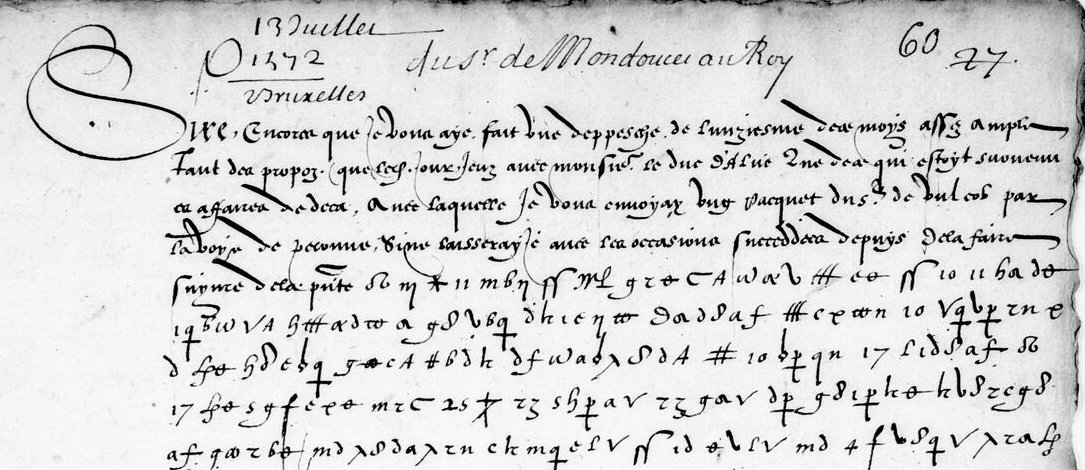
The despatch is only partly enciphered. Clear-text bands carry the connective narrative and the whole close, and the cipher is reserved for the sensitive matter, as usual for a resident who trusted the courier with the rest. The clear bands need no key. On f. 60v, a Spanish informant’s report:
J’ay esté asseuré par Espaignol mesme qui cy vient qu’il n’y a pas troys mil hommes de pied & cinq cens chevaux cy tout. Toutesfois ilz demourent encores là arrestez. Et dit on que du costé de Mastricq se marche quelques regymens d’allemans nouvellement leuez…
f. 61r closes in clear: Sire je supplie le Createur qu’il vous donne … très longue vie. De Bruxelles ce [Ve] jour de Juillet 1572, signed de Mondoucet, over vostre treshumble tresobeyssant et tresaffectionné serviteur et subiect.
The ciphered lines (22 on f. 60r, one on f. 60v, six on f. 61r) decode in stretches with the same key. They speak of religieuse, Espaigne, the saint père and the pape, Escosse, Angleterre, troupes de terre, catholique, ministres, liberté, garnison; f. 61r gives … le prince … service du roi, … parenté entre les autres cour[s], … avaient esté capitulé … réduit.
Re-checked 21 September 2026: these words overstate the decryption. Re-marking the open alpha (= r) on the 13 July strips and decoding again with the 1572 key, the 1573 key and a merged key gives no real gain. On the 16 July control block the 1572 key scores only about 60 % of letters, and that block is the one it was fitted on. Counted strictly, word-divided output that reads as French sense covers about 1 % of the 1,082 cipher glyphs of 13 July, and about 8 % counted leniently. The words above are the language model's fill as much as the cipher's. The despatch is not deciphered: the leaves are legible, and what is missing is a better 1572 key, for which the single 863-letter crib is too short.
05 The 1573 letters: 9 September deciphered, 4 January in print
The catalogue listed two 1573 letters from Antwerp and Amsterdam as having no full reading. On the leaves, the 9 September 1573 letter (Amsterdam; cipher ff. 135r–137v) has a complete Court decipherment on ff. 139r–141r (“deschiffré”), and it is verbatim: a hard-EM alignment of 4,735 hand-transcribed glyphs against it runs line for line with a glyph-to-letter ratio of 0.91, the shortfall being word signs such as dict, faict, monsieur. The alignment gives the 1573 key, about 55 signs, the 1572 system with the same homophones.
The 4 January 1573 letter (Antwerp; cipher f. 126v, 4 lines, f. 127r, 31 lines, f. 127v, 4 lines) has no decipherment anywhere in the volume, only four interlinear glosses on f. 127r (hambourg, Lan…, and two unsure). It was decrypted with the 9 September key and the French 5-gram decoder. The control: a key rebuilt without block 1 of 9 September decodes that block blind at 77.5 % of letters. Re-transcribing every 4 January line on the strips corrected 20 glyphs, and splitting the round a from the open alpha with a crossing tail, which the first transcription had merged, showed that the alpha is always r and the round a never is (l, y, i); the control rose to 79.0 %. The gloss hambourg decoded in place, and about 55–60 % of the 4 January letters gave sense, among them “seize ou dix huict”, “soubz ombre de chercher parti”, “desavantaige … qu’il fera”, “l’Angleterre avoit … tenir cent …”, “[H]ambourg, où on croit debvoir servir pareil”.
The text was then found in print. Mondoucet kept a register of his despatches from September 1572 (Bibliothèque de Reims), and L. Didier printed it in 1891: the letter of 4 January 1573 is on pp. 141–142 of volume 1, in clear, ending “D’Anvers, ce IIIIe jour de janvier 1573”. The ciphered part is:
… il se donnoit fort secrètement wartgueld des costez de Collongne, Francfort, Spire et autres villes, sans qu’il se puisse savoir de quelle part; et aultres encores, ne voullans estre descouvertz, prenent aultre voye, donnans argent aux collonnelz pour entretenir leurs reistres-mestres et gentilzhommes, et lesdictz reistres-mestres entretenans leurs soldatz particulliers. Aussi, que les villes de [Hesse?], Strasbourg et aultres faisoient levées de gens; outre plus, qu’il estoit depuis naguières arrivé à Collongne seize ou dix huict cappitaines venans de Suède et Dannemarch … De tout ce qui se passera j’espère en donner toute lumyère à V. Maté par le rapport que m’en fera ung cappitaine allemand … qui m’a semblé estre plus propre que aultre, par ce que, soubz umbre de chercher party, il descouvrira tout ce qui se fait … J’ay seu que Monsr le duc d’Alve avoit pris ceste forme de wartgueld avec le duc de Brunsvick … et croy qu’il aura fait le semblable à l’endroit du duc de Lauembourg de Saxe … Davantaige, Sire, je ne veulx oublier de vous advertir comme j’ay [apprins] que la royne d’Angleterre avoit fait tenir cent mil escuz à Hambourg, que l’on croyt debvoir servir pour pareil effect. Estant en ceste ville, j’ay descouvert qu’il y avoit quelque temps qu’un certain évesque de Hirlande y séjournoit, quy y est entretenu par ledict sieur duc, avec lequel il conduit la pratique dudict pays de Hirlande …
(Didier 1891, i, 141–142; spelling normalised from the OCR where it was garbled.) Every stretch the decoder had given stands in the printed text, and the lines it had not decrypted are now filled: Louis of Nassau’s secret wartgeld retainers, captains from Sweden and Denmark at Cologne, a German captain sent as a spy, Alba’s own wartgeld with Brunswick and Saxe-Lauenburg (the gloss Lan…), English money at Hamburg, and an Irish bishop kept at Antwerp by Alba for a design on Ireland (the decoder’s “de l’Irlande” in l. 31). The edition was in the page’s sources from the start but was not opened until after the ciphertext-only passes, so those passes are an independent partial decryption; the text of 4 January is the edition’s. The 13 July 1572 despatch is not in Didier: the register begins on 6 September 1572, and Didier’s own inventory of fr. 16127 calls that letter “chiffrée et en grande partie sans déchiffrement”.
06 The lesson
A ciphered despatch that four validated aligners could not align is an ordinary homophonic substitution; what defeated the solvers was an unvalidated automatic segmentation that produced a 1.3–1.4 glyph-per-letter ratio and broke the one-to-one mapping. The lesson: check a glyph-per-letter ratio taken from an automatic segmentation against a hand count on a passage of known plaintext before relying on it. What remains is a clean retranscription of the ciphered lines to a fixed glyph accuracy and the collation of the clear bands with the other fr. 16127 letters. A second lesson came from 1573: open the edition before decoding. Didier printed the 4 January letter in clear, and the page’s sources had cited it all along.
07 Sources
- BnF, Département des Manuscrits, Français 16127, Gallica ark:/12148/btv1b90609766 (digitisation); catalogue notice cc46244h.
- Working files in
research/gallica_sweep/mondoucet/: the volume inventory, the hand transcriptions (hand/ct_f60.txt,ct_f60v.txt,ct_f61.txt; cribct_f62.txt,ct_f62v.txt), the key (hand/key2.json,key_counts.json,key_manual.py), the decoder (hand/lm_decode.py) and its output (hand/decode_all.txt), the verbatim 16 July reading (pt_f64.txt), and the full reading (reading.md); for 1573,f1573/reading.md, the transcriptions inf1573/ct/, the keyskey1573.jsonandkey1573_split2.json, the decoderdecode1573.pyand its outputsdec_4jan*.txt. - L. Didier, Lettres et négociations de Claude de Mondoucet, résident de France aux Pays-Bas (1571–1574), 2 vols (Paris and Reims, 1891–92), i, 141–142 (4 January 1573); archive.org; Gallica.