At a glanceRead from the contemporary decipherment · 437 of 439 cipher numbers
- The letter
- The postscript (“P. S.”) of a letter to a “Most Reverend Father”, written by someone in the service of a “Celsissimus Princeps” after the death of Şerban Cantacuzino, Prince of Wallachia, on 29 October 1688. Three pages, unsigned and undated; the main letter is not with it.
- Where
- PAN Biblioteka Kórnicka, BK 1560 (a volume partly from the archive of Jan Szembek), item “List zaszyfrowany” (“encrypted letter”), Wielkopolska Digital Library edition 343124. Our catalogue had it as an early-18th-century letter from an unknown sender to the Szembek family.
- The cipher
- Single letters replaced by two-digit numbers from 12 to 51 in a mixed order, one number per letter, with a separate number for the ae diphthong. It is used for single words inside clear Latin, often with the ending left in clear. Two three-digit code groups occur.
- How it was deciphered
- A second hand wrote the plain word above every cipher run but one. The key was rebuilt from those glosses (22 numbers, no conflicts). Deciphering each run with the key alone reproduces the gloss, apart from the writer’s own slips.
- What it says
- The writer protests that his side has kept faith while “some Christians” broke their promises. He calls Dunod an “impostor and detractor” who led the late Prince Şerban astray, and reports that a certain Gegenbey was killed and his head sent as a gift.
- Still open
- One code group, 202, which has no gloss, and the clear word before it. The writer’s prince and the recipient are not named.
01 The document
BK 1560 is a 150-leaf miscellany of papers from 1694 to 1731, partly from the archive of Jan Szembek, Crown Chancellor of Poland. The Wielkopolska Digital Library has split it into about a hundred items. One of them, “List zaszyfrowany”, is three pages foliated 40–41 in an old hand. It sits among letters to Szembek of 1730–31, which is probably why it was taken for an 18th-century Szembek letter. The text begins “P. S.” and ends at the foot of the third page without a signature. The letter it belongs to is not in the item.
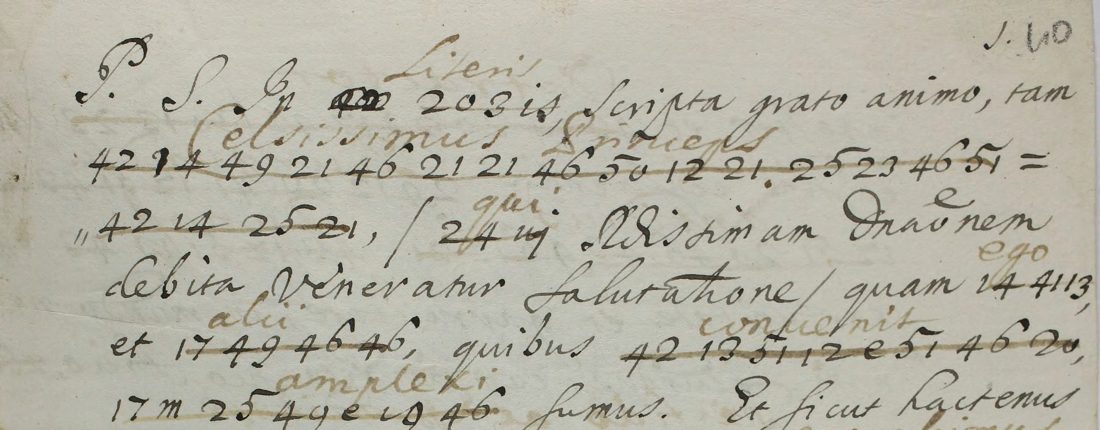
The postscript is in clear Latin, but about seventy words are written in numbers and struck through with a line. Above each run a second hand, in lighter brown ink, wrote what it means.
02 The cipher
Each letter has one two-digit number. The table is not in alphabetical order (a = 17, b = 29, c = 42, d = 43, e = 14), so it was mixed on purpose. There are no homophones and no nulls. The writer spells ae as a separate number, 15, and e as 14. He leaves y in clear and often writes the end of a word in clear letters, so “25 er 40 46 43 13” is perfido and “42 13 50 25 er 20 17” is comperta.
| a | b | c | d | e | ae | f | g | h | i | k | l | m | n | o | p | q | r | s | t | u/v | x |
|---|---|---|---|---|---|---|---|---|---|---|---|---|---|---|---|---|---|---|---|---|---|
| 17 | 29 | 42 | 43 | 14 | 15 | 40 | 41 | 44 | 46 | 48 | 49 | 50 | 51 | 13 | 25 | 24 | 23 | 21 | 20 | 12 | 19 |
Two groups have three digits. 203, followed by the clear ending -is, is glossed Literis, so the key had a short code list for words. 202 has no gloss.
In all there are 436 two-digit cipher numbers in 70 runs, plus the two code groups and one heavily struck single digit.
03 The reading
Words in cipher in the original are in italics. The reading is the contemporary gloss, confirmed number by number with the rebuilt key; where the two differ, the note under section 05 says which is right.
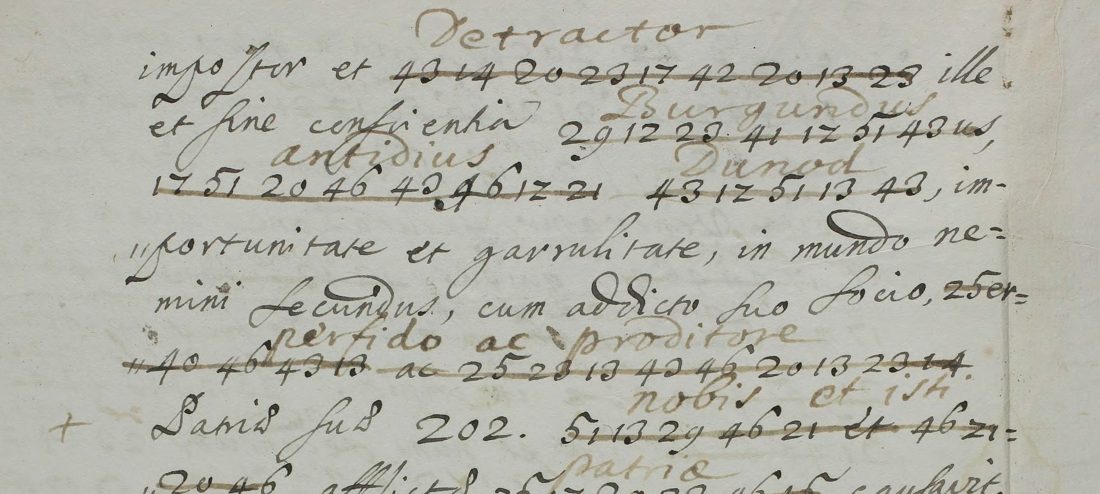
P. S. Ip[sis] Literis scripta grato animo, tam Celsissimus Princeps (qui R[everendi]ssimam D[omi]nationem debita veneratur salutatione) quam ego et alii, quibus convenit, amplexi sumus. Et sicut hactenus syncere in omnibus processimus, ita et nunc secundum rectam Christianam conscientiam procedimus et procedemus, quamvis aliqui Christiani non ita se gerant et nobiscum procedant, uti promiserant, et multis modis nos solicitaverant. Sed hoc remittimus ad divinam Justitiam et Providentiam, quae omnia scit et videt. Oh! D[omi]ne mi R[everendi]ssime Pater, si audiret quanta et qualia, ac quibus modis impostor et Detractor ille et sine conscientia Burgundus Antidius Dunod, importunitate et garrulitate in mundo nemini secundus, cum addicto suo socio, perfido ac proditore, Damis(?) sub [202], nobis et isti afflictae patriae causavit, ac illum piae memoriae defunctum Principem Serbanum seduxit: quorum mendaciis et deceptionibus, pulchris verbis obvolutis, credens, et consilia omnium aliorum respuens, in grandes nos et istam miseram patriam intricavit difficultates.
O si intelligeretis promissiones quas ab illa aula defuncto Principi adducebant, et hinc ducebant, quae nunc propter illorum iniquas delationes plura falsa sunt comperta. Profecto quaedam ad risum moverent, quaedam admirationem causarent, quaedam vero prae pudore silentio obvolvi deberent. Deus iustissimus secundum opera et conscientiam illorum de ipsis vindictam sumat.
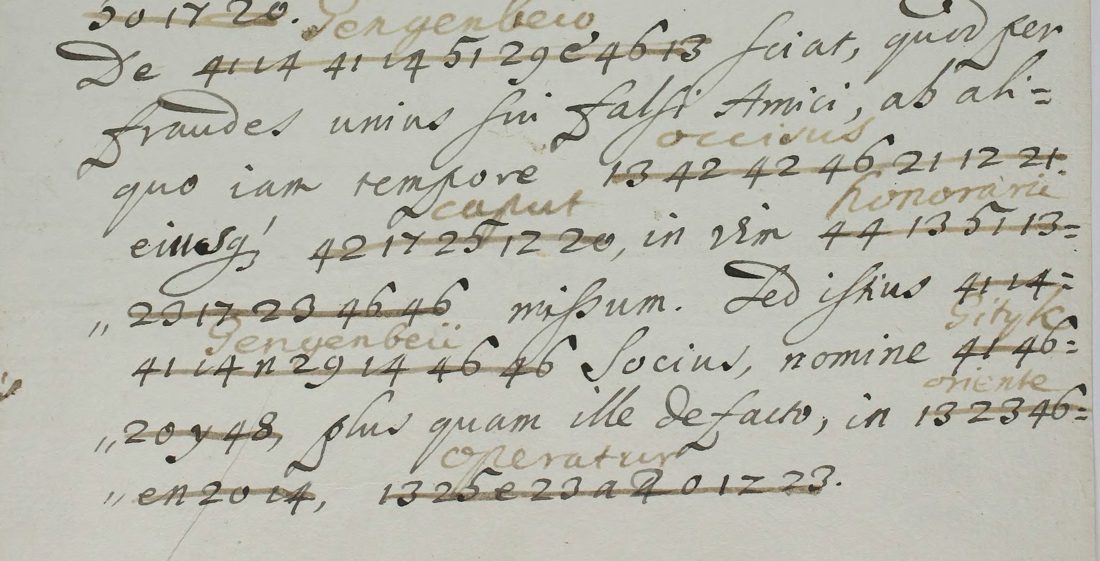
De Gegenbeio sciat, quod per fraudes unius sui falsi amici ab aliquo iam tempore occisus, eiusque caput in vim honorarii missum. Sed ipsius Gegenbeii socius, nomine Gityk, plus quam ille de facto in oriente operatur.
Translation. P.S. The letter written in your own hand was received with a grateful heart, both by His Highness the Prince (who salutes Your Most Reverend Lordship with due veneration) and by me and the others whom it concerned. As we have so far proceeded sincerely in everything, so now too we proceed, and will proceed, according to a right Christian conscience. Some Christians, however, do not behave so and do not proceed with us as they had promised and as they had urged us in many ways. But this we leave to divine Justice and Providence, which knows and sees all things. Oh, my Lord, Most Reverend Father, if you heard how great and what kind of things, and by what means, that impostor and detractor did to us and to this afflicted country: the Burgundian Antidius Dunod, without conscience, second to none in the world for importunity and chatter, with his devoted companion, a perfidious traitor […]. He led astray that Prince of pious memory, the late Şerban, who believed their lies and deceptions wrapped in fine words, rejected the counsel of all others, and entangled us and this wretched country in great difficulties.
O if you understood the promises they brought from that court to the late Prince and carried back from here! Through their wicked reports, most of them have now been found false. Truly, some would move one to laughter, some would cause wonder, and some ought to be wrapped in silence for shame. May God most just take vengeance on them according to their works and their conscience.
Of Gegenbey, know that some time ago he was killed through the treachery of a false friend of his, and his head was sent as a gift. But this Gegenbey’s companion, named Gityk, is in fact more active in the East than he was.
04 Who and when
“Burgundus Antidius Dunod” is Antide Dunod, a Jesuit from Franche-Comté (the County of Burgundy). With Count László Csáky he was Emperor Leopold I’s envoy to Bucharest in 1687–1688, pressing Şerban Cantacuzino to break with the Ottomans and join the Holy League. “Defunctum Principem Serbanum” is Şerban himself, who died on 29 October 1688, so the postscript was written after that date. “Illa aula”, the court whose promises proved false, is then Vienna.
The letter does not name the living “Celsissimus Princeps”. Speaking of “this wretched country” after Şerban’s death points to his successor in Wallachia, Constantin Brâncoveanu (1688–1714), but that is an inference, as is any date closer than “after October 1688”. Gegenbey, Gityk and the “Most Reverend Father” were not identified. How the paper reached the Szembek archive in Poland is not known.
05 Method, and where cipher and gloss differ
The item was found in the WBC structure of BK 1560. Its three DjVu pages were downloaded and decoded with the DjVu.js library. Every run and its gloss was transcribed from full-resolution crops (runs.tsv). A script aligned each run with its gloss where the lengths agree and collected the number–letter pairs: 22 numbers, each with a single letter. It then deciphered every run with that key alone. 61 of the 70 runs match their gloss letter for letter. The nine others:
- 203is: the code group, glossed Literis.
- gerant, solicitaverant, Gegenbeio, Gegenbeii: the numbers spell these; the glosser wrote gerent, sollicitaverant, Gergenbeio, Gergenbeii.
- de-functsm: the writer put 21 (s) for 12 (u).
- pricipem: the writer left out 51 (n) in Principem.
- defunct: the final o of defuncto is not written.
- audi?et: a heavily struck digit (20 or 23) stands where the gloss has the r of audiret.
None of these is a key conflict: the key and the contemporary gloss give the same text.
06 What remains uncertain
- 202: a code group with no gloss. It follows a clear word read here as “Damis” (the first letter is D or P), which is itself uncertain; the phrase probably names Dunod’s companion or the damage he did. A cross in the margin marks the line. Open.
- The struck digit in audi?et: its value is r by the gloss and the sense (H). The final letter of the blotted run in intricavit (12 or 27) reads v by the key and the gloss (H).
- The identification of the writer’s prince as Brâncoveanu (M), and the persons Gegenbey and Gityk (unidentified).
07 Sources
- PAN Biblioteka Kórnicka, BK 1560, “List zaszyfrowany”: Wielkopolska Digital Library, edition 343124 (DjVu images 065–067, free for all uses).
- On Antide Dunod and Count Csáky’s mission to Şerban Cantacuzino, 1687–1688: Şerban Cantacuzino and Constantin Brâncoveanu (Wikipedia), with the literature cited there.
Transcription (runs.tsv), key, check script, reading and profile: targets/szembek1689/ in the repository.