
01 The letters
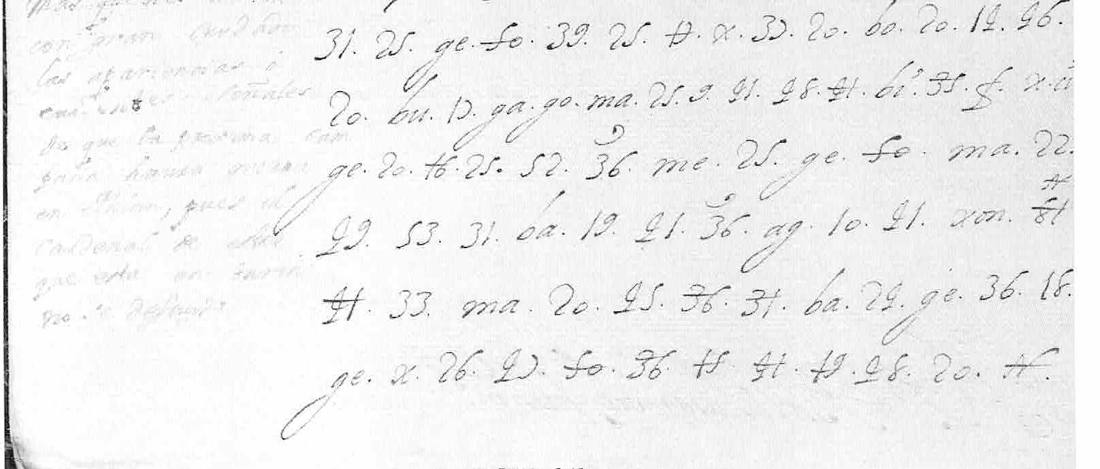
The file is one of several in SEG 2559 holding letters to Fuenmayor from Spanish diplomats, 1674–79. DECODE describes Carpio’s ten as partly decrypted: “the solution is written in the margin, without revealing the key.” R1004 and R1005 are marked as not decrypted, meaning DECODE saw no decipherment on them. Each letter opens with a clear paragraph of compliments, then turns to cipher. The cipher is in one hand, in point-separated groups, with the null groups N, R, g and 4 struck through at the start and end of each block. The decipherment runs vertically in the left margin.
02 The key
| Token | Value |
|---|---|
| 9–30 | single letters: a 9, b 10, c 11, d 12, e 13, f 14, g 15, h 16, i 17, l 18, m 19, n 20, o 21, p 22, q 23, r 24, s 25, t 26, u 27, x 28, y 29, z 30. In practice they spell word-final consonants: n, r and s are the commonest tokens in the file. |
| 31–60 | consonant + vowel, rows of five in the order a e i o u: m 31–35, n 36–40, p 41–45, r 46–50, s 51–55, t 56–60 (33 mi, 36 na, 39 no, 48 ri, 52 se) |
| struck numbers | t row 15–19, f row 20–24, vowel + l 30–34 (31 el), vowel + s 35–39 (36 es), vowel + n 40–44 (41 en, 42 in, 43 on), vowel + r 45–49, que 50, qua 51, qui 52; struck N, R, g, 4 are nulls |
| letter pairs | a syllable with its consonant changed and its vowel kept. Cipher b → c, c → b/v, g → d, l → g, m → l, so ge de, gi di, bo co, ci vi, ma la, la ga, lu gu. Also ag ha, eg he, and a separate sign for lle |
| 116 | V.S. (Vuestra Señoría) |
| code words | sen = Rey; gin/jin/jen = S.M.; gus = Príncipe [de Orange]; quol = Inglaterra; ana = Nápoles; ten = Francia; pon = armada; san = Bruselas; gon = señor(es); ran, xan = gobernador; xon = guerra; tan = Flandes (?) |
03 The two letters DECODE lists as not decrypted
13 November 1677 (R1004). Normalised; bracketed words are uncertain.
… lamentarme con V.S. de lo que en todas partes nos persigue nuestra mala fortuna, pues con la llegada del Cardenal de
Estrées a Turín se teme alguna gran novedad en Italia, y las cosas de [Flandes] se hallan en el estado que V.S. sabe. Si bien en las
materias del Congreso parece debemos suspender el juicio hasta ver lo que resulte del abocamiento del Príncipe de Orange con el Rey de
Inglaterra. En los embarazos de esta corte no se me ofrece qué añadir a lo que diré a V.S. en mis antecedentes, sino que si bien
aguardaba este correo las órdenes de S.M. no las he recibido, pero no dudo las traerá el siguiente, pues de Madrid me avisan que
habían llegado allá las cartas en que di los primeros avisos sobre estas dependencias.
“…to lament with Your Lordship how our ill fortune pursues us everywhere: with Cardinal d’Estrées come to Turin some great novelty is feared in Italy … in the Congress [of Nijmegen] we must suspend judgement until we see what comes of the Prince of Orange’s meeting with the King of England … I expected His Majesty’s orders by this post and have not had them.”
20 November 1677 (R1005).
… más de que nos tienen con gran cuidado las apariencias y evidentes señales de que la próxima campaña habrá
guerra en Milán, pues el Cardenal de Estrées, que está en Turín, no se descuida.
“…except that we are much concerned by the appearances and evident signs that next campaign there will be war in the Milanese, for Cardinal d’Estrées, who is at Turin, is not idle.”
04 The other eight, in brief
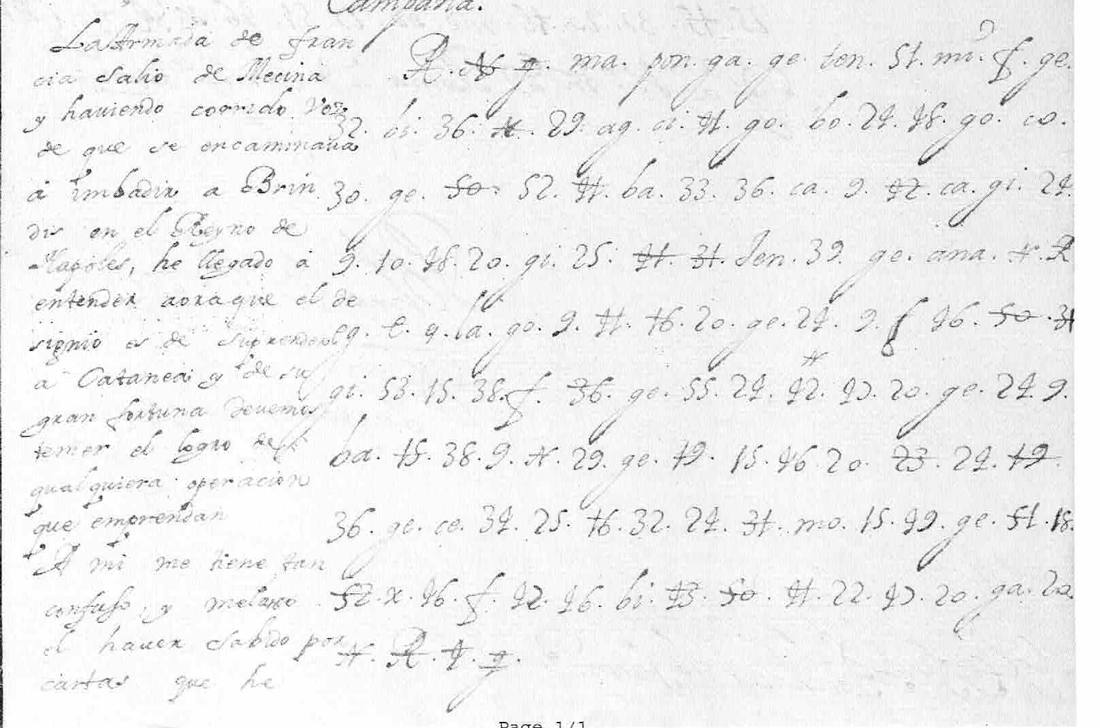
- 4 Sept (R1010). The French fleet has left Messina. It was said to be bound for Brindisi, but its design is Catania. Carpio is dismayed by news from Brussels that Orange raised the siege of Charleroi “intempestivamente”.
- 18 Sept (R1011). False rumours are raised in Rome against the Spaniards after Charleroi. Carpio has had no satisfaction from the Pope or his ministers. The militia is called out and guns are mounted on Castel Sant’Angelo.
- 25 Sept (R1009). He got neither remedy nor inquiry. He consults the cardinals of the Spanish party, the viceroy of Naples and the governor of Milan.
- 2 Oct (R1006). The offences continue. The French fleet and galleys, after holding off Catania, are said to have gone back to Toulon badly battered.
- 9 Oct (R1007). Still no satisfaction. On the cardinals’ advice he stays away from the papal audiences while he waits for the viceroy of Naples.
- 16 Oct (R1008). No news. He holds firm until orders come.
- 4 Dec (R1002). On the King’s orders he asked for an audience of Innocent XI about the disputes. It was refused twice, and the Pope would take the King’s business only through a cardinal. Carpio will not treat the principal business until the point is settled.
- 11 Dec (R1003). The loss of Freiburg (taken by Créqui, 16 November) and its consequences beyond the Rhine. The Pope refused the audience again. He waits for the Marqués de los Vélez.
05 Method
DECODE’s ciphertext transcriptions (by RP and MEG, 2020) were parsed into tokens. The 4 September letter has a legible marginal
decipherment, and lining its first lines up against the cipher showed the layout. The letter pairs looked like Spanish syllables with the
wrong consonant. ca 9 [42] ca gi 24 against “va a imbadir” fixed a = 9 and r = 24, and 36 = na in both Mecina and
encaminava. The rows of five followed from 33 mi, 36 na, 39 no and 48 ri. Every token of all ten letters was then tallied in context,
which settled the consonant changes (gi-os Dios, lu-ar-de guarde, ne-lo-cios negocios). The decoder
(targets/carpio1677/dec.py) applies the tables mechanically, and its output is Spanish throughout. The code words were identified
from context and from the historical events they fit: Charleroi, Freiburg, d’Estrées at Turin, Orange in London.
06 What remains uncertain
- The decryptions come from DECODE’s transcriptions. A few misread numbers show as nonsense syllables, and some tokens as untranscribed (
{..}in the raw files). The two November letters were checked against the images; the other eight were not. - Code words: tan = Flandes, cun iles = españoles and lun = cart[as] are C (conjecture from context). sen, gin, gus, quol, ana, ten, pon, san are H: each is confirmed by a marginal decipherment or by an event.
- Struck 14 is not fixed. It stands before -sta and -ticia, so possibly ju, which gives justa and justicia.
- The eight margin letters are summarised here, not edited.
07 Sources
- Archives générales du Royaume, Brussels, Secrétairerie d’État et de Guerre, inv. nr. 2559. Images and transcriptions on DECODE, records R1002–R1011 (login required).
- Related letters to Fuenmayor in the same file: DECODE R964–R966 (Salinas and others, 1674–76).
Notes, decoder and decoder output: targets/carpio1677/ in the repository.