01 The documents
All the documents are in busta 2337 of the Esteri series, photographed for DECODE (records R9553–R9589, access by login). The headings give the dates and places:
- London, 1816: 1 April (R9553, no. 2314, headed “Cifra della Segreteria di Stato”), 30 August, 6 September, 26 September, 4 October (R9556, R9557, R9579, R9558).
- Paris, 1816: 3 June (R9555), 17, 19 and 23 October (R9559, R9560, R9587), 30 November (R9561, seven pages), 1 December (R9566, despatch 3874, with a second fragment in another hand), 3 December (R9562).
- Undated, to Circello: R9554 (no. 2589), R9563 (2814), R9564 (3388 or 3588), R9565 (3721), R9567 (4086). The fragments R9582–R9585 date from 1817–1819.
- Paris, 1823, to the Cavaliere de’ Medici: 4, 8 and 11(?) September, 9 October (R9569, R9571, R9570, R9589). The papal conclave that followed Pius VII’s death is the theme.
- Another code: R9586 and R9588 (values 100–1100, faint pencil glosses), not attacked. R9590 (Paris, 12 March 1830) is also in another code.
The images are not in reading order. R9579 runs P2, P3, P1, P4; R9569 P2, P1; R9561 begins at P2.
02 The code
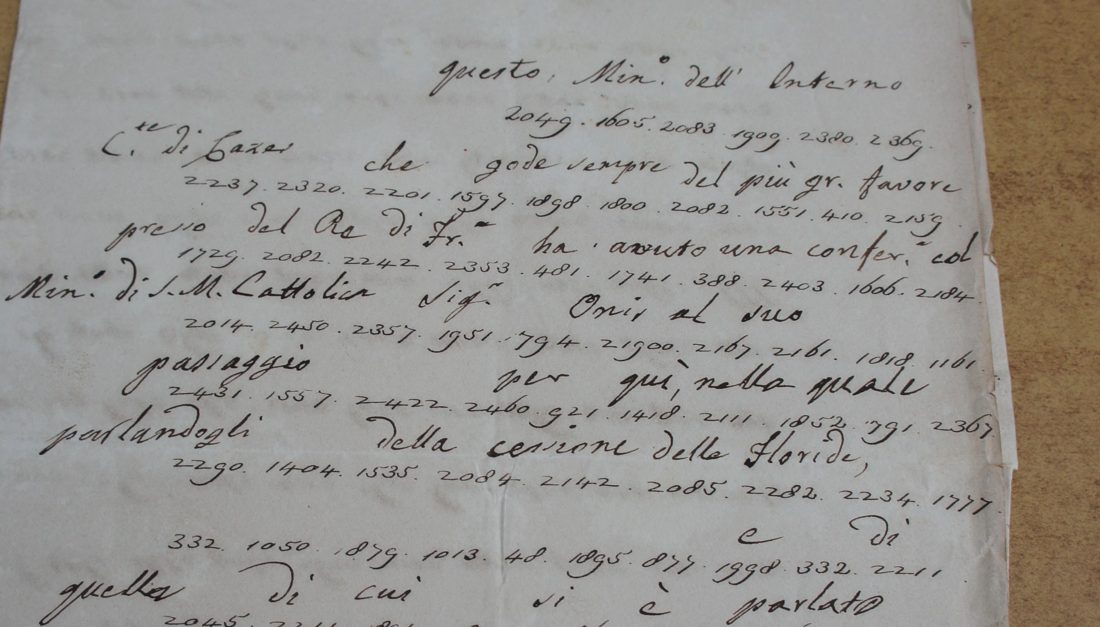
The groups run from 1 to about 2,450, with dots between them. The same frequent groups appear in 1816 and 1823 (2201, 2211, 332, 1909, 2450, 2232, 1864, 1843), so one book served for seven years. Its units are syllables, common words and names, and a word is spelled from as many as it needs:
| groups | reading |
|---|---|
| 1708 2027 1994 · 1708 1531 1994 | ele·va·zione · ele·(null)·zione |
| 1609 2448 2221 1951 2450 · 1609 2380 2221 2076 | pon·ti·fi·ca·to · pon·te·fi·ce |
| 2009 2211 1725 2295 · 2012 2448 1535 2169 | Car·di·na·le Cas·ti·gli·one |
| 2367 2290 1404 1535 · 2367 2232 2450 | par·lan·do·gli · par·la·to |
| 2357 1758 2318 · 1919 2318 · 1739 1714 2318 | li·ber·tà · No·ta · un·i·ta |
It is homophonic: di is 1112 and 2211, pa is 1201 and 2363, ere is 1836 and 2381. It is a two-part code with local alphabetical runs: 2201 che, 2205 ci, 2211 di, 2221 fi, 2230 l, 2231 l’, 2232 la; 2082 del, 2083 dell’, 2084 della; 2045 quella, 2049 questo; 2161 is, 2162 Isola; 1919 no, 1920 non; 2445 ter, 2448 ti, 2450 to. Between runs the order is scattered. A group written with a fifth figure (21900, 18900, 16480; about a hundred cases) always falls where the decipherer wrote nothing, so these are nulls.
03 What the glossed letters say
1 December 1816 (R9566, first ten lines). Decazes, the Minister of the Interior, “who still enjoys the greatest favour with the King of France”, has met the Spanish minister Onís on his way through Paris. Speaking of the cession of the Floridas, and of the cession of Cuba to England that had been talked of, he “skilfully insinuated”… The gloss stops there.
8 September 1823 (R9571). “La Francia desidera il Cardinale Castiglione per Papa, ma si biasima di avere il Duca [di] Laval troppo fatto ciò vedere, e si teme che ciò nuoccia al suddetto porporato per la sua elevazione al Pontificato. Non esiste alcun accordo tra la Francia e l’Austria per l’elezione del Pontefice.” (France wants Cardinal Castiglioni as Pope. The Duc de Laval is blamed for making this too plain, which may harm the cardinal’s chances. France and Austria have no agreement on the election.) Castiglioni was elected as Pius VIII only in 1829; Leo XII was chosen on 28 September 1823.
9 October 1823 (R9589). Now that the King of Spain has his liberty and the orders given in Medici’s despatch no. 688 of 28 September, there can be no question of Castelcicala passing the note to the Conference. Postscript: the Duc d’Angoulême will not be back for two months.
4 September 1823 (R9569) is glossed over ten lines. It concerns the election “al Sovrano Pontificato”, France’s intentions, and whether it would use “l’esclusiva”, the veto.
04 Method and what remains open
The 27 records were fetched from DECODE and transcribed from full-resolution crops by two transcription agents: 9,428 groups in the main code, 1,315 distinct. The glosses were aligned group by group, and the key was extended by hand from repeated contexts. Its 162 values are graded in key.tsv: 90 taken directly from a contemporary gloss (G), 18 glossed and confirmed in a second context (X), and 54 inferred here and unconfirmed (I). With them, 45% of the groups in the target letters get a value. Scoring candidate syllables for each unknown group with an Italian 5-gram model did not separate the candidates. The known neighbours are too sparse, and the segmentation into syllables or words is unknown.
So no letter is decrypted in full. The partial decode (reading_partial.txt) is a working file, not an edition of the text. Some I values are surely wrong: “il Sr troppo l d’An ta” in R9579 must be a name. The next step is to decrypt the 1816 letters one at a time, around the Floridas–Cuba–Decazes themes the gloss supplies, using the alphabetical runs to bracket unknown groups. The code book itself, if it survives in the Esteri or the Segreteria di Stato papers of the ASNa, would settle it at once. The consular keys of Borbone 1666 on DECODE (R9532–R9541) are from 1859–60 and do not apply.
05 Sources
- Archivio di Stato di Napoli, Ministero degli affari esteri, busta 2337, items 4–41, photographed for DECODE (R9554, R9566, R9571, R9589 and neighbours). The images are not in the public domain; only a crop is shown.
- Busta 2317 (DECODE R9549): a 1797–98 Vienna despatch with its decipherment, in a different code. It is not the plaintext of these letters, whatever DECODE’s note suggests.
- Fabrizio Ruffo, principe di Castelcicala: Dizionario Biografico degli Italiani. No edition of his ciphered despatches was found.
Transcriptions, key, scripts, notes and profile: targets/castelcicala1816/ in the repository.