
01 The documents
The BnF notice and the DECODE records give the folios: no. 23 f. 35 (key slip f. 36r), no. 24 f. 37, no. 25 f. 38, no. 60 f. 88, no. 78 f. 111 in fr. 3623; on Gallica canvas = 2 × folio + 9. The two letters bound between them, no. 26 (f. 39, from Sy, 11 January) and no. 27 (f. 41), are entirely in figures with a contemporary decipherment between the lines, but in another key.
02 No. 23: Bienvenut, Paris, 28 February 1590
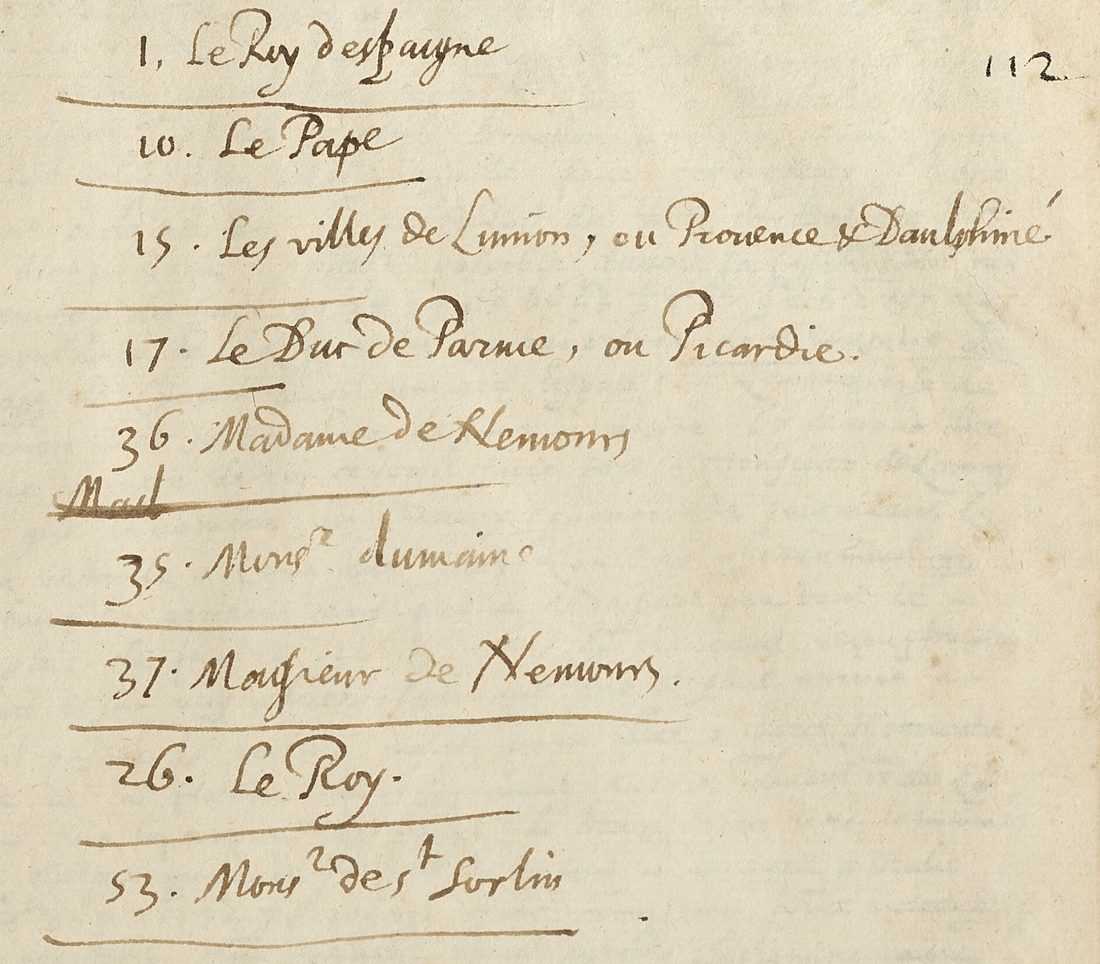
Every number in the letter is on the slip, so the letter decodes end to end (grade H). It is addressed to “Vostre Altesse” and reports the court of the League in Paris:
[Madame de Nemours] me pourmena hyer par la gallerie du logis de la Reyne plus d’une heure… elle me monstra plusieurs avis qu’elle avoit eu de [M. de Saint-Sorlin]… J’ay advis… qu’il y a une tres estroicte intelligence entre [le Pape] & [le Roy d’Espagne]… le courrier que Mr le Legat despescha a Rome… pour entretenir la guerre jusques a ce que [le Pape] puysse envoyer 8 ou 10000 hommes de guerre avec lesquelz il baste l’ame a [Mayenne]…
03 Nos. 24, 25, 60: an alphabetical two-digit key
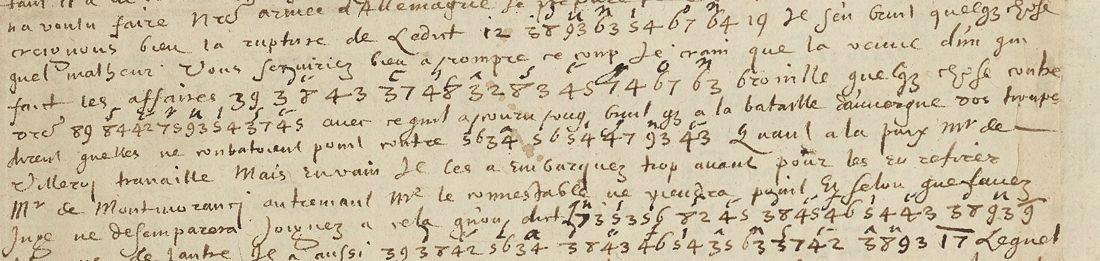
The glosses give d u n i, a, n and, in no. 60, L u d o v i c. Set against the context they place a = 34/35, c = 37, d = 38, i = 53/54, l = 56/58, n = 63/64, o = 67, u = 93. The values rise with the alphabet, so every other figure has a predicted slot: e 42–45, f 46, g 47, h 48, r 74–75, s 82–86, t 92. Decryptions were accepted only when each value fell in its slot.
| Where | Figures | Reading | Grade |
|---|---|---|---|
| 25, “la rupture de l’edict” | 12 58 93 63 54 67 64 19 | [de] l’union [19] | C/I |
| 25, “ne combatroient point contre” | 56 34 56 54 47 93 43 | la ligue | C/I |
| 25, “Je a aussi” | 39 38 42 56 34 38 43 46 54 35 63 37 42 38 93 17 | [39] de la defiance du [17] | I |
| 25, “qu’on dict” | 17 33 53 56 82 45 38 45 46 54 43 38 93 39 | [17] … se defie du [39] | I, first half open |
| 25, “qui faict les affaires” | 39 38 43 37 48 32 83 45 74 67 63 | [39] de Chazeron | I |
| 25, “vostre” | 89 84 42 75 93 54 37 45 | [89] service | I |
| 60, “du sieur” | 19 56 93 38 67 93 53 37 | [19] Ludovic | C |
| 60, “en est aussi” | 39 38 43 56 35 94 62 32 64 | [39] de la V?an | I, name open |
| 24, “du faict” | 99 38 39 45 30 93 38 67 92 52 37 | open | — |
| 24, “mal disposé” | 16 39 56 43 99 95 93 35 92 05 54 86 | open | — |
Chazeron is named in clear in no. 24, which supports the decryption in no. 25. The figures below 30 and 39, 89, 99 behave as word or name codes and have no key.
04 Laurière, Châlons, 9 July 1593 (fr. 3625 no. 55)

The OAI item list of fr. 3625 places no. 55 at f. 66r (canvas 143): Laurière’s letter, “Chalons ce IX juillet 1593”, clear French with eight cipher runs (86 groups) in a mixed code of figures, letters and signs. The first pass (21 September) aligned the interlinear decipherment of his 13 July letter (no. 10, f. 10r) into a twelve-entry table and decoded 19 groups in fragments. That table turned out to be one group out of step: ✗ is le Roy, not que; 335 is soit; 141 is catholique; “101 54y+” is au-ro-i-t, not Sa Majesté.
The key (29 September 2026). setsunaatto (GitHub issue 13) identified the writer’s own key sheet: Tomokiyo’s Nevers key no. 57, BnF fr. 3995 ff. 102–103, endorsed “Monsr de La Verriere”, “Chartres 1593 fevrier” (Honoré Mauroy La Verrière, whom the catalogue calls Laurière). Each letter has two signs; the figures 1–72 are syllables, row + 14 × vowel (the sheet heads its grid “ba 1, be 15, bi 29, bo 43, bu 57”); 73–98 are double letters (92 = pr); 99–353 are words in alphabetical order (184 est, 285 necessaire, 347 vous); overbarred figures are provinces and towns; special signs stand for the Pope, the King, Lorraine, Gondi and the Grand Duke of Tuscany. Every entry used below was checked here on the sheet, and lines 1–2 of the issue’s transcription against the page and against the first pass’s transcription, group for group. The issue also tested the key blind on no. 10: 80% of the office’s glossed letters fall in matching runs of four or more, against a shuffle maximum of 30% (section 05).
| Run | Deciphered |
|---|---|
| 1, after “pour vous faire resouvenir” | vous estes necessaire pres du Roy afin qu’il ne retarde d’ung jour son assemblée, ce que ses ennemys luy donne[r]ont tout l’empeschemen[t] qu’ilz pourront pour luy faire prandre autre dessein |
| 2, after “Revenant a mon voiage” | [le duc de Lorraine] montre desir de traiter, mais necessaire avant que [le Roy] soit catholique |
| 2b, before “ce moquans de cela” | quoy fait une election |
| 3, after “francoir” | s’il veult atandre la volonté du [Pape], non aussitost qu’il sera catholique, qui la traitera |
| 3b, after “et en donne sa parolle” | [le Cardinal de Gondy] pour [le grand duc de Toscane] |
The bracketed letters are missing in the cipher itself. The letter was written sixteen days before Henri IV’s abjuration at Saint-Denis: Laurière presses Nevers to be at the King’s side so that the assembly is not put off, reports that Lorraine will treat only once the King is Catholic, and that the Leaguers mock the idea of an election. He also asks whether the Pope’s consent is to be awaited.
05 Laurière, Courgenay, 13 July 1593 (fr. 3625 no. 10): the key against the office’s decipherment

No. 10, Laurière’s letter of four days later, has the office’s decipherment written between the lines, and it was not used to fit key no. 57. (Issue 13 used one of its runs to check which y-shaped sign is e and which is i; with the two swapped, the blind score below falls only from 157 to 152.) setsunaatto (pull request 15, 30 September 2026) transcribed five of its runs from crops that hide the glosses, fixed that transcription, and only then read the glosses. The other eight glossed runs were transcribed with the glosses in view. The score counts the gloss letters that fall in runs of four or more that the key reproduces; the control shuffles the signs of each run, 2000 times.
| Runs | Gloss letters in matching runs of four or more | Shuffled control |
|---|---|---|
| 5 runs transcribed blind | 157 of 196 (80%) | 33.8 ± 6.3, at most 58 |
| the same, without the run first seen with its gloss | 121 of 160 (76%) | 21.8 ± 5.0, at most 42 |
| 8 runs transcribed with the glosses in view | 311 of 354 (88%) | 97.7 ± 10.6, at most 129 |
Checked here before merging: the script reproduces these figures, and the first pass’s own transcription of three of the blind runs (21 September, before the key was known) agrees with the blind one on every figure group but one. Of the 21 word numbers the contributor added from the sheet, 18 were found on f. 103r exactly as given (100 aux, 122 bien, 150 congnoystre, 234 hault, 303 pouvoir, 307 quant and the rest); the other three were not viewed. The sheet’s alphabet rows also showed that our key file had c and h the wrong way round (μ stands under C, the c-shaped sign under H), as the contributor had pointed out. That is corrected.
Apart from spelling and gaps in the gloss, key and office disagree in one run. Over “25 29”, where the 29 carries a bar with turned-down ends (the mark of a province number: 29 is “L’Espaigne ou Espagnols” on the sheet), the office wrote qui ne se; the key gives que [l’Espagne]. Over “344 234” it wrote pour son. The figures are clear on the page and the sheet makes them tout hault, but the phrase is faire tout son effort, so Laurière probably meant 334 (son) and wrote 234. Among the other runs:
- ne pouvoir recongnoistre le Roy que premieremen ilz n’eusse eu la volonté du Pape, qui ne viendront jamais a c’est … que par force
- et que [l’Espagne] fera tout hault [son?] effort maintenant pour anpescher que le Pape ne le resoive, qui seroit tousjours une extreme longueur pour sortir du mal
- que nous tenons que [le marquis de Pont] suivra le duc de Lorraine (the marquis’s sign is close to the key’s, not identical: grade M)
- a l’assemblée ou elle sera tres necessaire
One run has no gloss at all. After “que nous avions despesché” it reads: [le grand duc de Toscane] quant [le Roy] nous bailla par escrit (sa?) volonté. The barred 3 before volonté is not on the sheet, and sa is a guess from context.
06 What stays open
- The two passages of no. 24, the first half of one no. 25 passage, the name in no. 60, and the code numbers 12, 16, 17, 19, 39, 89, 99 (and 22, 44, 51, 84 in no. 24).
- No. 78 (f. 111r, 1591): one group, “traictast de 96 □ 3 9̄ f 3”, too short to decrypt.
- In the sibling no. 10: the barred 3 of the unglossed run, and the marquis de Pont’s sign (grade M).
07 Sources
- BnF français 3623, Gallica btv1b525245007, canvases 79–86 (ff. 35–38), 185 (f. 88), 233 (f. 111).
- BnF français 3625, Gallica btv1b52511322v, canvases 31 (f. 10r, no. 10) and 143 (f. 66r, no. 55).
- DECODE records R9453, R9454, R9455, R9459, R9460 (no decipherment on the records).
- S. Tomokiyo, “Ciphers of the Duke of Nevers”, cryptiana.web.fc2.com/code/nevers.htm (keys of BnF fr. 3995; no. 57, “Mons. de Laveriere”, is Laurière’s key).
- BnF français 3995 ff. 102–103, Gallica btv1b525085665, canvases 196–201 (key no. 57).
- setsunaatto, GitHub issue 13 (29 September 2026): the identification of key no. 57, the transcription and decipherment of no. 55, and the blind test on no. 10.
- setsunaatto, pull request 15 (30 September 2026): the blind test on no. 10 as a script (
check_3625_10.py), the transcription of all its glossed runs, and 21 more word values of key no. 57.
Transcriptions, decipherments and the profile are in the repository folder targets/champagne1590/.