01 The documents
The file holds forty-seven reports of Sadoleto, June 1482 to November 1483, most in his own hand, with a handful of ducal minutes in reply (Mátyus 2020). Vestigia catalogues all of them with images; DECODE has eighteen of those with cipher. The ones that matter here:
| Item | Date, place | Form | Status found |
|---|---|---|---|
| DECODE R1101 · b. 1/9 no. 7 (Vestigia 1284) | 15 July 1482, Pozsony | four pages, long cipher passages | no. 7a (Vestigia 1283) is the full contemporary clear copy: read at the time; used as a crib |
| DECODE R1102 · no. 8 (Vestigia 1286) | 16 July 1482, Pozsony | clear letter; seven cipher lines at the foot of p. 2, more on pp. 3–4 | no clear copy: deciphered here in gist |
| DECODE R1103 · no. 11 (Vestigia 1294) | 17 August 1482, Pozsony | copy for Ercole of Sadoleto’s letter to King Ferrante; four faint cipher lines on p. 2 | no clear copy: fragments only |
| DECODE R1104 · no. 13 (Vestigia 1298) | 31 August 1482, Pozsony | one page, mostly cipher | “Decrypted”: clear copies 13a and 13b (Vestigia 1295, 1297); used as a crib |
| DECODE R1106 · no. 26 (Vestigia 1318) | 27 November 1482, Pozsony | four pages, partly cipher | two sheets of decipherment, 26a and 26b (Vestigia 1319, 4004): read at the time |
DECODE’s “partially decrypted” on R1101 and R1106 reflects that the decipherments are filed as separate items and were not attached to the records; the chancery deciphered both letters in full at the time.
02 The key, from two cribs
No Este key for this embassy is known. The archive’s Cifrario series holds a key “per corrispondere con Nicolò Sadoletti a Napoli tra 1479 e 1480”, rebuilt by nineteenth-century archivists (Cremonini 2017, n. 39), but it is not digitised. The key was therefore rebuilt from the letters.
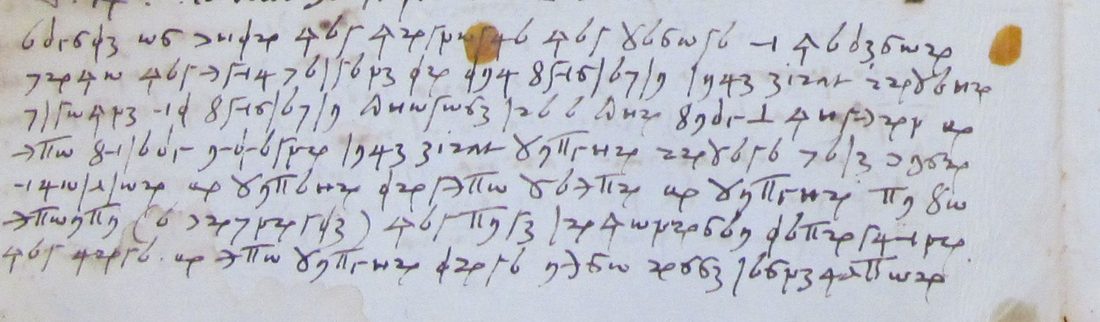
The cipher keeps word divisions, which makes alignment straightforward. The clear copy 7a of 15 July runs “… volesse unirse e pigliare questa impresa, e non lassasse pretermittere questa opportunità laquale mai più fo, né forse sera, e che lo facesse per lo amore …”, and the first lines of the cipher on the original’s second page match it word for word. The one-page letter of 31 August and its clear 13a confirm it: “epsa me dice che è certa che la liga non … perchè Millano et Fiorenza non voriano …”. One habit shows up at once: where 13a has perchè the original writes quid in ordinary letters, which works as a code word.
| Sign | Value | Sign | Value | Sign | Value |
|---|---|---|---|---|---|
| ʒρ, –1 | a | →, ) | g | 3, η, round 6 | o |
| > | b | 2 | h | Δ (stem through apex) | p |
| | (plain stroke) | c | ω | i | Δ with looped apex | q |
| φ | d | π | l | ſ, Γ | r |
| ь (6 with a stem), small Γ | e | 4 | m | 7 | s |
| 8 | f | б (flat-topped 6) | n | μ, ρ | t |
| u, и | u | Ɨ (v with a loop) | v | ʉρ | et |
The table is in targets/sadoleto1482/key_working.md with the aligned words for each sign. It is a plain alphabet with a few alternative signs for common letters; no syllable signs were needed. The nomenclator is small or rarely used: one group in the letter of 16 July does not spell out and is almost certainly a code word (below).
03 Pozsony, 16 July 1482: what Venice offered the King
The letter’s clear part is routine news of the court. The last seven lines are in cipher.
Essendo in Buda per partire per venire a Posonia, sapi per gran secreto da […] Francesco como [X] haveva scripto ad Francesco Quirino, che è qua, fo[sse] a … gli fa[cesse] … como [X] voleva havere seco bona a[micit]ia, et voleva dargli Vegla, et voleva lo figlio (e bastardo) per loco capitaneo de la [arma]ta per mare, et gli voleva dare ogni anno cento milia.
“Being in Buda about to leave to come to Pozsony, I learnt in great secret from […] Francesco that [X] had written to Francesco Quirino, who is here, […] that [X] wanted to have good friendship with him, and wanted to give him Veglia, and wanted his son (the bastard) as captain-general of the fleet at sea, and would give him a hundred thousand every year.”
The words that fix the decipherment could be nothing else: Buda, Posonia, Francesco twice, Quirino, Vegla, capitaneo, per mare, ogni anno, cento milia. The sense fits the moment. Veglia (Krk) had been taken by Venice from Count Giovanni Frankopan in 1480, and the count was at Matthias’s court that summer (13a: “le qui lo Conte Zohane da Vegla”). The “son, the bastard” can only be János Corvin, Matthias’s natural son and intended heir. The sum links this letter to a later one. Six weeks later, in the letter of 31 August, Sadoleto told Ercole that Matthias “per cento milia ducati ogni anno pigliaria la impresa”, that is, would enter the war for the League for a hundred thousand ducats a year. The cipher of 16 July shows where that price came from: it was the figure the other side had already put on the table.
[X] is a five-sign group that occurs twice, after como both times, as the subject of haveva scripto and of voleva havere seco bona amicitia. It does not spell a word in the letter key, so it is a nomenclator entry, and the context makes it the Venetian side, most likely “la Signoria”. The informant’s title before Francesco is another three-sign group (see the second pass below).
Second pass, 20–21 September 2026
A second pass corrected the text above and found more cipher. The informant’s title spells out in the ordinary alphabet as dom, so the name is “dom Francesco”. Group [X] turns up again in the letter of 27 November, where the contemporary decipherment 26b renders it as the Signoria of Venice. A six-sign group K is aligned with the King of Hungary’s title in the 15 July clear copy. The doubtful end of line 3 and start of line 4 give fosse a [K] / gli facesse offerta. The sign for ss is checked against facesse and imparasse in the 15 July letter, and the sign for ff against affinita. The corrected seven lines:
essendo in Buda per partire per venire a Posonia, sapi per gran secreto da dom Francesco como [la Signoria di Venetia] haveva scripto ad Francesco Quirino che è qua, fosse a [el Re di Hungaria] e gli facesse offerta como [la Signoria] voleva havere seco bona amicitia et voleva dargli Vegla et voleva lo figliolo (e bastardo) per loro capitaneo de l’armata per mare et gli voleva dare ogni anno cento milia
The cipher does not stop there. The sentence continues on p. 3 (“… ducati. ma voleva potere soldare et cauare gente de questo regno. et questo l’aveva saputo sua [S.] per subtile via et non volse per cosa del mondo che io monstrasse saperne cosa alcuna”): Venice also wanted the right to recruit soldiers in Hungary, and the informant made Sadoleto promise to show no knowledge of it. Further down p. 3 comes a mixed passage of clear and cipher in which Sadoleto argues his own case to Ercole:
per ogni modo disponerse ad dare a questo [Re] cento milia ducati ogni anno sino a sei o septe anni, che seri[a] questa suma che li domanda, et non seria gran suma alla liga, considerata la indubitata victoria che sua m[aesta] … — non scio percio se sua maesta atentasse(?) … monstra desiderare et haver piu bisogno in questo principio. ma … alla liga … tractare, et non e da perder tempo, et se vol[e]no spen[dere] dinari a questo tempo et fare la bona spesa …
“… to make up [the League’s] mind at all costs to give this King a hundred thousand ducats a year for six or seven years, which would be the sum he asks, and it would not be a great sum for the League, considering the certain victory that His Majesty … he shows he wants it and needs it more at this beginning … there is no time to lose, and if they mean to spend money, now is the time to spend it well …” So the letter sets the Venetian counter-offer beside Sadoleto’s advice to match it: a hundred thousand ducats a year from the League. Page 4 carries one more cipher line, “se bene non la mandato a questo …”.
04 Pozsony, 17 August 1482: a faded block
R1103 is the copy, sent to Ercole, of Sadoleto’s letter to King Ferrante of Naples. Four lines of cipher in the middle of p. 2 have faded almost to the colour of the paper. Contrast stretching on the blue channel brings out perhaps half the signs, and they give fragments only: “… se tener che … et … lo credo …”, “… suoi …”, “… vostro … meco … che …”. The clear text around the block concerns the King’s price for joining the League and the hundred thousand ducats, so the block probably says something about that, but no reading is offered. It needs better imaging of the original.
05 The 1483 letters: all deciphered at the time
DECODE lists twelve more Sadoleto letters of 1483 from Buda and Zagreb (b. 1/10, R1107–R1118), several as partly decrypted. None is open. Four have clear copies filed beside them (nos. 4a/4b, 20a, 21a, 24a on Vestigia); two of the DECODE records are those copies themselves (R1108 = 9a, R1113 = 20a, R1115 = 24a); and the three letters with no filed copy carry the chancery’s decipherment on slips pasted to the leaf: R1109 (4 April, to King Ferrante) over both cipher pages, R1116 (Zagreb, 3 October) and R1118 (30 November) at the foot, keyed to the cipher by a caret. The slips show on DECODE’s photographs; on Vestigia’s later ones they have been lifted, which is why the pages appear to have no decipherment. The 1482 key decrypts the cipher of R1118 in agreement with its slip (“ma come scripsi a V.S. non gli [s]panza questo accordo col turcho”).
06 Method
All images are 4320 × 3240 two-page spreads, fetched from DECODE with a logged-in session and from Vestigia, which needs no login. The cipher lines were cut into strips, glyphs segmented by connected components and numbered on the strip (the segmentation script is the one written for the Milanese letters of 1489, see Buda 1489), and transcribed by eye against the clear copies. The pairs of signs most easily confused were settled on high-magnification crops: the two Δ forms (p and q, which differ only in the loop at the apex), the stemmed and flat-topped sixes (e and n), and the long ſ against Γ.
07 What remains uncertain
- 16 July, line 1 and lines 5–7 (Buda, Posonia, Veglia, the son, the fleet, the hundred thousand): H.
- 16 July, lines 2–4 as corrected (dom, fosse a, facesse offerta): C. [X] = the Signoria of Venice, from 26b: C for the referent; the exact wording of the code group is not known. K = the King of Hungary, from 7a: C for the referent.
- Page 3: subtile via, soldare et cauare gente, victoria, in questo principio, dinari a questo tempo, spesa: C. seri[a], indubitata, atentasse, vol[e]no spen[dere]: M.
- Still without a reading in the 16 July letter: the word after epsa non scia che; a clear word and a cipher word (piacede?) after ma; a form of promettere(?) with an unassigned K-shaped sign; the last word of the page-4 line (effecto? M); a small cross mark after et. Each lies under a stain, in the binding fold, or turns on a sign with no value yet. Blue-channel enhancement was tried on all of them.
- 17 August: fragments only. I
- 27 November: the decipherment sheets 26a and 26b were located but not aligned sign by sign with the cipher.
08 Sources
- DECODE database, records R1101–R1106 (ASMo, Ambasciatori, Ungheria b. 1/9 nos. 7, 8, 11, 13, 16, 26): R1102 ↗, R1103 ↗.
- Vestigia database (Pázmány Péter Catholic University): 1283 (7a), 1284, 1286, 1294, 1295 (13a), 1297 (13b), 1298, 1318, 1319 (26a), 4004 (26b): vestigia.hu ↗.
- Norbert Mátyus, “Nicolò Sadoleto követjárása Magyarországon (1482–1483)”, Vestigia 3 (2020), 150–163, on the embassy and on why the letters were never printed: real.mtak.hu ↗.
- Judit W. Somogyi, in the same volume, 216–230, n. 25: the letter of 24 June 1482 carries a marginal decipherment.
- Cremonini, “Note sulle testimonianze dell’Archivio di Stato di Modena…”, Rivista di Studi Ungheresi 16 (2017), 105–154, n. 39: the 1479–80 Sadoleto key in ASMo, Cifrario b. 4 fasc. 1.
- Iván Nagy and Albert B. Nyáry, Magyar diplomácziai emlékek Mátyás király korából, vol. 3 (1877), which prints the Este correspondence of 1482 but none of Sadoleto’s letters.
The key with the aligned words, the transcription of 13a, the glyph-by-glyph reading of 16 July, the DECODE and Vestigia record data, and the segmentation scripts are in targets/sadoleto1482/ in the repository. The archive images are not redistributed; the one crop on this page is shown for identification.