
01 What the four pieces are
The catalogue cites piece numbers, which are not folios. BnF fr. 3983 and fr. 3984 are two volumes of the Collection Mémoires de la Ligue, and their catalogue notice carries a piece-by-piece dépouillement that gives both. Taken from it:
| piece | folio | the entry |
|---|---|---|
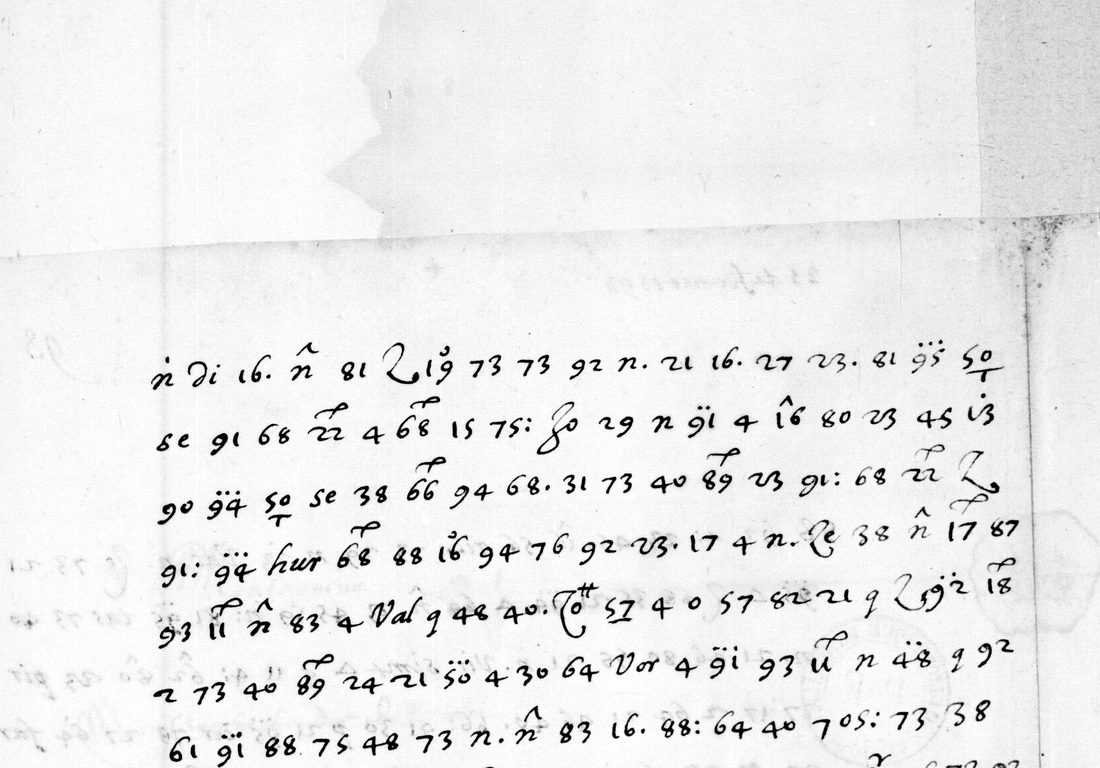
| fr. 3983 no. 45 | f. 98 | “Lettre, avec chiffre, d’«el conde DE MIRANDA,… al duque de Feria,… De Napoles, a 25 de hebrero 1593». En espagnol.” |
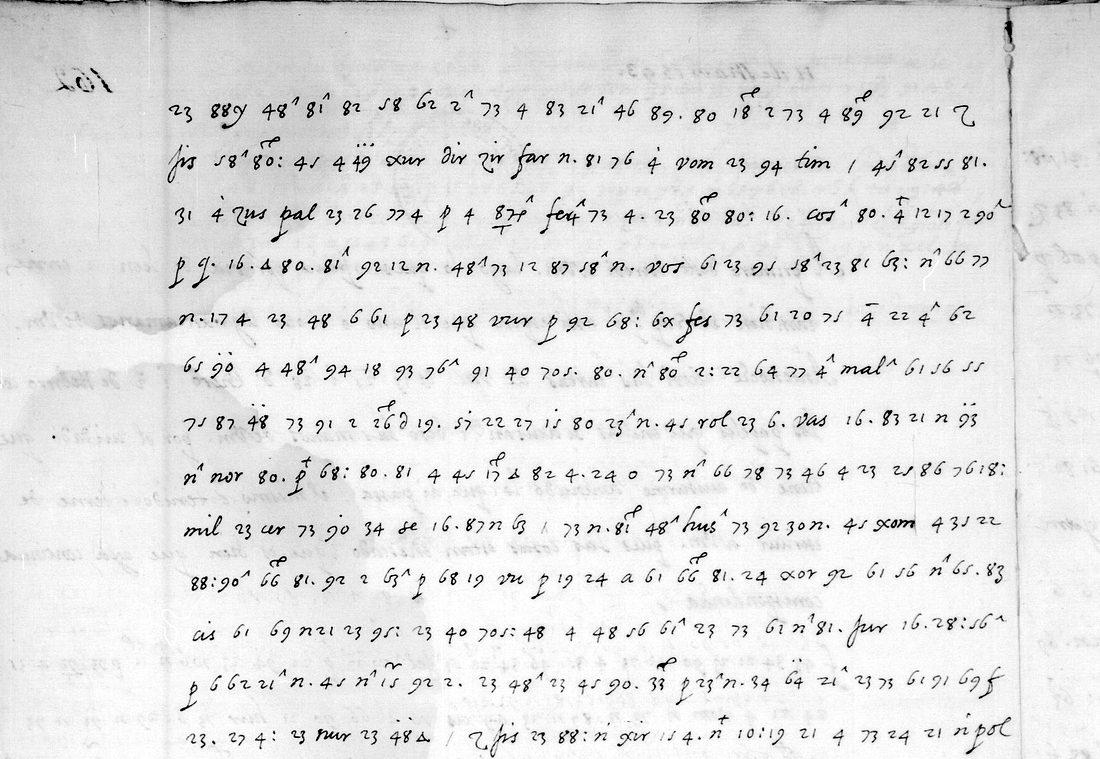
| fr. 3983 no. 79 | f. 162 | “Lettre, avec chiffre, d’«el duque DE SESSO,… a don Diego de Ibarra,… De Roma, 11 de março 1593».” |
| fr. 3984 no. 47 | f. 108 | “Lettre, avec chiffre et commencement de déchiffrement, d’«el duque DE SESSA» à Philippe II. «De Roma, 30 de junio 1593». Copie.” |
| fr. 3984 no. 68 | f. 145 | “Lettre, avec chiffre, de «D. DIEGO DE IBARRA,… De Paris, a 10 de julio 1593».” |
Neither volume’s canvases are labelled, and neither is foliated at a constant rate: some pieces are shot page by page, others as openings, and the leaves carry piece numbers and folio numbers in different corners. The map was built by reading folio numbers off a full-width top strip at intervals: for fr. 3983, c178 = f.98, c200 = f.111, c220 = f.122, c276 = f.156; for fr. 3984, c188 = f.103, c228 = f.123, c266 = f.144. That places the four targets at canvases 178, 286, 198 and 268, and each was confirmed on the image.
02 Two keys, published as images
Tomokiyo’s page for Philip II’s reign carries 32 images, two of which are the keys that matter here:
phelippes2.png, “Spanish Cipher (1592–1593)”: the cipher used among Philip II, Parma, Feria, Sessa, Acuña, Olivares, Fuentes, Tassis, Ibarra, Doria and Miranda, which he cites at fr. 3983 ff. 98, 158 and 162. That is nos. 45 and 79.spanish3mansfeld.png, the syllabic cipher for the duke of Feria and the count of Mansfeld of July 1593, cited at fr. 3984 ff. 130 and 145. That is no. 68, and the leaf bears it out: its values run far higher (97, 98, 800, 7243) and it carries three-letter word codes (pra, rom, mon, xen, vul, cil), as he describes.
As with the Maisse ciphers, the local copy of that page in this repository is a text dump, so the tables are absent from it and the leaves look keyless. Tomokiyo reconstructed the keys from other letters. He lists the four letters as “undeciphered”, which on cryptiana means that no contemporary decipherment is known; no decipherment of them had been published.
Applied, the tables give Spanish. The syllables are two-digit numbers for consonant + vowel, so 38 94 68. 31 73 40 89 23 91: decrypts to yo · su · pon · go · que · ha · va · de · ser. Every line also carries code groups the table does not have.
03 The office key, and its nomenclature
The catalogue entry ends “Verify first. Tomokiyo’s Spanish keys of 1589–93; DECODE for Sessa.” DECODE’s record search returns two records for these correspondents, and both are keys:
| DECODE | name | sender | type |
|---|---|---|---|
| 4076 | BNF_Français_3995_094 | Don Diego de Ibarra | Key — homophonic substitution, nomenclatures |
| 4077 | BNF_Français_3995_096 | Don Diego de Ibarra, Duc de Sessa | Key — homophonic substitution, nomenclatures |
Both point into BnF fr. 3995, the Nevers cipher key book, a volume this repository already fetches for the Lorraine cipher. Folio numbers there run about canvas − 91 in this stretch (c188 = f.97, c190 = f.98, c194 = f.101). Folio 97 is the key itself, and it is complete.
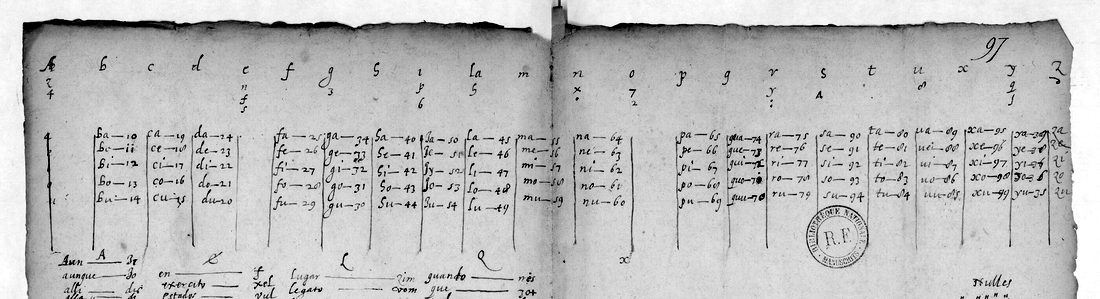
The sheet gives the letter alphabet with its symbol equivalents (a = 4 / ʒ, e = n / f / ʃ, g = 3, i = y / 6, n = x / ·, o = 7₂, r = y / :, s = ∆, u = o, y = q, z = ∂), the syllable table, a row of Nulles and, beneath them, the code list that Tomokiyo’s table does not have.
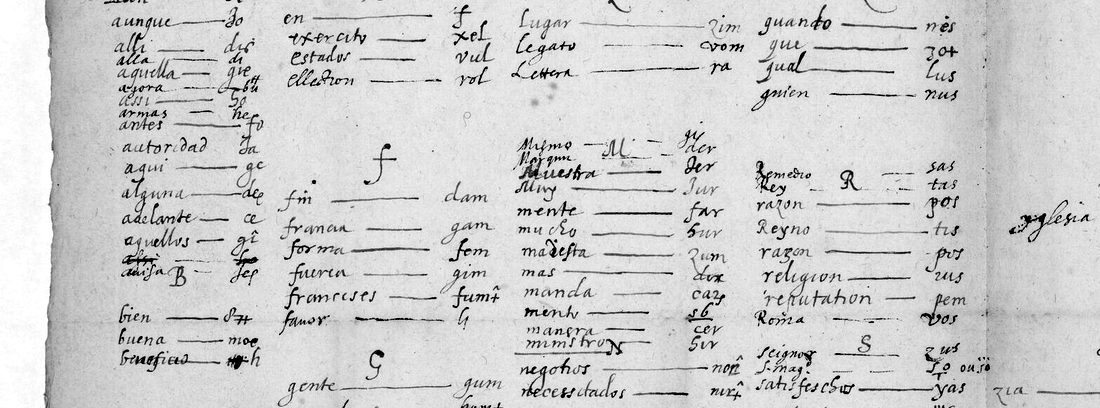
These are the groups that were open on the leaves. With them the diacritics can be fixed, and two of the marks are confirmed on plaintext: the ring is −h−, giving 1̊9 = cha in achaque, and the dot above is final −l, giving 13 with a dot = bol in bolsa. A trailing dot is final −n, a colon final −r, a circumflex final −s, a bar means the number itself, an umlaut doubles the consonant, and ⊤ marks a code group.
04 The decipherment
The keys were applied to all four leaves. Each was fetched at native resolution, deskewed (the angle within ±3° that maximises the variance of the row profile) and cut into centred line strips.
no. 45, f. 98: the Conde de Miranda to the duque de Feria, Naples, 25 February 1593
Every cipher line on the leaf is deciphered. The one band without a decipherment is a blank gap with show-through from the verso and holds no cipher:
… el [alla] con este achaque, que siendo confidente … se po[drá] procurar … a costa de la bolsa … yo supongo que hava de ser … residencia … sobre esto … a que hava dado ya alguna [Roma] … no [se] verá lo que en esto convernà hazer, que yo me remito a su prudencia. Solo le suplico que … tuviere [lettera] me mande [causa]r … la persona que se eligirá … donde le po[drá] escribir a dar algun recado, si fue[re] … dar de manera que no se entienda, por que la hora que … le tengan por … perderá mucho[s] …
no. 79, f. 162: the duque de Sessa to Diego de Ibarra, Rome, 11 March 1593
Every cipher line on the leaf is deciphered. There is no cleartext; the only bands without cipher are the folio number 162 and the docket 11 de Março 93:
… de ver los testemonios que a todos levantan … a [legato] … de feria … constantes, si bien los que bivimos en [Roma] no desemos de … por [causa] que no dura 4 dias, ni pasa a los sucesores. Se hazen tan estas ordinarias … difi[cul]tades en la [election] … con todo eso es [negocio] tan importante … que espero que le a de favorecer … de [manera] que … conviene … que entre los … que siguen la … [di]versas pretensiones … en cada uno … si no me espanto … no puedo dexar de hazerlo, a lo menos, de que no estén [ministro]s conformes … ganados, de que no se pue[den] denfiar …
no. 47, f. 108: Sessa to Philip II, Rome, 30 June 1593
This leaf carries a partial contemporary decipherment above the cipher. Where both survive, the decryption agrees with the gloss, which checks the office key on a third letter of the group:
| cipher | decoded here | the 1593 decipherer’s gloss |
|---|---|---|
ʒ 3̄0 23 65 g̈o 21 16. | 30 · de pa ssa do · con | a 30. del Passado con |
68: 87 4 23 55: … 22 26 77 21 23 22 4 n. 22 7 | por via de mar … di fe ri do de di a en di a | por una [via] de mar … ha ydo defiriendo de dia en dia |
Further on: a ve esperando a ver si venia … de los … de que no tiene … de [legato] [mucho] …, against the gloss “si ver[n]ia alguna nueva cierta” and “fres[ca] carta”.
no. 68, f. 145: Don Diego de Ibarra, Paris, 10 July 1593
This leaf is in a different cipher, the Feria–Mansfeld key, whose numbering is unrelated: ba 24, ca 25, da 10, la 59, ma 49, que 66, and de the single figure 8. The letter opens in cleartext and changes to cipher mid-sentence:
“… a la venida del mensagero que despache, porque espero que me dara V.S.a mas claridad de las cossas, porque en la primera me dise V.S.a” — then que aguarda cavallería y … y no continua … que aya recivido su …
05 What is open
The keys give plaintext on all four letters, on none of them completely. What is still open:
- nos. 45 and 79 are deciphered across every cipher line on their leaves. Open in them are scattered single groups, marked
·in the decipherment files: mostly rarer code words and a few diacritics that are ambiguous at this resolution. - no. 47 is deciphered across nine of its thirteen bands; the rest of the leaf is not transcribed.
- The Feria–Mansfeld cipher has no published code list, and that is the main gap. Its three-letter groups (pra, dur, hes, gar, pun, rom, mon, xen, vul, cil) carry much of no. 68’s sense, so its lines decrypt to syllables without becoming continuous Spanish. Tomokiyo tabulates none of them, noting only vas = segnor in passing. The nearest candidate was checked and excluded: fr. 3995 f. 101 (canvas 194), the large multi-column code list on the leaves beside the Spanish office key, is in Italian (Austria, Ambasciatore, Assemblea, Battaglia, Bisogno, Borbone, Borgo o Sobborgo, Cardinale di, Castello, Cattolici, Concilio generale, Corte di) and belongs to another correspondence.
- The other leaves of fr. 3995 near the key (ff. 94, 96, 98) hold further Spanish keys of the same office, including the one already identified here as “1592 / Chifre d’entre le Duc de Parme et le Roy Cath[olique]” at f. 98. They have not been worked.
06 Sources
- BnF, Département des Manuscrits, Français 3983, btv1b9059406b, 481 canvases. no. 45 at canvas 178 (f. 98), no. 79 at canvas 286 (f. 162).
- BnF, Français 3984, btv1b9060633d, 515 canvases. no. 47 at canvas 198 (f. 108), no. 68 at canvas 268 (f. 145).
- BnF, Français 3995, the Nevers cipher key book, btv1b525085665. The office key at f. 97, canvas 188.
- DECODE records 4076 and 4077, which name those key leaves.
- BnF archives et manuscrits, Collection Mémoires de la Ligue, notice ark cc504266, for the dépouillement that gives piece → folio.
- Satoshi Tomokiyo, Spanish Ciphers during the Reign of Philip II, cryptiana.web.fc2.com, for both reconstructed keys and the leaf-by-leaf citations.
- Image rights: Bibliothèque nationale de France.
Working notes, the key file, the decoder, the folio maps and the fetch scripts are in targets/sessa1593/.