

01 The five records
| Record | Date and origin | Earlier source | Result |
|---|---|---|---|
| R1140 | 31 May 1482, Pozsony | MDE III, no. 10, pp. 13–14 | Printed cipher reading |
| R1141 | 8 June 1482, Pozsony | MDE III, no. 12, pp. 16–17 | Printed cipher reading |
| R1142 | 8 March 1486, Buda | MDE IV, supplement no. 45, pp. 367–368; III no. 54, p. 67; Berzeviczy no. LVI | Reading spread over three printed sections |
| R1143 | 2 May 1486, Buda | MDE III, no. 75, pp. 93–96; manuscript slips | Printed and manuscript readings |
| R1154 | 29 May 1505, Naples | Berzeviczy no. CCCII, pp. 423–424 | Plain Italian; DECODE date corrected |
The first four letters are to Beatrice’s sister Eleonora; the last is to her nephew Ippolito. The last shelfmark is b. 2/7, 11, not b. 2/2. R1143’s six images show three written pages, two of them photographed twice with decipherment slips moved, plus the address side. Image counts must not be used as counts of distinct ciphertext pages.
02 31 May 1482: troops against Venice
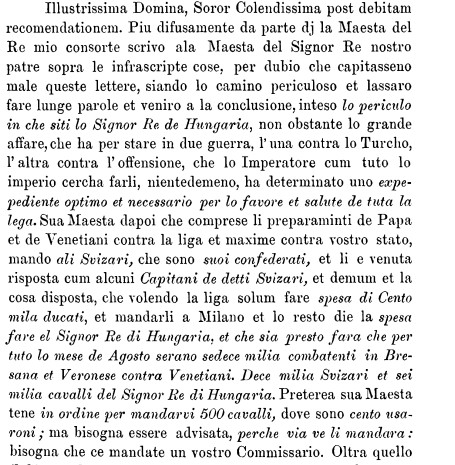
The edition gives the plaintext of the cipher: Matthias offers an intervention against Venice, provided the league sends money to Milan. The proposed force comprises ten thousand Swiss and six thousand cavalry; five hundred more cavalry, including a hundred hussars, also need a safe route. He does not intend to declare himself openly against Venice before his relationship with the league is settled.
uno expediente optimo et necessario per lo favore et salute de tuta la lega
Dece milia Svizari et sei milia cavalli del Signor Re di Hungaria.
These are excerpts of the 1877 decipherment. The manuscript’s cleartext and cipher boundaries match the edition’s roman and italic sections. The editorial note states that the italic words were written in secret signs.
03 8 June 1482: money and effective cooperation
Beatrice relays Matthias’s criticism of the league’s reluctance to spend. The king repeats the troop offer, requires payment at Milan, and asks for decisive cooperation. The published text has the proverb:
ali avari che per sparagnare uno grosso perdeno lo ducato
Misers save a grosso and lose a ducat. Near the end the decipherment describes endless negotiations as “uno Jocare de balla cum retornare sempre ali principij”—playing ball and always returning to the starting point. The printed page has balla; the OCR text gave holla. The edition and manuscript both date the letter 8 June, despite a secondary citation giving July.
04 8 March 1486: a letter split by the editors
The first written page contains cipher passages about bringing Andriolo to Hungary, paying his expenses and honoring the king’s promises. They appear in MDE IV, supplement no. 45. The editor associates the negotiation with the Djem/Cem affair; that identification is the editor’s.
The intervening plain pages concern Ippolito’s appointment to Esztergom and opposition from Cardinal Ascanio. Berzeviczy printed them in 1914, explicitly omitting material already published in MDE III p. 67 and IV p. 367. The final paragraph of the physical letter matches MDE III no. 54:
Con la cyfra havemo antiquamente con Vostra Signoria … ne li mandamo qui alligata un altra nova
She is using the old cipher and sending a new one for subsequent correspondence. The printed no. 54 is therefore the closing part of this letter and adds no further ciphertext to the set. The related same-date letter printed as no. 53 should not be substituted for this manuscript.
Limit: the 1878 decipherment keeps Virtus, Fortis and repeated M. in awkward positions. They are on the printed page and are not OCR errors. Their role in the cipher is not established. They are not deleted here as supposed nulls, and the printed text is not claimed to be flawless.
05 2 May 1486: decipherment slips on the leaves
The first cipher block discusses Milanese support for Ippolito and the contrary account given by Cardinal Ascanio’s envoy. A separate handwritten slip over the block begins “che don hippolyto vostro figliolo…”. The next photograph shows the same page with the slip moved aside. A later slip reads:
che quello Andriolo se conferisca qua
The corresponding request appears in MDE III no. 75 in the same context. Both the manuscript slips and the printed edition give earlier decipherments. The precise date and scribe of the slips were not established here.
06 29 May 1505: “we have no cipher”
R1154 is ordinary Italian chancery writing. Beatrice asks Ippolito to send a trusted messenger with letters for the cardinal of Esztergom, giving the journey the appearance of Ippolito’s own business. She then explains why she will not write more:
Et per non esser certa che le littere pervengano secure, et per non havere cifra: non ce extendemo altramente per questa
“Because we are not certain the letters will arrive safely, and because we have no cipher, we do not go into further detail in this letter.” Berzeviczy prints it as no. CCCII. The manuscript’s final dating clause, M° quingentesimo quinto, agrees with its docket and photograph label: 1505, not 1504.
07 What was verified
The evidence is the agreement of dates, salutations, clear passages, cipher boundaries and manuscript decipherment slips with the editions. No full transcription of the symbols was made, no key was recovered and no percentage was measured. The method is existing decipherment: printed decipherments found and matched to the images. The March editorial markers remain unresolved, and the letter-by-letter accuracy of the older decipherments has not been tested.
Tomokiyo’s Cryptiana index has no article on Beatrice; his other publications were not searched. Archive photographs remain local because DECODE states that their publication requires archive permission.
08 Sources
- Iván Nagy and Albert Nyáry, eds., Magyar Diplomácziai Emlékek Mátyás király korából, III (1877), nos. 10, 12, 54, 75, pp. 13–14, 16–17, 67, 93–96.
- Nagy and Nyáry, eds., volume IV (1878), supplement no. 45, pp. 367–368.
- Albert Berzeviczy, ed., Aragoniai Beatrix magyar királyné életére vonatkozó okiratok (1914), nos. LVI and CCCII, pp. 81–84 and 423–424.
- ASMo, Carteggio Principi Esteri, via the five DECODE records linked above; eighteen photographs downloaded for private research.
- Satoshi Tomokiyo, Cryptiana index, checked 20 September 2026.
Research report, metadata and machine-extracted source passages: targets/beatrice1482/. The extracts are labeled as uncorrected OCR; they are not a diplomatic transcription.