01 The document
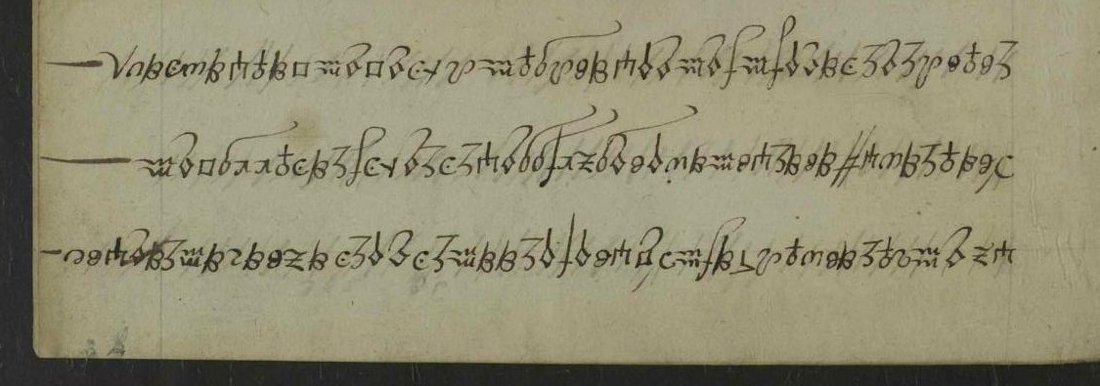
Page one has ten numbered lines of signs, written across the sheet, with no word division. Page two carries the address, To my Especiall & most Esteemed Cosin William Boswell Esq., a seal, and the endorsement S[i]r Ra: Boswele. 24 Jan. 1627, that is 1627/8. Below it, in the same hand, is a list of eight topics: Hopyan, Pettyt, the Court of Wards, Yorkshire lands, Sir Anthony Aucher, Morgan, one unread, and the Earl of Dorset. The same page has a tally of every cipher sign with the numbers of the lines it occurs in. That is the working sheet of whoever took the letter apart, either Boswell or a clerk. DECODE’s own note already doubted that the King wrote it; its author and 1628 date are catalogue placeholders.
02 The key
Woodard transcribed the signs as letters a–x. Aligned with his plaintext, all 442 signs map consistently:
a U/V  b P  c O  d N  e S  f A  g T  h E  i R  j D  k Y  l B
m I    n F  o H  q G  r K  s M  t C  u L  v W
p S (two uses, read here)    w ? (two uses)    x ? (one use)
Letters with no sign in the text are j, q, x, z. The writer confuses P and F (ofinion), puts H for F (heares = feares), and has an extra S in maskinge and L for R in loldes.
03 The decipherment
Upon Saterday, being our fifteenth of the presente, our[s] greate Duke returned from Plimmouth to Whitehall, contrary to the opinion of very many who conceaued he [w x] would not haue appeard heere before he had heard how the pulse of the Parlamente had gone. But being confident of the King’s fauour, [f]eares not the many enemies that he hath in the Lower House, especially hauing so greate a party in the Higher House by reason of the Bishops and the new Lords, which for the most [part] are(d) of his owne makinge; and to take away the ill opini[on] of such lordes …
The text breaks off mid-sentence at the end of line 10. The “new Lords” are the peers Buckingham had had created, the bishops were largely of his party, and the Parliament being discussed that winter was summoned by writs of 30 January 1628.
04 Date
In the Julian calendar the 15th fell on a Saturday in December 1627 and March 1628; 15 January 1628 was a Tuesday. With receipt endorsed on 24 January 1627/8, the Saturday is 15 December 1627. Buckingham had come back by way of Plymouth from the failed Île de Ré expedition in November 1627. The date of his arrival at Whitehall was not checked against a printed source here.
05 What remains uncertain
- p = s: H in his owne; C in our[s] greate Duke, where the sign may be a slip.
- Second w = “part” (C): one sign for a whole word, so a small nomenclator or an abbreviation mark.
- w x after “conceaued he”: not deciphered (I). Possibly a nomenclator pair or nulls.
- Item 7 of the topic list and the note beside the endorsement (Bradburn?) are not made out; whether the tally sheet is Boswell’s or a clerk’s is unknown.
06 Sources
- The National Archives, Kew, SP 106/5 ff. 20–21; images on DECODE R413 (login required).
- Mark Woodard, Furman University, decipherment of Record 413 (PDF, DECODE, 9 November 2021).
Notes, transcription and profile: targets/boswell1628/ in the repository.