‖ Δ α ψ p w m o α # 1· □ o o ƒ 3 c 1· auoir veu d’ascendre a Geneve … (f. 128, interlinear)
Langres → Nevers · letters, digits and graphic signs, apparently with code symbols · 3 July 1592
Dinteville to the Duke of Nevers, 1592
toDuke of Nevers
BnF Français 3621, no. 116, f. 130 (DECODE R9451; Gallica btv1b52524472n, view 269). A clear letter from the royalist lieutenant in Champagne with two cipher passages, about ten lines in all.
The catalogue listed it as a transcription job, because DECODE says the leaf has a decipherment. It has none. The one crib, the interlinear decipherment of a sibling letter at f. 128, did not yield a key, so the cipher is not deciphered. No earlier decipherment was found.
Summary. DECODE describes R9451 as a “letter, with cipher and decryption”, and the catalogue therefore marked it as deciphered at the time. The image shows no decipherment. f. 130r has a clear letter dated at Langres on 3 July 1592 with two passages in cipher (about 3 and 7 lines), then an autograph postscript in clear French. The volume turns out to be on Gallica in full resolution, and two leaves earlier, f. 128r is another Dinteville letter of July 1592 in the same symbols, with a contemporary decipherment written above each cipher line: m’a dict avoir veu d’ascendre a Geneve deux millions d’or d’Espaigne … quarante cinq + mulets chargez … prendre le chemin de Besançon. That is a crib of about 150 symbols. A test for a key of one symbol per letter (homophones allowed, up to three null types) finds none: the same symbol sits under o in auoir and under d a few symbols later. The decipherer also left some symbols as crosses, which suggests code symbols for words. The cipher is not deciphered. The next step is a careful symbol-by-symbol transcription of f. 128 against its interlinear, then of f. 130.
01 The leaf
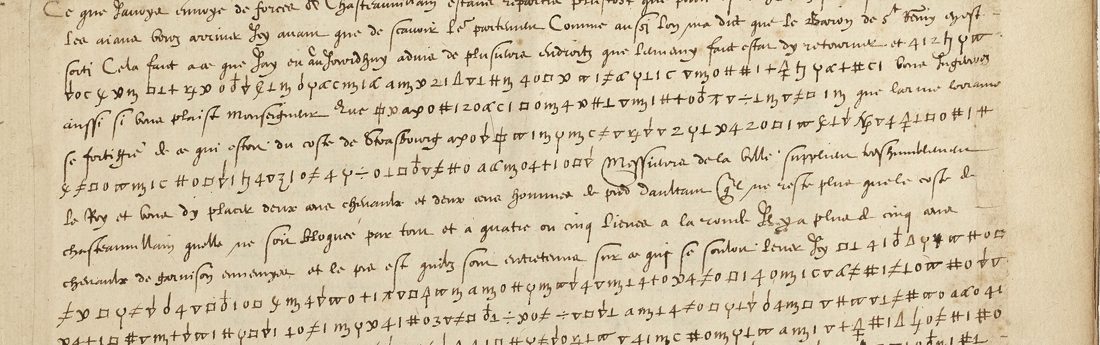
f. 130r, the head of the letter: clear French with the first cipher passage (lines 4–7) set inline. Image: Bibliothèque nationale de France, fr. 3621 f. 130r, via Gallica (btv1b52524472n, view 269).
The letter is in clear French, and the cipher breaks into it twice. The symbols are a mixed set: digits (1 3 4 9 0), letters (o v w m z c a) and marks (# ψ α Δ □ ¢ ∇ π ƒ +), some barred or crossed, many followed by a dot. There are roughly 400 to 450 symbols. The paragraph after the date, beginning Monseigneur ce matin j’ay sceu … l’armée lorraine, is Dinteville’s own postscript in clear. The verso carries the address. Nothing on the leaf glosses the cipher.
02 The crib on f. 128
f. 128r, another Dinteville letter of July 1592: the cipher lines, with the contemporary decipherment written above each (“avoir veu d’ascendre a Geneve deux millions d’or d’Espaigne”). Image: Bibliothèque nationale de France, fr. 3621 f. 128r, via Gallica (btv1b52524472n, view 265).
This leaf is probably no. 114, which the BnF notice lists as a Dinteville letter “avec chiffre et déchiffrement”. It uses the same symbols as f. 130. The decipherment is written above the cipher, roughly word by word, and runs: … m’a dict / avoir veu d’ascendre a Geneve deux millions d’or d’Espaigne / … quarante cinq + mulets chargez qui doibt aussi passer dans trois / jours et prendre le chemin de Besançon …, news of Spanish money moving through Geneva and Franche-Comté towards Flanders.
03 What was tried
I transcribed the second cipher line of f. 128 as 50 symbols against its 48-letter gloss. A search for a consistent key (each symbol one letter, several symbols per letter, up to three symbol types as nulls) finds no solution. The first five symbols fit auoir cleanly, but α then has to be both o and d. Either the cipher is not a plain homophonic alphabet (code symbols for words such as Geneve and Espaigne, or symbols worth more than one letter), or my reading of the glyphs by eye is wrong in places. With about 150 aligned symbols and no second crib, the two cannot be separated from here.
04 What remains
Both cipher passages of f. 130: not deciphered.
The f. 128 system: undetermined. The crib exists, but no key has been rebuilt from it.
Next steps: a verified hand transcription of f. 128’s three and a half lines; a sweep of the rest of fr. 3621 (and fr. 4716 no. 31, Dinteville to Nevers, 1590) for more Dinteville letters with decipherments; then the nomenclator-plus-language-model method used for Lorraine 1592 and Pélissier 1592.
05 Sources
BnF Français 3621, Gallica view 269 (f. 130r) and view 265 (f. 128r).