01 The letter
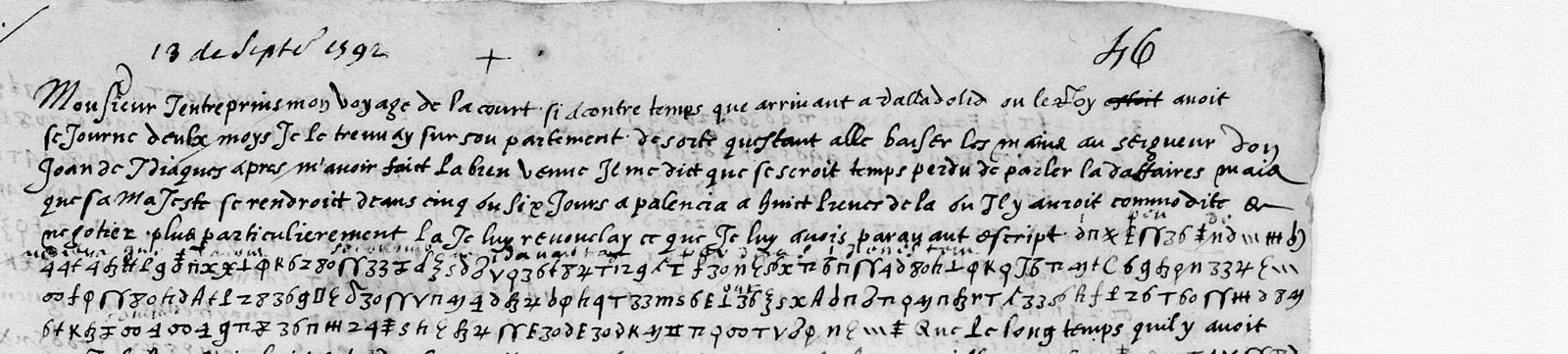
BnF fr. 3982 is one of the Mémoires de la Ligue volumes (fr. 3974–3995), which gather League correspondence, much of it ciphered, from the 1580s and 1590s. No. 22 runs from f. 46r to f. 50r with the address on f. 50v: nine close-written pages, about fifty lines each, dated “A Burgos le xiij septembre 1592”, signed “Vre bien humble et obeissant serviteur Pelissier”, and marked Tripta (the third copy sent). Clear French and cipher alternate within the same lines, and the cipher is written with a small repertory of letter-like signs, figures and marks.
02 The key
Tomokiyo’s League page reconstructs the cipher Pelissier used in nos. 45 and 46 (Madrid, 27 October 1592) from their clean decipherment on f. 115. It is a homophonic alphabet with one to seven signs per letter. Some signs are two-digit numbers (24, 26, 28, 30, 33, 36, 44, 56, 60, 80). There is a sign for et, signs for the doubled letters rr, ss and uu, and six nulls. His table is not reproduced here; it is on his page. No. 22 is six weeks older and on the same key, with two additions:
- Code group 315 is the Béarnais, Henri IV: “le [315] ayant incontinant tourné la teste et s’estant campé pres l’armée catholique”, “les forces d’Allemaigne … iointes au [315]”. It occurs on four of the nine pages.
- Code group 310 occurs once, on f. 50r: “ne correspondront pas a ce que pretend [310], et l’ambassadeur … a esté renvoyé sans aultre esclaircissement sur ses demandes”, next to a passage on the governor of Milan. A claimant with an ambassador at Philip’s court and a Milanese connection is most likely the Duke of Savoy, Philip’s son-in-law, who had his own pretensions in France; the Duke of Lorraine is the alternative. Context only.
- Code group 441 occurs once, on f. 49v: “non seulement en [441] mais en toutes aultres regions de la Chrestienté”, which asks for France. Context only.
The decipherer’s glosses check the key wherever they are legible. They agree on de, auisa, meschans, roy, les tirer, Noyon, a la main qu, n’auoit, en atendant, quar la bataille, mais le retour, de crainte, langaiges, Valentia, a gens matez des and (qu’ay)ant pleu a Dieu, among others. One gloss disagrees in an instructive way. Over “nos forces” the glosser wrote os a orc: he applied the table’s ϝ = a literally where the sense needs f. The hand that deciphered this letter in 1592 was working from the same table, and it slipped on the same sign.
Calibration. Tomokiyo’s table gives each sign a letter; it does not say how to tell apart signs that look alike on a fast page, and that is where the first decryption stalled. The two letters he built the key from were therefore aligned with their clear text on f. 115, sign by sign: 835 signs of no. 45 (f. 111r) and 929 of no. 46 (ff. 113r–v). That settles the look-alikes with known plaintext:
- 4: the plain closed 4 is n (and often m), never t; t is the 4 with a hooked lead-in off the crossbar, or with a curl. The first transcription had written both as 4, and a decode that let every sign take any letter wanted that 4 to be t 355 times.
- ⊤: flat-topped is a; with a hooked top and a descender, p; with a tail, s. The lone hooked τ is g.
- δ: with a straight ascender o; curling over into a long hook, c; with a big open loop over a closed bowl, r.
- 56: compact, y; with the long hooked 5 and the 6 set high, c. 8: plain, n; crossed at the waist, q.
- + is h and ∐ is l, never e; π is i, never s (the tailed ϖ is s); the barred ӿ is u and the large plain ✗ a null; 7 is b, or h.
The October letters and no. 22 were written by the same hand six weeks apart, and the page transcribers found a few further habits in no. 22 alone: an alpha-shaped sign and a barred 5 for g, a small box-shaped ∐ for e, the tall double long-s for rr, and a looped ℓ that stands for u or e by context. The whole guide, with exemplar crops of every form, is targets/pelissier1592/GLYPHS.md and cal/atlas/.

03 What it says
Deciphered words are quoted as written, with the letter’s spelling. The page summaries below are in English. The full text, page by page, with gaps marked, is in
targets/pelissier1592/READING.md.
- f. 46r. Pelissier reached Valladolid just as the court was leaving, and Don Juan de Idiáquez put business off to Palencia. In cipher, he says his credit is gone, “le credit m’est[oit] failly pour n’avoir satisfaict au payement des sommes qui m’ont esté prestées a Madrid”. He takes the King’s long silence for a refusal and asks leave to go home. He is told Philip has his own ministers in France. Philip’s answer to the rest is “yo lo creo”. Then comes the grant: “elle m’avoit ordonné cinq cens ducats, qui valent environ quatre cens cinquante escus, ou plus”, payable in Madrid, “ou je me pouvois retirer avec les ambassadeurs et aultres estans par deça de la part de princes estrangiers”, so that he can wait for news.
- f. 46v. At Burgos, Don Juan gives him a private hour. Pelissier’s theme is reputation, and his example is Parma’s army of 1592. While it flourished, “la plus part de la noblesse catholique qui suit ce party se retira chacun en sa maison” and towns began to treat. If it had wintered in France, the Béarnais would have been brought to “une ruine tres certaine”, and the Germans “n’eussent eu l’audace de sortir de leur pays pour l’assister”. Its return to the Low Countries undid everything: League towns afraid of being exposed if the enemy returned began their own dealings, and La Fère, Soissons and the places of Picardy, perhaps Corbie “pres d’Amiens” (a doubtful reading), were left in danger.
- ff. 47r–47v. The French “aymeroient mieux mourir touts l’un après l’aultre” than be forced, as the rising against “le dernier Roy” showed; mildness and benefits would win them to anything. The King asks whether Pelissier speaks on Mayenne’s orders. He has had no word since the armies faced each other at Caudebec. The Spanish answer is that no king had ever given such help, and any failure lay with those who received it. Pelissier’s reasons for putting off the Estates are taken for a trick. The minister recalls that Mayenne, in the time of the Cardinal de Bourbon, had pressed for everything else to be set aside for the Cardinal’s “deliurance”, and Pelissier is heard to say it would be “necessaire que l’on mist sus deux armées”. Yet the minister concedes that the League’s French would take it very badly if Spain delayed “la nomination d’un roy legitime pour l’opposer a l’heretique et tyran”. Of the Spanish ministers, Pelissier writes: “ilz ont les oreilles delicates”.
- f. 48r. He calls for a “troisiesme moyen”. This is the wrong time to hold the Estates: the people are exhausted, the clergy intimidated, and the nobility held only by its interests, and they would sooner accept “un accord qui creera un Roy pour l’opposer a celuy qui se pretend”. He foresees a war that may end only “par l’extermination de la race de l’un desditz deux Roys”. His remedy is the plan already put to Philip “de tenir deux armees en pied”. One army would drive the enemy from the Seine to the Loire. The other would take the Seine towns and free Paris and Rouen. He answers the cost, “pres de trois cens mil escus par mois”, by saying the effort need last only a few months. A war left to drag on would be “si sanglante” that, driven to despair, it would spare neither age nor sex: “ne pardonnant a aage ni sexe”.
- f. 48v. The army should be mostly French, “tant a pied qu’a cheval”, stiffened by “un corps de sept ou huit mil Alemans” and some Spaniards and Walloons “assistés de bons capitaines”. A victory would ruin the enemy. After a defeat, an army of Philip’s own nations “seroit preste pour recueillir les reliques de ceste deffaicte”. Piecemeal aid only ruins the provinces. And if Philip showed “quelque affection particuliere en la nomination du roy”, everyone would follow.
- f. 49r. The campaigns of 1591–92: Chartres, Noyon, the Prince of Ascoli’s relief, Caudebec, Henri’s daily offer of battle, and the retreat towards Château-Thierry. The clear text blames Parma for letting chances go by, which gave the enemy room to spread the rumour that Philip fights only to keep the French busy while he subdues his Low Countries rebels.
- f. 49v. What Frenchmen were saying: that Philip wanted France kept “en telle balance” so that he could take his share of a divided crown. Then the case for Navarre. God called him “comme par miracle a la succession”. He has lived “en perpetuelle peine et travail, pauvre et miserable”, and so he will want peace. If he turned on the Catholics, they would be “libres du serment de fidelite”. Such talk works on “gens matez des maux soufferts et plains de desespoir de mieux”. Philip alone can cure the malady, and would add to “Catholique” the names “tres chrestien” and “liberateur de la Chrestienté”.
- f. 50r. “Ilz vont minant l’authorité” of Mayenne: finances first, then command, then credit: “ilz luy diminuent le credit … l’abaisser le plus qu’ilz pourront. Dieu veulle que je me trompe”. Whatever [310] pretends to, its ambassador has been sent home without an answer, and Pelissier pleads for a union among the League so close that an offence to one would be felt by all. In clear, Pelissier stays “pour essayer de tirer une derniere resolution sur la partie de cinquante mil escutz”. A postscript describes a visitor sent to Palencia, whom the King received well enough to send him horses for his audiences.
04 How it was decrypted
- Transcription by sign. Each page was cut into third-width bands at 1.5× from the full-resolution Gallica scan. Every sign was written as a token (a name for its shape) and every clear passage in full. Seven parallel agents did ff. 47r–50r; ff. 46r–46v were done here and served as the worked example.
- Decoding with the key. Each token carries the letter the key gives it, plus alternatives where two signs look alike. A 4-gram language model of period French chooses among the alternatives and supplies the word breaks. No solver changed the key.
- Second pass. For every row that did not decode to French, the signs were transcribed again at 2.5× and genuine misreadings were corrected on every page. A change was made only when the sign was visibly different on the leaf, never just because French would then appear. Each page’s decryption file lists the glosses and whether they agree.
- Calibration and third pass. The key’s own source letters were aligned with their clear text (section 02), the look-alike families were split into separate tokens, and every row of all nine pages was transcribed again against the scans with them. Open words fell from 413 to 256 and doubtful ones from 278 to 158.
A failed approach. Twice, once per page and once over the whole letter, a solver (hill-climbing) adjusted the sign-to-letter map against the language model, starting from the key. Both times it drifted to a degenerate map in which every frequent sign is e, which a noisy transcription always rewards. The key was right. The errors were in the tokens, which had merged signs the key keeps apart:
- 56 with a flourish is c, and plain 56 is y.
- The plain δ is o, the δ with a long curling hook is c, and the closed-loop ∂ with a curled top is r.
- The flat-topped ⊤ is a, the hooked τ is p, and the small curled “Tz” is g.
- Among the barred I forms, the plain one is l, the bold-footed one is o, and the double-barred one is o as well (Ƒ).
- vv is et, and also ff.
- ϝ is a in the table and f in dozens of words.
The calibration in section 02 corrects this: most of these splits are now tokens in their own right, confirmed on known plaintext.
05 What remains open
- 256 words open, marked
[?], against 3,734 decrypted inside the ciphered stretches (94 %), and 158 more decrypted but doubtful, marked(?). Every page’s decryption file lists its open rows with their tokens. They are single signs the eye cannot settle, a hole in f. 50r, and names. Nothing is supplied by conjecture. - Grades. The key is H (in print, and confirmed on 1,764 signs of known plaintext and by the glosses). The decryption of the firm stretches is H; the (?) words are C. 315 = the Béarnais is H (it recurs, and “appeler [315] comme par miracle a la succession” fixes it); 310 = Savoy and 441 = France are M, one occurrence each; Corbie and Amiens on f. 46v are I.
- Names. The Dominican confessor on f. 50r decrypts to c-o-r-n-e | n-t-(u/e) across a line break, “Cornente” or “Cornete” if a heavily inked 4 is cancelled; not identified. A “don …” beside the governor of Milan, the visitor of the postscript, and a place in the 1592 campaign (f. 49r) are open.
06 Sources
- BnF Français 3982, Gallica ark
btv1b9060543f: no. 22 at views 100–108; nos. 45 and 46 at views 230 and 234–235, with their decipherment on f. 115 at views 238–239. - S. Tomokiyo, “A List of Cipher Materials in Mémoires de la Ligue” (
league.htm), cryptiana.web.fc2.com: the entry for fr. 3982 no. 22 (“Nine pages long. Mostly in cipher, only partially deciphered.”) and the key reconstructed from ff. 111 and 50. - No published decipherment of no. 22 was found (web search, 18 September 2026).