b c d f g h l m n, Hurtado's also end in p and z, and the same group xul means despues in Sánchez's key and lo in this one.
No published key or decipherment was found. Tomokiyo's 2025 article reconstructs Sánchez's cipher and Juan Manuel's; it does not mention Hurtado, and his records fall outside both ranges it lists.
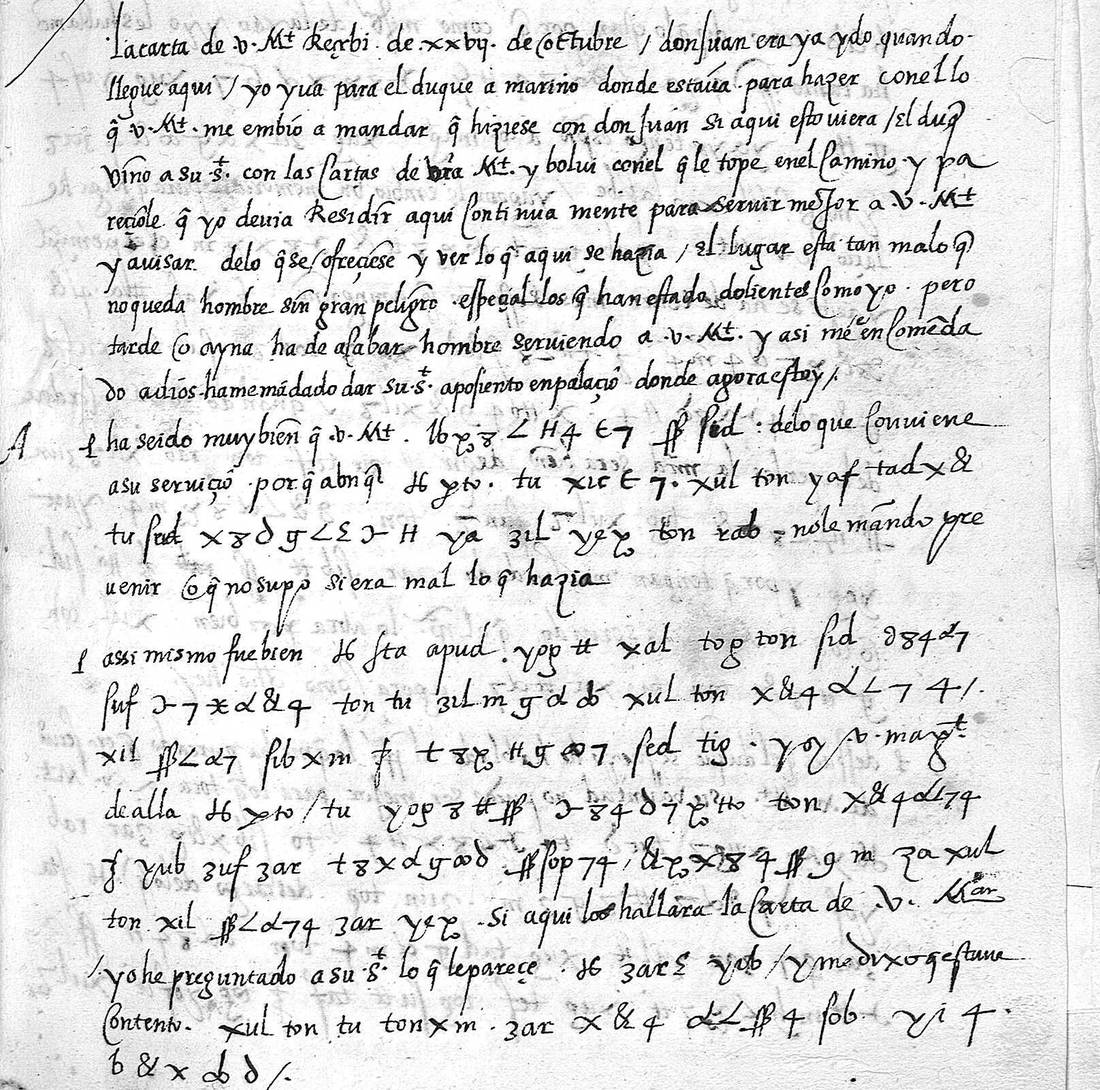
R9644 carries both the ciphered letter and the clerk's full clear version of it (ff. 241–242), in lettered sections A, B, C keyed to the same letters in the margin of the cipher; R9650 has its own clear version (f. 272). Aligning cipher against plaintext fixes forty-seven code values, with twenty-nine more kept separately as probable. The probable set includes all ten substitution-alphabet symbols: an 8× zoom showed that symbols which must stand for different letters look almost identical at the resolution first used.
The key also works on letters it was not built from: two thirds of the tokens resolve directly in R9648 and R9650, and in R9656, a letter three weeks later with no clear version and no duplicate, it gives el papa without a crib.
Four of the nine letters are complete in content: the two with clear versions, R9648 (a duplicate of R9644), and a record that carries no cipher at all. They show Adrian VI temporising between Charles V and Francis I: the French resolved to come into Italy with a great sum of money to Lyon, the Pope tan escasso que nunca hombre lo fue mas and his household unpaid, the peace track running through the archbishop of Bari.
Extent: partial. The key was recovered from contemporary adjacent plaintext. Four letters are complete in content, and their ciphered leaves are partly decrypted word for word. The five records with no clear version give fragments only, because the substitution alphabet is still incomplete.
01They are not Sánchez's letters
These nine records sit in Salazar 9/26 among Alonso Sánchez's despatches from Venice, were catalogued with them, and look at first like more of the same: the same months, the same recipient, cipher mixed with clear inside the sentence, code groups of the same shape and the same three-letter build. The catalogue treated them as one target.
Two tests separate them. In Sánchez's nomenclator every code group ends in one of b c d f g h l m n; Hurtado's groups also end in p and z (tep, tap, groups ending -z), which Sánchez's key does not contain. And where the two keys use the same group they disagree: xul is despues in Sánchez and lo here, ho is que in Sánchez where this cipher uses ton. Same design, same chancery tradition, different key.
Nor is it Juan Manuel's, the third imperial cipher of 1522 Rome: none of the values fixed here appears in Tomokiyo's 173-code table for it. That table is itself a partial recovery, so this test supports a separate key without proving it, and it is recorded that way.
02Earlier work on these records
Satoshi Tomokiyo's Correspondence in Cipher of Imperial Ambassadors Alonso Sanchez and Juan Manuel (1522) (Cryptiana, 6 September 2025) reconstructs two of the three ciphers in this group of volumes. It does not mention Lope Hurtado, and his records (R9634, R9644–R9646, R9648–R9650, R9652, R9656) fall outside both of the ranges it lists. A web search found no decipherment. DECODE records seven of the nine as Non-decrypted, that is, with no decipherment attached.
03The crib was bound with the cipher
R9644 (ff. 237–243, 1 November 1522) holds the ciphered letter on ff. 237–239 and the clerk's own full clear version on ff. 241–242, headed Al Rey — De Lope Hurtado, de Roma, del primero de noviembre, written out in lettered sections with A, B, C standing in the margin of both. R9650 (ff. 269–272) has the same arrangement, its clear on f. 272. R9648 (9 November, with no decipherment on DECODE) is a duplicate of R9644, so one clear version covers two records.
04The first anchor
The clear at the foot of section A reads … porque esta tan escasso que nunca hombre lo fue mas; hasta que el arçobispo venga creo que sera mejor no apretallo mucho. On the cipher page the middle clause stands in the clear, bracketing the run: six tokens for six words, with no room for misalignment:
ton | tab | xud | xul | ɣm | xon |
|---|---|---|---|---|---|
| que | nunca | hombre | lo | fue | mas |
and tu = no from no apretallo mucho. From there the alignment extends: zun top at da por, ᵇʒ7 and teɡ at era and para, zil ɣub zed zar at con el arçobispo de Cosenza, ɣub taf at el papa, rab at v. ma.
05How the cipher is built
Three-letter code groups carry most of the text and are written as plain latin trigrams; spelled runs between them use a substitution alphabet. Three features matter for decryption, and none is described in the published account of the sibling ciphers:
- Homophones at code level.
taandtuboth mean no, and both occur in the same line. The alphabet has them too: the single spelled word perdida writes d with two different symbols. - Codes also stand for syllables.
xur+zun= na+da;ton+ℓ∞74= que+rian;zil+ a spelled ocia = conocia;nul+vuc+s = obligados.zunis da the whole word in da por, the second syllable of na·da, and the middle of que·da·rian. - Several codes can make one word.
lu+ho= porque,lul+ta= quales,ton+d+o = quedo.
A code group can therefore be part of a word, a whole word, or one of several groups forming a word. A decryption that treats each group as one word goes wrong in both directions.

xul ton tu ton·d·o zar d·o·n, lo que no quedo de don [Joan]. A code completed with two alphabet symbols, then a name spelled out. Image: Real Academia de la Historia, Colección Salazar y Castro 9/26 f. 237, via DECODE R9644.06Tests on letters the key was not built from
A key fitted to its own crib can reproduce the crib and nothing else. This one was tested on other records.
R9648, which has no decipherment on DECODE, gives nine tokens for nine words with nothing left over: ʋ ton ɣub taf tu ɣof ɣuc ton + spelled venga = «y que el papa no esta en que venga»; further down, la paz por los infieles y por la necessidad. Its spelled perdido decrypts letter by letter from six symbols fixed on the other record; the word was not searched for.
R9656 is the stronger test: a despatch of 20 November with no clear version and no duplicate anywhere. Applied without a crib, the key gives el papa for ɣub taf after the clear words las cartas traxo don Correo q vino con la valante.
Measured with a resolver that applies confirmed values only: 70% of tokens on R9648 f. 262, 62% on R9650 f. 270, 57% on R9645 f. 243, which has no crib of any kind. The figures do not change when the alphabet values are downgraded to probable (below), because almost all resolved tokens are code groups, the better-established half of the key.
07What the letters say
The content of four of the nine is complete: R9644 and R9650 from their clear versions, R9648 as R9644's duplicate, and R9652, which DECODE records as Partially decrypted though it carries no cipher at all. That leaf is written entirely in clear and signed Lope Hurtado.
R9644, 1 November. Charles V had written to warn Adrian VI directly; Hurtado approves, because if the Pope will not do his duty he should at least not be able to plead that he was not warned: no se disculpe despues con dezir que v. magestad no le mando prevenir. The Pope's voluntad is good and his obras satisfy nobody; he pleads the Turks and the Emperor's need, and is tan escasso que nunca hombre lo fue mas. Hurtado presses for the papal household to be paid before the other side buys them: si no los corrompiessen dandoles. The King of France asks a safe-conduct to send an ambassador and the Pope will not have him come.
R9650, November. The main news is that los franceses son determinados de venir en Italia, y enbian gran suma de dinero a Leon, brought by post from the archbishop of Bari, with Hieronymo Adorno's intercepted letters behind it. Adrian is urged to act sin dilatar mas, and takes it tan tibiamente que no se espera de todo bien.
R9652, November. A licenciado Bernardino, «gran bellaco», is in Rome; the Duke of Sessa wants him seized; the Pope will order it if the man is inside Rome, declines a night arrest when he is found lodging with his brother in the city (aqui no seria bien), and offers a formal suplicacion instead. It closes with las nuevas de Rodas que escrive el visorrey, the viceroy of Naples on the siege of Rhodes.
Sánchez's R9653 of 20 November carries the same Rhodes news from Venice, out of Candia and the Signoria. Rome and Venice reported the siege to the Emperor in the same fortnight, in two different ciphers, now bound in the same volume.
08What is open, and how complete the decipherment is
- Five records have no clear version (R9634, R9645, R9646, R9649, R9656), so there the key is applied without a crib. Measured, it resolves 42% of tokens on R9656 and 57% on R9645, concentrated in the function words and the names, with the spelled content words as the misses. R9645 comes out as … se si no con […] con vuestra magestad, que no […] en […] esta[do] […] de vuestra magestad …; R9656 as … no […] el papa […] la […] que […] su el papa. These are fragments. An earlier draft of this page said these five were deciphered “in substance”; the measurement does not support that, and the claim is withdrawn. Enough survives to identify what a passage is about when the surrounding clear text helps, and not enough to give the text of the letter.
- The substitution alphabet is the limit. Nine symbols are fixed and cross-checked:
⋃=p,8=e,ʒ=r,x/6=d,L=i,7=a,4=n,m/ᶻ=o. Beyond these, transcriptions of the spelled words contradict each other at DECODE's image resolution. One contradiction proved to be a homophone missing from the key, and the others may resolve the same way; unassigned symbols are left blank. - Confidence is recorded for each value. The key file carries a
confidencecolumn; the resolver applies confirmed values only and shows probables in angle brackets. A check for pairs of codes with the same plaintext led to four retractions, kept in the file as commentedRETRACTEDlines, among them an early guess thatzarmeant Bari, when it means de. Nothing probable was used to derive anything else, so nothing downstream needed unwinding. - A correction to DECODE. R9652's status should be not enciphered; DECODE has partially decrypted.
09What would complete it
The limit is image resolution. DECODE serves these leaves at 3440×2465 for a two-page opening, about 1700 px across a folio: enough for the Latin-letter trigrams, too little to separate two similar cursive symbols. That is the cause of the alphabet limit, and further crib work does not change it.
DECODE, checked with a logged-in session, has nothing better. The full-size file filesrv returns is that 3440×2465 opening; MASTER_, MS_, ORIG_ and .tif variants all come back as the server’s not-found placeholder, and the Image Manager answers “You do not have permission to access” to a viewer session, so its zoom view is unreachable too. The ceiling is DECODE’s stored derivative.
The volume belongs to the Colección Salazar y Castro, which the Real Academia de la Historia has been digitising at its own Biblioteca Digital. If Salazar 9/26 is there, those images will be far better than DECODE’s derivative copies, and recovering the substitution alphabet becomes routine. That would give an exact text of the ciphered leaves and should allow a full decipherment of the five records with no clear version.
It could not be done from here: bibliotecadigital.rah.es returns HTTP 403 to automated requests and puts a bot check in front of its search, in the same way DECODE’s image server needs a logged-in session. The search term is the old signature, Salazar y Castro, A-26, and the leaves wanted are ff. 237–243, 260–272 and 334–335.
10Sources
- Biblioteca de la Real Academia de la Historia, Colección Salazar y Castro, Signatura 9/26. Images consulted through DECODE under login; not reproduced beyond the crops above.
- DECODE records R9644, R9648, R9650, R9652, R9656, and R9634, R9645, R9646, R9649.
- S. Tomokiyo, Correspondence in Cipher of Imperial Ambassadors Alonso Sanchez and Juan Manuel (1522), Cryptiana, 6 September 2025: the sibling ciphers, against which this one was compared.
- The Venice side of the same archive: Alonso Sánchez at Venice, 1522.
Key, decipherments, the resolver and the working notes: targets/lopehurtado/.