
cef = xxvi and cif = xxvii, are then confirmed in the text of R9653.
Two letters outside Tomokiyo’s coverage are deciphered in part here: R9653, a leaf mostly in clear on the siege of Rhodes with a ciphered paragraph at the foot reporting letters out of France; and R9635, a whole page of cipher on the sums owed by the Signoria and the restitution of seized goods, which attests a third predicted numeral, cab = xv.
Finally, the Lope Hurtado letters use code groups ending in p and z, which Sánchez’s key does not have. They are in a third cipher of the same family, not yet reconstructed.
Outcome: known key (Tomokiyo 2025) applied; the entry corrected and two letters deciphered in part. The remaining twenty-seven records need transcription and checking against the published key; no cryptanalysis.
01What was already published, and when
Satoshi Tomokiyo, Correspondence in Cipher of Imperial Ambassadors Alonso Sanchez and Juan Manuel (1522), posted on Cryptiana on 6 September 2025 and enlarged on 9 September, reconstructs the key. He worked from the contemporary decipherment attached to DECODE R9605, and describes how he began: browsing R9613 he noticed that vog and xig were frequent and so likely common monosyllables, and that a q with a double bar was often affixed to a code and might be the plural -s; he was then stuck on the handwriting of the decipherment. Turning to R9605 he saw vog veg near the end, two codes close together in an alphabetical listing and both frequent, and matched them to en el in the plaintext. After that, as he puts it, there was no real difficulty.
The article gives the substitution alphabet as a hand-drawn table, the nomenclature, and the deciphered first lines of R9593–R9632, plus the whole of R9621 and the last paragraph of R9623. It also reconstructs the parallel cipher of Juan Manuel, imperial ambassador at Rome (DECODE R9499–R9529), which is built to the same design with different values.
For the prior-solution record: a published key and partial decipherment existed a year before this work, it was found before the attempt, and everything below uses it. Bergenroth’s Calendar (1866) also abstracts fourteen of these letters from the contemporary decipherings; that was found after R9635 had been deciphered in part.
02What the catalogue entry got wrong
The entry read “RAH, Signatura 9/24 (29 items)”, 1522–23, and justified its importance by the negotiation that brought Venice out of the French alliance and ended in the treaty of July 1523. The fifty-five DECODE record pages R9603–R9657, tabulated, contradict all three parts.
- The shelfmark. The run is spread over Salazar 9/23, 9/24, 9/25 and 9/26. R9603–R9618 are in 9/24, R9619–R9632 in 9/25, R9633–R9657 in 9/26, and Tomokiyo’s list reaches back into 9/23.
- The dates. Every record carries a 1522 date, the last of them November 1522. Nothing in this group reaches 1523, so the treaty of July 1523 is outside it. The letters belong to the year of La Bicocca, the loss of Genoa and the fall of Rhodes; the Venetian realignment came the year after.
- The authorship. Nine records are by Lope Hurtado de Mendoza, not Sánchez: R9634, R9644, R9645, R9646, R9648, R9649, R9650, R9652, R9656.
A further correction matters more. DECODE marks almost every record in the group Inline Cleartext: Yes, meaning a contemporary decipherment is bound with the ciphertext, and the Calendar of State Papers Spain, vol. 2, calendars many of these same letters with the note “Autograph in cipher. Contemporary deciphering”. These letters were deciphered at the time. What they lack is an edition. DECODE’s Non-decrypted means that no decipherment is entered in the database; the catalogue entry took it to mean that none exists.
03The cipher, and the rule that orders it
The system is the 1496 Ferdinand-and-Isabella type: a homophonic substitution alphabet, three nulls that letters open with, a q with a double bar for the plural -s, and a nomenclator of three-letter codes for common words, names and places. Word division is kept. The vocabulary is large for the date.
Tomokiyo’s table, set out as data, shows that the codes follow a pattern. They are consonant–vowel–consonant over
- first position, sixteen consonants
z y x v t s r p n m l h g f d c b, running backwards through the alphabet as the plaintext runs forwards; - middle, the five vowels
a e i o u; - third position, nine consonants
b c d f g h l m n.
That is 720 slots, of which about 177 were recovered. Sorting by (first consonant, third consonant, vowel) puts the plaintext in alphabetical order: zid zod zud | zef zif | zog zug | zel | zem zom | zen zun gives a(h)un, ahun, al, allende, algun, alla, alli, antes, aqui, aquell, arma, assi. The alphabetisation is the clerk’s own and is loose at the edges (allende before algun, cosa before concorda), so what the rule gives for an unassigned code is a range, not a point. Where the plaintext is a numeral series, the range collapses to a value.
04The numeral series, predicted and then confirmed
Tomokiyo has cob xviii, cub xix, cad xx through cud xxiv, and caf xxv, and leaves the rest of the block blank, with a query on cud and an uncertain “[xxviii?]” in his reading of R9598. The ordering rule fills the run:
| code | cab | ceb | cib | cob | cub | cad | ced | cid | cod | cud | caf | cef | cif | cof | cuf |
|---|---|---|---|---|---|---|---|---|---|---|---|---|---|---|---|
| value | xv | xvi | xvii | xviii | xix | xx | xxi | xxii | xxiii | xxiv | xxv | xxvi | xxvii | xxviii | xxix |
The two in bold were predicted before they were seen, and then met in the foot paragraph of R9653 in a context that can only be a pair of dates (next section). That in turn resolves the uncertain “[xxviii?]” of R9598 as cof. The predicted values are carried in key_codes.tsv flagged as this project’s, separately from Tomokiyo’s.
05R9653: the fall of Rhodes, in clear, with a ciphered postscript
R9653 is Sánchez to Charles V, Venice, 20 November 1522, Salazar 9/26 f. 299–301. It is beyond the end of Tomokiyo’s list and is not calendared in CSP Spain 2. Folio 299r is a mixed leaf: six lines of cipher at the head, some thirty lines in clear, two lines of cipher at the foot, then the signature.
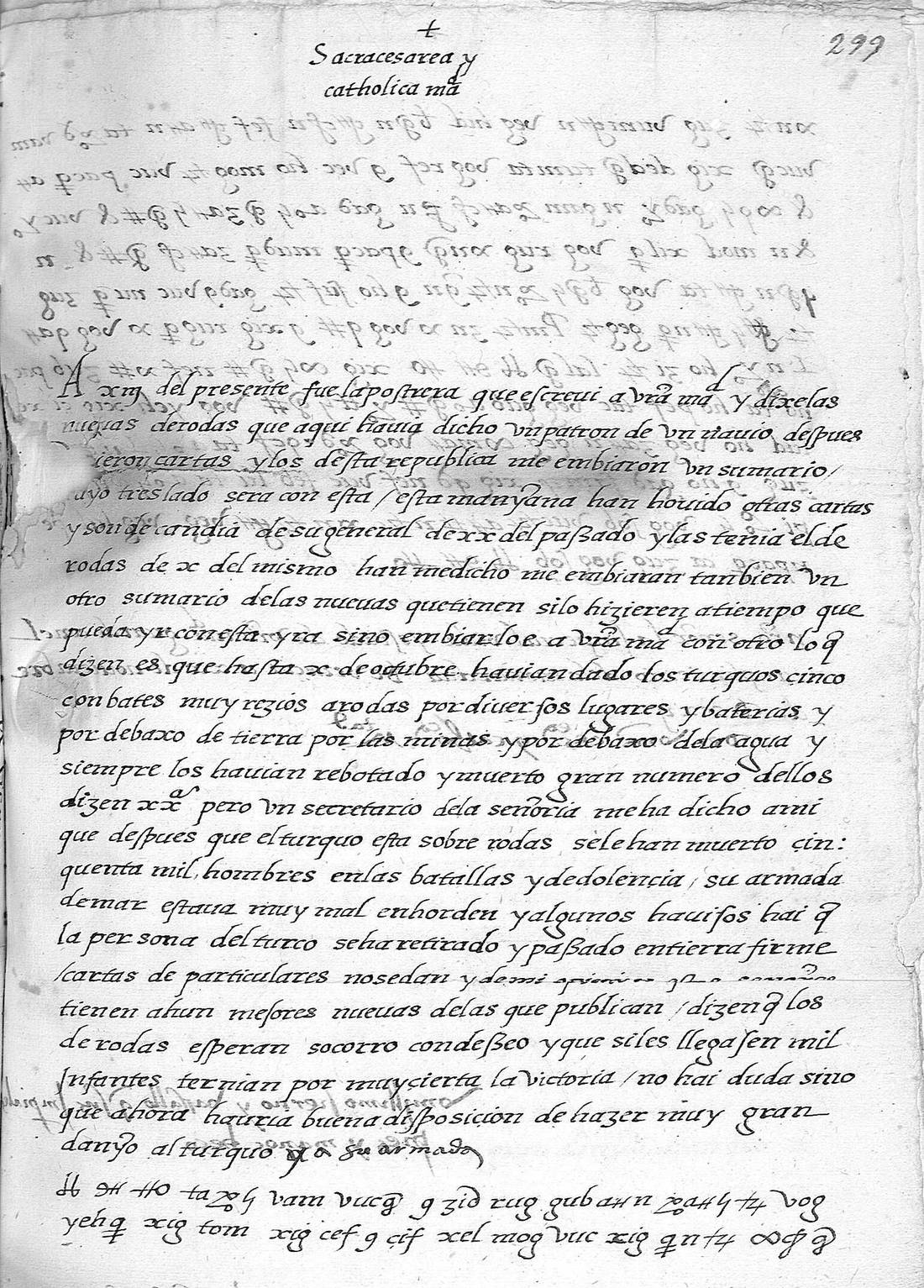
The clear middle, transcribed from the image:
A xiij del presente fue la postrera que escreui a v[uest]ra m[agesta]d y dixe las nueuas de Rodas que aqui hauia dicho vn patron de vn nauio; despues [vinie]ron cartas y los d’esta republica me embiaron vn sumario, cuyo traslado sera con esta. Esta manyana han houido otras cartas y son de Candia de su general de xx del passado, y las tenia el de Rodas de x del mismo. … Lo que dizen es que hasta x de octubre hauian dado los turquos cinco conbates muy rezios a Rodas por diuersos lugares, y baterias, y por debaxo de tierra por las minas y por debaxo de la agua, y siempre los hauian rebotado y muerto gran numero dellos — dizen xx mil. Pero vn secretario de la Señoria me ha dicho a mi que despues que el turquo esta sobre Rodas se le han muerto cinquenta mil hombres en las batallas y de dolencia; su armada de mar estaua muy mal en horden, y algunos hauisos hai que la persona del turquo se ha retirado y passado en tierra firme. … Dizen que los de Rodas esperan socorro con desseo, y que si les llegasen mil infantes ternian por muy cierta la victoria. No hai duda sino que ahora hauria buena disposicion de hazer muy gran daño al turquo y a su armada.
Rhodes capitulated a month after this was written, on 22 December 1522.

The second line runs yeh+plural xig tom xig cef y cif xel mog vuc xig …: “cartas de Francia de xxvi y xxvii del passado de …”: letters out of France of 26 and 27 October, the month in which Francis I’s position in Lombardy collapsed. It is this pair of dates that confirms cef and cif. The first line gives ta es, vam embaxa(dor), vuc+plural, zid a(h)un, rug la, gub señor, vog en, around spelled-out letters not yet settled.
A small corroboration from the other end of the group: Lope Hurtado’s letter of 9 November (R9648) opens in clear “La carta de V. M[agestad] recebi de xxvj de octubre”, the same post that Sánchez reports reaching Venice.
06R9635: a full page of cipher, deciphered in part
R9635 is Sánchez to Charles V, Venice, 16 September 1522, Salazar 9/26 f. 20–22, calendared in CSP Spain vol. 2 p. 482 and also beyond Tomokiyo’s list. Folio 20r is the best ciphertext page in the group: about twenty-five lines of cipher, whole-page, in a clean well-spaced hand, with a contemporary decipherment written between the lines in lighter ink. The decipherment covers only patches, so most lines have to be decrypted with the key.
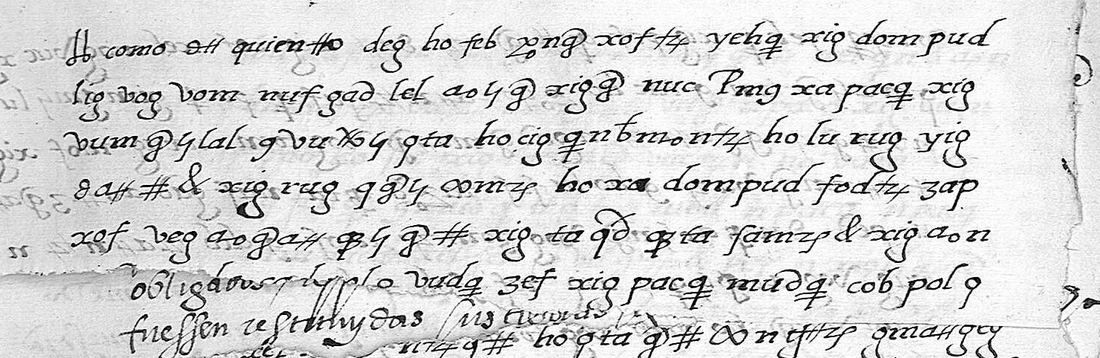
| cipher | reading |
|---|---|
xof+s yeh+s xig dom pud | das cartas de vuestra magestad |
pac+s xig vum gɣ lal | los de esta republica |
xel gub rac | del señor infante |
vud+s zef xig pac+s mud+s cob pol9 | ducados allende de los otros xviii mil |
ped xig cab pol9 vud+s | mas de xv mil ducados |
faf+s pac+s … pol9 vud+s pic xig vom | todos los … mil ducados luego de esto |
| interlinear gloss | obligados … fuessen restituydas sus bienes |
The subject is money and reprisals: the sums owed by the Signoria under the capitulation (eighteen thousand ducats outstanding from a previous year, more than fifteen thousand in another reckoning) and, in the glossed lines, goods seized that were to be restored to their owners. That is the same business as the sequestrations of imperial vassals’ goods at Venice which fill R9638 (11 October 1522) entirely in clear, and the same reckoning of xx mil ducados allende de xviii mil that Tomokiyo deciphered in the last paragraph of R9623.
Two points of notation, which the page settles: pol9 is pol (mi) followed by the letter sign for l, giving mil; that sign is easily taken for a g in this hand; and gɣ lal is the spelled letters r-e followed by lal (publica), giving republica, the word these despatches turn on.
This page also attests cab = xv, in mas de xv mil ducados, the third of the numerals predicted from the ordering rule, after cef and cif in R9653. None of the seven is contradicted.
07The letter alphabet, and a misidentified sign
Tomokiyo gives the substitution alphabet only as a hand-drawn table. Measured off the table at high zoom, it has about thirty signs over twenty-two letters (a b c d e f g h i l m n o p q r s t u x y z), most of them with two or three homophones: a = n, ʒf; d = ∞, 3, ɸ; g = bold ∞, L; n = ᶻ, ℞₄; and so on.
Two results follow. The “q with a double bar” is the letter s, and there is no separate plural marker. The plural ending is the letter s written after a code group, so Tomokiyo’s guess that it “may well be the plural ending -s” is right, for a different reason. And r is a different sign, a q with a loop, easily confused with it in this hand.
The map is carried in alpha.py and checks out on spelled runs taken from R9635 f. 20r: nx#gn = ahora, ttn#n = nada.
At this stage it did not yet give the spelled runs continuously, for the following reason. Tomokiyo transliterates the code groups with latin labels drawn from a set that includes v, which is not one of the twenty-two plaintext letters; the code labels and the alphabet therefore do not share one transliteration, and every sign has to be matched to both by eye. At the resolution DECODE serves, telling apart the homophone pairs Ɋ (r) and ǂ (s), 9 (l) and Ɋ (r), ∞ (d) and bold ∞ (g) is a judgement call at each occurrence, and getting it wrong silently produces plausible-looking Spanish that is not what the page says. So the runs are left marked rather than filled in.
The remedy is in the glosses: collate the patchy interlinear decipherment on R9635 f. 20r word by word against the signs beneath it, which fixes each homophone in this scribe’s hand; the unglossed lines and the rest of the group then follow. That is edition work against a published key, not cryptanalysis.
08R9605: the cipher aligned with the clerk’s decipherment
R9605 (9/24 f. 39–44, 7 May 1522) is the record from which Tomokiyo recovered the key, and its images show why: the cipher and the clerk’s full contemporary decipherment sit on facing leaves. Aligned at the end of the letter, where the clear reads Plegue a Dios no lo yerre en el camino. De Venecia a vij de mayo 1522:
| cipher | plaintext | how |
|---|---|---|
nuf | no | code |
pac | lo | code |
ɡɣβ4q4 | yerre | spelled |
vog veg | en el | code — Tomokiyo’s own way in, met here in situ |
zn·β·aɤ + nuf | cami + no = camino | spelled, then a code group used for the last syllable |
Two results follow that the key alone could not give. Code groups stand for syllables as well as whole words: nuf is no the adverb in one place and the final syllable of cami-no in the next, so a decryption that treats every group as a word will divide the text wrongly. And the lookalike signs are distinct: camino needs β = m, ahora (nx#Ɋn, R9635 f. 20r) needs Ɋ = r, and the bold ∞ is g. All three are a “g”-shape at the resolution DECODE serves, and they are the single largest source of error in the spelled runs.
Continuing the same passage against the clear “la venida del visorey con todas las postas, que despacho y escrivo” gives three more results. xel def = del visorey and ded+xof = veni+da = venida, verbatim. The spelled run for escrivo is seven signs for seven letters, fixing z = c, ɡ = r, aɤ = i, m = v, # = o with the known plaintext above them. And va = despacho, not “desponho”: Tomokiyo’s table gives a word that is not Spanish, where the clear reads que despacho y escrivo with ho = que and va in that slot. It also explains his puzzled “me desponho x-e-r-o-n que” in R9623. A correction to the published key.
One check came out inconclusive and is recorded as such. The clear at “que fue a …” stands over the group cud, which Tomokiyo gives as “xxiv?”; had the clear read xxv, the whole c-block series would shift by one and the values predicted here would be wrong. It does not settle the question: the date is written over a correction and reads as something like xxv y xxvij, two dates rather than one, so it cannot be matched to a single group. cab, cef and cif do not depend on it: each was confirmed in its own context, independently of where the run starts.
The same alignment runs from the very first word of the letter. Clear (f. 42): “Ya dixe a V. Mag. que el embaxador de Hungria fue respondido de los desta republica con buenas palabras…”; cipher (f. 39r ll. 1–2): cig = ya; vu·o·ɣ = di+x+e = dixe; dom pud ho veg = vuestra magestad que el; vam vuc·ɡ = embaxa+do+r = embaxador; n·℞·∞ ɡ·aɤ = Hun-gria, spelled across the line break; sa = fue; ɡ·ɣ·q·ao·#·& vu vuc = r-e-s-p-o-n + di + do = respondido; xig vum ɡ·ɣ lal = desta republica; xa yuc·n+s = con buenas.
None of this is conjecture: the clerk’s plaintext corresponds to every group on the facing leaf. It fixes the sign table against a known plaintext instead of by eye: n=a, ɣ=e, ɡ=r, aɤ=i, o=x, #=o, q=s, ao=p, &=n, m=v, z=c, β=m, and the q-with-double-bar = s. (q=s here against Tomokiyo’s alphabet column q=t: two similar glyphs, and the pair to watch next.)
Applied to R9635, which has only patchy glosses, the table alone does not decrypt it, which corrects the diagnosis above. On R9635 f. 20r the first line is ‖ como ‖ quien ‖ deg ho feb ʒnɡ xof+s yeh+s xig dom pud. The tail is secure (das cartas de vuestra magestad), and the null padding matches R9605 exactly. But deg, feb and ʒnɡ resolve to nothing: none is in the nomenclator, and the last spells y-a-r, which is not a word. Sense wants recebi in that slot, whose code is hug, unlike anything written there.
So the obstacle lies in the step before the sign table: turning the cursive shapes into labels. R9605’s hand and R9635’s differ enough that a shape read confidently as d in one is something else in the other, and a wrong label yields a code group that either does not exist or exists with the wrong value. The alignment has to be done on the image, glyph against the clerk’s word above it, building a reference set of each sign as this scribe forms it, instead of transcribing to labels first and resolving afterwards. That is slower and more reliable.
R9605 and R9613 are therefore not counted as results here: the Emperor’s clerk deciphered them in 1522, on the facing leaves. Transcribing that clear text gives a continuous plaintext of those letters, which is an edition of a 1522 decipherment. The records with no contemporary decipherment have no such facing plaintext.
The next step is to align the whole of R9605’s cipher against its decipherment, several hundred signs of known plaintext, to fix each homophone in this scribe’s hand, and then carry it to the unglossed pages.
09Transcription: how the page is written
The failure reported above came from a wrong assumption about how the page is written; correcting it made the page decipherable. Everything here is written in ordinary latin-looking cursive. The two systems are told apart by shape-length and context: three-letter latin trigrams are nomenclator codes (xig, vog, dom, pud, lig, nuc), looked up in Tomokiyo’s table; single letters and short runs between them are the substitution alphabet, where the letterform and the value differ: n=a, y=e, g=r, o/✗=x, #=o, ao=p, m=u/v, z=c, β=m, 9=l, q-with-double-bar = s. Three nulls open each paragraph, padded with the clear words como and quien.
Verified on R9605 f. 39r l. 1 against the clerk’s plaintext on the facing leaf: cig vu·o·y n dom pud ho veg = “Ya dixe a vuestra magestad que el”, with vu(di)+o(x)+y(e) = dixe.
With that, the page can be deciphered. R9635 f. 20r ll. 2–3 give continuous text:
lig vog vom nuf gad lelao-y-g-xig-gnuc…xa pac+sxig vumg-y-lal
= “pues en esto no se puede perder nada … con los de esta republica”
Two things in that sentence are new. lel = puede, a code Tomokiyo did not recover: it falls between lal publica and lol pudi, and the sense fixes it. And perder is written p-e-r + xig (de) + r: a code group used inside a word for a syllable, the same pattern R9605 showed with cami + nuf(no) = camino.
Line 9 gives an independent check: nul (obliga) + vuc (do) + s = obligados, the word the 1522 decipherer wrote in the gloss above that stretch. Key, alphabet and gloss agree without being fitted to each other.
Further down the page: pef pac ho zel xig a-h-o | r-a = me lo que antes de ahora; yig (capitula) + c-i-o-n = capitulacion; and ho hob hec ho pac+s = que quien Inglaterra que los, with hec = Inglaterra; the English ambassador at Venice is a running subject of these months.
Lower on the page: vom+s cad pol-9 xig a-h-o-r-a = estos xx mil de ahora; ao-# xig g pac suf-z-e-r lu-ho = poderlo hazer, porque; and rug+s lul ta = las quales. The last examples show the converse of the stem-plus-ending pattern, codes run together to make one word: lu(por)+ho(que) = porque, lul(qual)+ta(es) = quales, suf(ha)+z-e-r = hazer.
The page closes with darian todos los …, no pude …, si no se … en …, and then opens a fresh paragraph with the same three nulls and pac+s xig vum r-e-lal = los de esta republica. One code there, cag, is unassigned in Tomokiyo’s table and sits at the end of the numeral run immediately before cig (ya); cag = xxx is the natural continuation and suits the sense, but it is one slot past where the run is attested and is left probable, not certain.
Line 5 gives xof veg + p-r-i-m-e-r-o + xig ta = da el primero de es[te], which fixes β = m on this page independently of camino in R9605; and at high zoom the ending of capitulacion is the curly second form of c that Tomokiyo draws as a backwards 3, so that word is settled rather than inferred.
Every line of f. 20r now has at least a partial decipherment. Continuous or substantial: ll. 2–6, 9, 10, 11, 13, 15, 17, 18, 20, 22, 23, 25, with the passages at ll. 7 and 14; partial, with runs still unresolved: ll. 1, 8, 12, 16, 19, 21, 24. The subject, the sums, the parties and the drift of the argument are deciphered throughout the page, while a scatter of spelled runs inside partially deciphered lines stays open. It is not a word-perfect diplomatic edition and is not offered as one. (The crops were cut by dividing the written area into twenty-five equal bands, so the line numbers are approximate; each decipherment is tied to its own words.) The remaining runs need the same transcription work and no cryptanalysis; they are left untranscribed rather than filled in by inference. One token resists: gta, a dozen occurrences, cannot be a code (its middle position is not a vowel) and is most likely g (y) + ta (es), but that does not sit well everywhere and is left unresolved. The edition is in targets/sanchez1522/edition/.
Folio 21 is two further full pages of cipher, denser than f. 20r, with the decipherer’s gloss obligados … fuessen restituydas sus tierras continuing across it. One paragraph on the right-hand leaf, marked A in the margin, is written entirely in the clear, and it names the English ambassador:
M[icer] Ricardo Paceo, embax[ad]or de Inglaterra, me ha dado el incluso memorial y rogado que escriva a v[uest]ra m[agesta]d suplicandole por las cartas que dize para el Papa y para don Joan. Sup[li]co a v[uest]ra m[agesta]d muy humilmente, con primero las mande enbiar, pues es persona que merece toda buena obra de v[uest]ra m[agesta]d, por ser muy servidor suyo y aficionado &c.
Richard Pace, Henry VIII’s envoy at Venice, has given Sánchez an enclosed memorial and asked him to press the Emperor for the letters he wants for the Pope and for don Juan, that is Juan Manuel, the imperial ambassador at Rome, whose own 1522 cipher Tomokiyo reconstructed in the same article. Sánchez seconds the request warmly. This fixes the identification behind hec = Inglaterra met on f. 20r, and it is the same Pace who opens R9631 in Tomokiyo’s list. The two leaves of f. 21 are not yet transcribed line by line.
10Lope Hurtado de Mendoza writes in a third cipher
The nine Lope Hurtado records bound in the same volumes look at first like more of the same: the same period, the same recipient, cipher mixed with clear inside the sentence, code groups of the same shape. They are not in Sánchez’s cipher.
The test is the third position. Sánchez’s codes end strictly in b c d f g h l m n. Folio 260v of R9648 gives tep, tap, and groups ending in z, finals that Sánchez’s key does not contain. Juan Manuel’s Rome cipher, by contrast, does use p r s t z as finals (jap papa, jir, jus, boz, qat). So Lope Hurtado’s key is a third member of the family.
Whether it is Juan Manuel’s own key is not settled here. None of the groups legible on that leaf (ton, tep, tap, xul, xild, zar, xurzun) has a value in Tomokiyo’s Juan Manuel table either, but that table is itself a partial recovery, so their absence decides nothing. Several of these records carry contemporary decipherments, so the key is recoverable by the same route Tomokiyo took; they need a separate target.
11What is open, and how reliable the decipherment is
- The six-line head paragraph of R9653 f. 299r is not transcribed. Ink has bled through from the facing leaf and at the resolution DECODE serves the two hands cannot be separated reliably. Transcription, not cryptanalysis, is the obstacle.
- R9653 f. 300–301 and R9635 f. 21–22 have not been examined.
- On R9635 f. 20r the spelled-out letter runs between the code groups are only partly transcribed, so the page has continuous sense but is not yet a continuous text. Collating the patchy interlinear glosses line by line against the cipher would settle the letter alphabet in this hand and close it.
- The other twenty-seven records are untouched here. Most have a contemporary decipherment bound in, so the work is transcription and edition against the published key.
- Lope Hurtado’s key is unreconstructed.
- Grades. The resolved run of R9653’s foot paragraph is graded C: certain on the code groups, which are unambiguous against the published key and make continuous sense. The remainder of that paragraph and the whole head paragraph are I, incomplete. The clear middle is a transcription of ordinary Spanish secretary hand and carries no cipher grade; two words in it are conjectural and marked with brackets above.
cofxxviii,cufxxix,cabxv,cebxvi,cibxvii are predicted, not observed, and are flagged as such in the key file.
12Sources
- Biblioteca de la Real Academia de la Historia, Colección Salazar y Castro, Signatura 9/23, 9/24, 9/25, 9/26. Images consulted through DECODE under login; not reproduced beyond the crops above.
- DECODE, records R9593–R9657 (and R9499–R9529 for Juan Manuel). R9653, R9648, R9605.
- S. Tomokiyo, Correspondence in Cipher of Imperial Ambassadors Alonso Sanchez and Juan Manuel (1522), Cryptiana, 6 September 2025. The reconstruction of the key is his. Archived in the folder as
tomokiyo/. - Calendar of Letters, Despatches, and State Papers, Relating to the Negotiations Between England and Spain, vol. 2 (1866), nos. at pp. 382–485, which calendar many of these letters from the contemporary decipherings.
Working files, the DECODE metadata table, the key with its predicted entries, and the decipherment: targets/sanchez1522/.