
01 The document and the key
The record has four images. Page 1 holds four cipher lines and the clear text beneath. Page 2 is a clear Dutch letter headed “Den 7 Mey 1795”, beginning “Weest zoo goed en zegt aan mijn Broer dat hij een brief van mij onder couvert van mijn Banquier … ontfangen moet hebben”. It speaks of money drawn on the banker, a bill of exchange, and letters from Hamburg that never came. One word in it is ciphered: 24 43 25 55 15 15 65 = famille. Pages 3 (17 lines) and 4 (8 lines and a postscript) are all cipher.
The key is R1892’s (see that write-up): 11 t, 12 w, 13 ij, 15 l, 21 z, 22 o, 23 k, 24 f, 25 m, 31 d, 32 n, 33 v, 34 h, 35 b, 41 g, 42 u, 43 a, 44 s, 45 p, 51 c, 52 r, 55 i, 65 e; the circle with a dot is de.
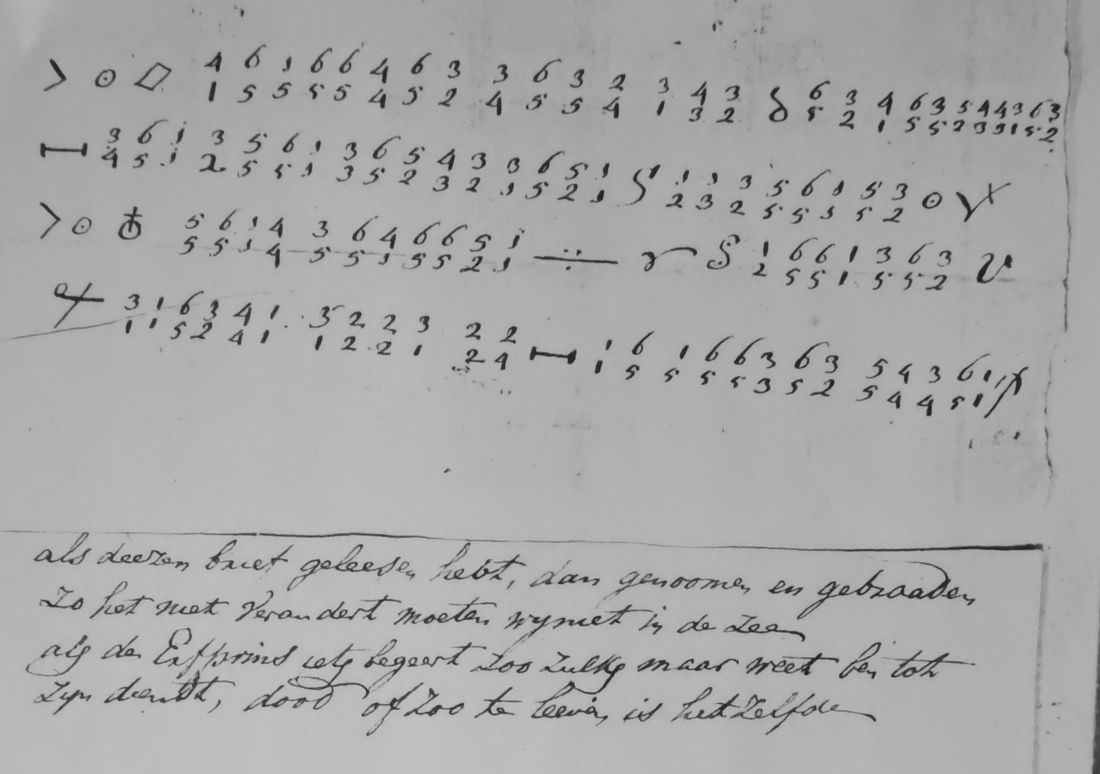
02 Page 1, with its clear text
als deezen brief geleesen hebt, dan […] genoomen en gebraaden. Zo het niet verandert, moeten wy niet in de Zee. Als de Erfprins iets begeert, zoo zulks maar weet: ben tot zijn dienst, dood of zoo te leeven, is het zelfde.
“When you have read this letter, [it is] taken and roasted. If it does not change, we must not [go] to sea. If the Hereditary Prince wants anything, let him only know it: I am at his service; dead or alive, it is all the same.” Word signs fixed by this page: >⊙▱ als deezen brief; δ genoomen; H-bar zo/zoo; long S moeten; ⊙Y de Zee; >⊙♁ als de Erfprins; ÷ zoo; ɣ zulks; § maar; v tot; crossed 8 zijn; ʃ zelfde.
03 Pages 3 and 4
Deciphered with the key; | marks a word sign not decoded, [ ] a restoration.
… [van] onse alliansie met [Frankrijk] geeft | ook verandering. Men heeft de officier[s] en de trouppes [zoo] wel [uit] malkander gelegen … is | staat op veele der gedimitteerde offeciers te maaken; men zi[et] | niet veel | stellen. Ook is er geen de minste saamenhang tussen | [z]elve, zij [zijn] geheel verstrooijd … hooft … natuurlijk zoude | zig | zouden toonen hebben … de politiken ook | verslappen … op vertrouwen … men zig | niet te veel op[laten] … het point der coalitie met alle … men heeft de ratificatie [van] ons met [Frankrijk] gepubliceert, of schoon de ratificatie zelver nog niet gekoomen was; het was op | echte [brieven] [uit] Parijs [van] onse ministers Meier en Blaauw, en nu zijn nog | [Frankrijk] [als] ambassadeurs gesonden om [de] ratificatie van onse | over te brengen; [als] | maar blijft persisteeren [om] het tegenwoordig gouvernement niet te erkennen, dan zoo zij geen Robespierismus durven te introduceeren … zeer veel dispositie … is mijn respect … het geheele geselschap … groet mijn broe[der].
The news fits London in late April and early May 1795. Prussia had made peace with France at Basel on 5 April and ratified it that month; the Batavian Republic was negotiating the Treaty of The Hague (16 May); and the Orange émigré troops, dismissed or scattered after the flight of January, were the subject of R1892. Read with the values proposed for the graphic signs on 30 Sept 2026 (section 04), the ratification is that of the Dutch treaty “with France”, reported from letters of the Dutch ministers in Paris, Meyer and Blauw; that would date pages 3–4 to after 16 May 1795, later than the clear letter of 7 May.
04 What remains uncertain
- About twenty word signs on pages 3–4 (Λ, ∞, Δ, & and others) are not decoded; context proposes none of them with confidence.
- Signs read from context on 30 Sept 2026 (grade I unless stated): script L = uit (“[uit] malkander gelegen”, “[uit] Parijs”, and the P.S. “[uit]landig”); the flagged D-shape (not the plain Δ) = van (“[van] onse alliansie”, “de ratificatie [van] ons met”, “[van] onse ministers”); φ = Frankrijk (“onse alliansie met [Frankrijk]”, “ratificatie van ons met [Frankrijk]”); ⊥ = om (M: before a te-infinitive here and in R1892 p2, “[om] op antwoord te wagten”); > = als and H-bar = zoo (H, fixed on page 1); the parallelogram = brief (H, page 1), plural brieven by grammar. If φ is France, the treaty is the Batavian alliance with France (The Hague, 16 May 1795), and pages 3–4 would be later than the clear letter of 7 May.
- The transcription was made by a language model from photographs of photocopies. Several pairs are doubtful: p3 line 1 (“wat ze id men”), p4 line 8, and single letters in saamenhang, ministers and coalitie (grade C). The overall sense of pages 3–4 is H; individual clauses between signs are M.
- “Robespierismus” is clear (H); whose recognition of “the present government” is meant depends on the sign & before “maar blijft”, not decoded (England is a guess, not a reading).
05 Sources
- DECODE R2242, images I15891–I15894 (login); Koninklijk Huisarchief, The Hague, Koning Willem I, inv. XVIII-3.
- The key: DECODE R1892, key recovered from the ciphertext alone in this project (write-up).
Transcriptions, decrypts and notes: targets/r2242/ in the repository.