

01 The document
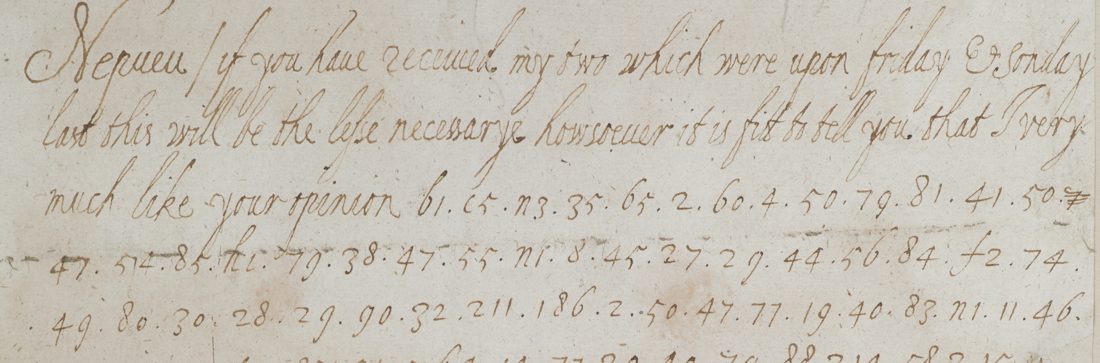
One page in the King’s hand, dated “Oxford 29 April 1645” and marked “Duplicate”, the second copy sent by another route. It opens in clear: “Nepueu, if you have receaved my two which were upon friday & sonday last this will be the lesse necessarye, howsoeuer it is fit to tell you that I very much like your opinion”. The cipher then runs almost to the foot, with a few clear words kept inside it (“I have”, “yett will”, “but what”, “order”, an “&”, “assuringe you that”). It closes “upon the word of your loving Oncle & most faithfull frend, Charles R.” The dorse is endorsed “From the King, Oxford Ap. 29 1645, Cypher”.
02 The key
The letter uses Lasry’s “TNA SP106-5” key, reconstructed in 2020 from Henrietta Maria’s circle’s letters of January 1646 (TNA SP 106/10 f. 247). Its alphabet is homophonic: E = 1–5, A = 14–17, T = 78–80, and so on. Its nomenclator groups include a1 = and, a4 = be, c5 = for, e5 = in, f2 = it, h1 = no, k1 = of, n1 = to, n3 = the, p6 = which. It was applied without change.
The key has no values for the groups 81–98. Most of them stand at the end of a phrase and act as nulls or stops. Two recur with a meaning fixed by context: 95 = my and 98 = artillery (“transport my artillery to you”, “bring my train of artillery”). Several letter+digit groups the key leaves blank are fixed by context: c2 = do, b2 = can, k4 = nor, and 412 in “412-ant” = warr(ant).
Before the key was found, two other ciphers were ruled out. The Duke of Richmond’s cipher, used in the sibling letter of 31 July 1645 (R4922), has letter values above 100. The Digby–Walsingham key (R8724) is a different system. A ciphertext-only homophonic solver on the numbers alone did not converge.
03 The decipherment
Modernised spelling; groups still open and values supplied from context are in square brackets.
Nephew, if you have received my two which were upon Friday and Sunday last, this will be the less necessary; howsoever it is fit to tell you that I very much like your opinion [61] for the present. Know [that] to [?thow] to follow it until I [211 186] enough to convoy, and draught [horses] enough to transport my artillery to you; to which [c1: end?] I have sent for Goring, who I hope (yet will not warrant) to be able to do both. But what [d4] can not [be done] if you do not [376] all our [148]s be in order: therefore I desire you to [327: march] speedily for my assistance, that in case I can not bring my train of artillery to you, you [may] come and fetch it; assuring you that no time shall be lost, nor pains spared for doing of this, if it be possible, upon the word of your loving uncle and most faithful friend, Charles R.
It agrees with Digby’s letter of 27 April, printed by Warburton (iii 77–78): “since your Highness says, you cannot relieve the place without the train, and that it is not possible for the King to bring the train to Prince Rupert…”. It also agrees with Digby’s of 30 April, which asks Rupert for one hundred draught horses.
04 What remains uncertain
- Code groups not in the key and not fixed by context: 61, 211, 186, 214, 376, 148, 327, c1, d4, e4 (probably if), o1, 03, 05. Grade: the sense around them is certain (C); the group values given in brackets are conjectures (M).
- 95 = my and 98 = artillery: each fits in three places that agree (C).
- “You [may] come and fetch it” (until 30 September 2026 this page printed “you may come and fetch it”). “You” is 68 4 75, y-e-u as written; the 4 stands at the torn edge of the line and is probably 45 (o) with its 5 lost. The next groups, 86 and 93, are outside the key and elsewhere mark the end of a phrase (after “to you” and “I hope”). “May” therefore has no group of its own and is supplied from the sense; the key’s group for may is g3. “And” is not a cipher group but a clear “&” in the King’s hand, the same sign as in “friday & sonday” and “Oncle & most”. It was first transcribed as e5, which is in on the key and is written much smaller in its three other places.
- A few letter strings are off by one symbol: “eravght” (draught), “seaevgh” (…s enough), “thow”. These are either the King’s slips or misreadings of the scan.
05 Sources
- British Library, Add MS 18983 f. 14; DECODE record R4921 (images login).
- George Lasry, reconstructed key “TNA SP106-5”, 2020, on DECODE R929.
- BL Add MS 32256 f. 5, DECODE R9116: a tally of the King’s cipher with the Queen.
- Eliot Warburton, Memoirs of Prince Rupert and the Cavaliers, vol. 3 (1849), pp. 77–81.
Notes, transcription, decipherment and profile: targets/rupert1645/ in the repository.