01 The two poems
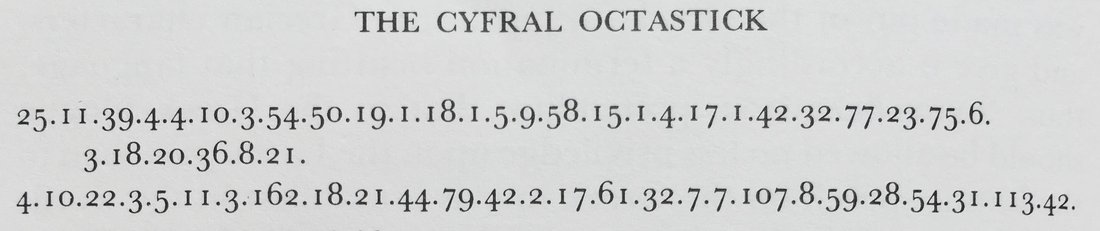
The distich stands under the heading “THE CYPHRAL DISTICH” after the thirty-two Proquiritations that close Logopandecteision, followed by six lines promising that “an honest skilful man” will find in it “his own heart’s wishes, and the Author’s minde”. Reticuli Labs showed on 1 September 2026, and the 1834 Maitland Club reprint confirms, that this page is in the 1834 Works (p. 417) and not in the British Library’s 1653 copy. The octastich stands on the last leaf of The Jewel (1652), a leaf missing from every digitised copy; its public transcription is Klaus Schmeh’s, from a scan sent him in 2014, and the HCPortal record holds a scan with the verse beneath it, which a reader quoted in 2019:
To this Octastick if you will subjoyn / A Decagram of this same stuff of mine, / All gather’d out of my Exskybalorum, / You’ll find a Rule by which, with great decorum, / You may most comfortably regulate / Your actions, thoughts and speeches; and know that / I love an aphaeresified treason / Better then any prosthesized reason.
Aphaeresis is the loss of a word’s first letter. Urquhart says, in his way, that the cipher is made of initials taken out of his own book.
02 A test that never sees the plaintext
A book cipher of this kind is normally judged by whether the letters it yields make sense, which invites the objection that a determined reader can make sense of anything. Urquhart’s habit removes that objection. If he scanned each page from the top and stopped at the first word beginning with the letter he needed, then for the right page the number he wrote is the index of the first word of its own initial. That is a property of the number and the page alone. For a wrong page, or a wrong rule, it holds at the base rate, which in this book is about 43 % for a random page and index because small indices are common and the first few words of any page are first occurrences by construction.
The EEBO-TCP transcription of The Jewel was parsed into word lists per page. The 1652 printer numbered pages 34–35, 38–39, 42–43 and 46–47 twice and skipped 60 and 110, so pages are counted physically from p. 1, and three duplicated page breaks that the TCP carries for re-shot images are removed. Schmeh’s 272-number transcription, the only one in circulation since 2015, omits the run-over lines of stanzas 2 and 6, one figure, and misreads one; a dynamic-programme alignment that may skip pages still placed it at 231 first-occurrence hits in 267 and decrypted five lines. The photographs of the 1983 edition on the HCPortal record give the full 285, which then decode straight, one number per page.
| Run | First-occurrence rate |
|---|---|
| The 285 numbers, one per physical page | 0.838 (238/284) |
| Same numbers shuffled, 200 trials | mean 0.434, max 0.491 |
| Numbers in order, pages randomly permuted, 200 trials | mean 0.436, max 0.509 |
| Schmeh’s 272 numbers, aligned with page skips | 0.865 (231/267), vs 0.686 shuffled and re-aligned |
| Distich, i-th number into i-th Proquiritation | 0.53 (34/64), no English |
| Distich, shuffled, against pages of The Jewel, 100 trials | mean 0.50, max 0.62 |
Line 1 alone makes the case: 28 of its 33 numbers are exactly the first word of the needed initial on physical page k, and the other five are one word off (25 for 26, 18 for 17, 23 for 22, 75 for 74) or a TCP variant, which is the size of difference one expects between a modern tokenisation and a 1652 page.
03 The decryption
Capitals are first-occurrence hits, lower case a word a few places off in the TCP tokenisation, _ the one page (physical 158) whose text the TCP
does not carry. The right-hand column is the plaintext.
wREATLORDMApTAInETHATREGtaFAMILIE          Great Lord, mantaine that regal familie
WtEREOFKINGCHARLStHaStCONtISTaEHiAD        Whereof King Charls the second is the head
ANDGRAnTTHatHEDAYBEARETHEFUPaEMESgEIGS     And grant that he may beare the supreme sweigh
WHERDENGLIsHSCoTSANDIOSoAREBORNEANDBRED    Where English, Scots and Irsh are borne and bred
AaDCOnERTHTO_aIttSUaPDApTHORIEIE           And [conerthto?] this usurp’d authoritie
REIGtEINMISnOtALPREDECESSORSSifAt          Reigne in his royal predecessors stead
SETHpLBEOURSOLtCESAtAmtaRHECBOR            Let him be our sole Cesar, Artur, Hector
OeREMPoRPUwJINGMONARCHANDPROTECTOR         Our Emperour, King, Monarch and Protector
AMsNSOwLtt                                 Amen, so be it
The decryption agrees with Vals’ published plaintext throughout, including the nine letters of line 5 that neither decryption resolves (conerthto, pages 149–157, eight of them exact first-occurrence hits) followed by the one letter on the TCP’s near-empty page 158. Their “one page used twice from position 159” is that page. Sweigh is Scots swey, “sway”; mantaine, Charls, Cesar and Artur are period spellings. The text is a royalist prayer for Charles II, written in London in March 1652 by a prisoner of Worcester, hidden in a book dedicated to the vindication of Scotland.
04 The distich does not follow
The same test applied to the distich under Vals’ Proquiritation rule, using Reticuli’s tokenised Proquiritations, yields 34 first-occurrence hits in 64 and the string
NTMAMNDN_OHTISEABRPTTSGSNTAATVTD, not O God uphold King Charls the second. Texts of thirty to a hundred words give high base rates, so 34 of 64 is
chance. Page-index variants on either book, with either numbering, with the second line restarting at page 1, all sit inside the shuffled control. Reticuli’s ten
infeasible positions stand. The distich is a different construction, or the same construction on a text not yet tried; no decipherment of it is established.
05 What remains
- Ten letters of line 5 (positions 151–160): nine decode as conerthto from the TCP text and one falls on a page the TCP does not carry. A misprint of the 1652 numbers, a miscount by Urquhart, or a divergence between the filmed copy and the print at pages 149–158; the 1652 leaves would settle it.
- The 46 positions where the TCP word is not the first of its initial are one to a few words off, tokenisation differences; they do not change the decryption.
- The distich.
06 Method and reproduction
In targets/urquhart/: ct.py holds both transcriptions of the octastich; pages.py parses the TCP XML of A95749 into pages under both
numberings; decode_1983_full.tsv gives every position with page, word, letter and first-occurrence flag; align.py is the alignment used on the
defective transcription; the controls are in the notes. The TCP text comes from the Text Creation Partnership’s GitHub mirror; the 1983 page photographs from the
HCPortal record, whose API answers at api.hcportal.eu.
07 Sources
- Sir Thomas Urquhart, Ekskybalauron: or, The discovery of a most exquisite jewel (London, 1652), EEBO-TCP A95749; Logopandecteision (London, 1653), EEBO-TCP A64608.
- The Works of Sir Thomas Urquhart of Cromarty, Knight (Maitland Club, Edinburgh, 1834), p. 417, “The Cyphral Distich” — Internet Archive worksofsirthomas00mait.
- Klaus Schmeh, Cipherbrain, 29 April 2015; 30 June 2017 (Top 50 no. 28); 28 July 2019 with the readers’ comments quoting the HCPortal verse.
- Vals AI, “Claude Fable 5.1 Solves the Cyphral Distich”, 31 August 2026.
- Reticuli Labs, “distich-refutation-2026-09-01”, GitHub, 1 September 2026, with the tokenised Proquiritations used here.
- HCPortal, cryptogram record 7 (Urquhart), Eugen Antal, with photographs of Jack and Lyall (eds), The Jewel (Scottish Academic Press, 1983), p. 212 and facing.