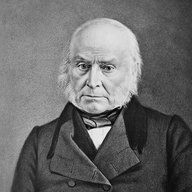
01 Adams: the premise checked
The starting point was a note the Madison editors attach to Armstrong’s letters (Founders Madison/02-10-02-0369 and 02-12-02-0197): the code was “also used by John Quincy Adams at St. Petersburg and by Jacob Lewis at Saint-Domingue; key not found but substantially reconstructed by the editors”. On Adams to Madison, 7 January 1811 (03-03-02-0121), the editors speak of “a code provided by the State Department to John Armstrong in France and to both William Short and Adams”, citing Ford 3:328. If that held, the 580-group Armstrong table already rebuilt on this site would decrypt Adams’s coded despatches. It does not.
- What Ford’s own text says. Secretary Smith’s instructions of 1809 (Ford 3:327–28) say that “the cypher with which you are furnished” is “the same with that of our minister at London” (William Pinkney), and tell Adams to “obtain at Paris, a copy of General Armstrong’s cypher also, for the like purpose”, that is, to correspond with Armstrong. In 1810 Adams acknowledges “the copy of General Armstrong’s cypher” (Ford 3:370). He held both. The despatches to Washington use the other one.
- What the microfilm shows. Every coded despatch checked on M35 reel 3 (1811 and 1812) uses a code in which 1385 = the, 1576 = of, 1384 = that, 668 = and, 1401 = I. In Armstrong’s code the is 972 and of is 1354. Run through the Armstrong table (592 entries as it now stands), these pages come out as noise. Reel 2 frame 0155, of 1810, is in the same Adams code.
So the table already held cannot decrypt Adams’s despatches. The editors’ note on the 7 January 1811 letter concerns a private letter to Madison, not a despatch, and was not checked against its manuscript, which is in the Forbes collection and not online; it may be right for that letter.
02 Adams’s code rebuilt
The method is the one used for Armstrong on M34 roll 13, with a second source added. On M35 reel 3 the Department clerk wrote the decode above the groups of several despatches; every pair on frames 0047, 0048 (1811), 0182 (No. 80, 29 February 1812), 0183, 0184, 0185, 0189, 0190, 0194, 0198, 0206 (No. 88), 0210–0211 and 0247 was recorded with frame, page side and line. For most pages there is no interlinear decode, but Ford printed the Department’s decipherments. Coded blocks were transcribed from the film and aligned with Ford’s plaintext, group against syllable, and checked by eye: 39 blocks of 1811, and then eight despatches of October 1811 to September 1812, No. 95 against the Department’s own clear copy on frames 0230–0232. All the pairs, 3,127 from the clerk (with the earlier pair list) and 2,785 from Ford, were merged into one table of 1,166 numbers, each with a grade:
| Grade | Meaning | Numbers |
|---|---|---|
| H | the clerk’s interlinear decode over the group | 431 |
| C | fixed by Ford’s printed decipherment between known neighbours | 312 |
| M | the split of the syllables or the digit is a judgement | 307 |
| I | inferred from the alphabetical slot and the sense only | 20 |
The code is a numbered syllabary of about 1,600 numbers: syllables, word-parts and common words, with 1–100 mostly whole words (13 observation, 16 Emperor, 29 United States, 44 negotiation, 78 President). An earlier version of this page described it as alphabetical blocks of fifty; the larger table does not bear that out. Values climb alphabetically only inside short runs, such as 1384 that, 1385 the, 1387 them, 1388 then, 1391 there, 1392 these, 1393 they, 1394 think, 1399 this, or 1592 on, 1594 one, 1595 ong, 1597 only, and then the run breaks (1304 tain and 1312 form sit among 1305 Bal, 1310 be, 1317 been). The alphabetical slot therefore brackets a value only where the neighbours on both sides are in order, and inference from it is kept to grade I. A superscript o after a group adds -s; a mark under a group changes it (a doubled letter, -ed, or another word: 1107 paper, 1107 with the mark well; 1457 last, with the mark ll; 1535 al, with the mark all). A few groups carry two values in the sources (508 rect and ear; 1570 of and occurr; 1173 when and would).
In this hand 5 and 6, 7 and 9, and 0, 6 and 8 are easily confused. Re-transcribing No. 88 from zoomed crops corrected seven groups over two passes (168, not 158;
1426, not 1425; 302, not 502; 792, not 492; 1061, not 1081; 588, not 888; 1384, not 1385), showed that two groups of the last line are digits Adams
himself overwrote (1383 than and 1097 sho, each with its last digit written over another), and showed that the underlined 1102 at the foot of the left page of frame 0206 is a catchword repeating
the first group of the next page, not a group of the text. The table, its sources and the conflicts are in the repository (targets/jqa/code_table.tsv,
targets/jqa/consolidate.py, targets/jqa/code_conflicts.txt, targets/jqa/overrides.tsv, where every hand decision carries its reason).
03 No. 88, 25 June 1812: the nine lines
No. 88 was written at St Petersburg on 25 June 1812, the day after the Grande Armée crossed the Niemen, when that news had not yet reached the capital. Ford prints it at 4:355–58, addressed to James Monroe. After Adams’s account of Prince Kurakin’s passports and the French ambassador’s demand for his, the paragraph ends: “On the other side I have reported to you what Count Romanzoff said to me the day before his departure for Wilna. Certainly negotiation then was his wish and expectation. [Nine lines of this paragraph not decyphered.]” The microfilm has the triplicate (M35 reel 3, frame 0206), and on it the clerk’s pencil stops exactly where Ford’s gap begins.
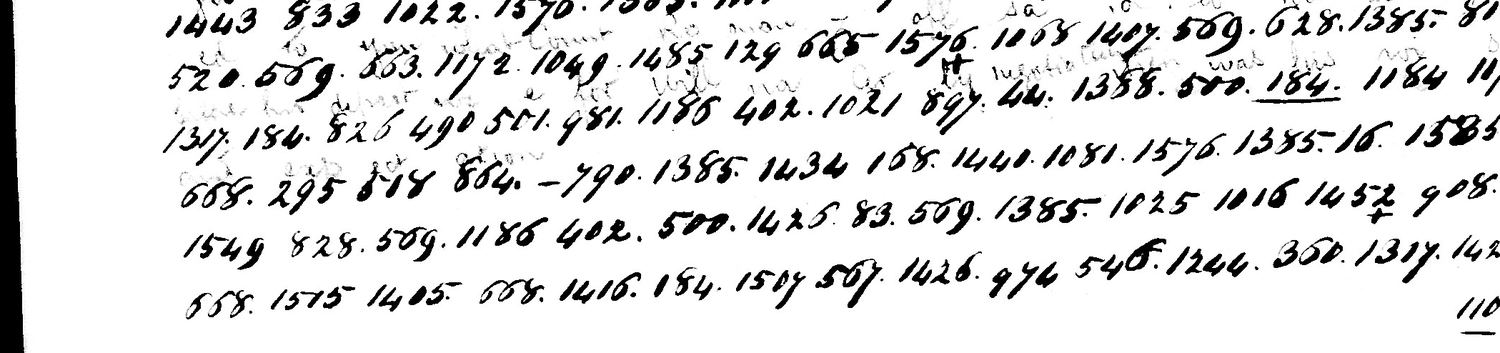
The block runs from the last four decoded groups to the end of the paragraph: 133 groups, 129 of them in Ford’s gap, with the clear words
scarcely (twice), undoubtedly and In the German Gazettes written in the line. The rebuilt table gives every group a value
(python render.py gap88.txt), and all 133 give sense in the running text (python measure.py): 106 on clerk-attested
values, 10 on Ford-fixed, 13 on uncertain and 4 on inferred ones; without the inferred values, 129 (0.970). In the decryption below, words in square brackets rest on
grade-I values; groups in braces have a value that does not make sense in the sentence. The opening words in brackets are the clerk-decoded close of the
sentence that Ford prints.
[Certainly negotiation then was his wish] and ex-pect-ation. But the [journ-ey] it-self of the Emperor Alex-an-der to Wil-na was in opposition to the Chan-ce-ll-or and adv-ice, and if his ac-tive in-flu-ence had not been im-pa-ir-ed before it, it can scarcely fa-il to have been af-fect-ed by his ill-ness im-medi-ate-ly after his ar-[riv]-al [thither], which was undoubtedly an a-po-ple-ct-ic str-oke. Since then he has had a second and a more sever-e one. In the German Gazettes even his de-a-[th] has been an-no-un-ced; but that was a mis-take. At all events it is scarcely pos-sible that he should rem-ain much long-er in the depart-ment of foreign affairs.
im-pa-ir-ed: the groups on the page are 1424, then the catchword 1102 at the foot of the left leaf, then 1112 1433 520 at the top of the right leaf. The catchword is the group Adams meant to begin the page with, 1102 pa (Ford-fixed nine times), and in No. 83 (frame 0190) he codes un-im-pa-ir-ed as 1477 1424 1102 1435 520 (1435 ir, Ford-fixed three times). The 1112 1433 on the new page are his own copying slips, one digit each, for 1102 1435: taken as he intended, impaired. Chan-ce-ll-or is 1385 1025 1016 1457 908 with the doubling mark under 1457, the same five groups Adams wrote for “the Chancellor” in No. 73 (frame 0165, Ford 4:256). The group before his illness is 792 by: the earlier transcription 492 use took an open hook for this hand’s looped 4.
Most of what the first pass of 18 September inferred is now attested: itself (1081 self, clerk 0184, 0185, 0190), advice (1575 adv, Ford 0132; 1405 ice, Ford 0036 and clerk 0190), apoplectic (1141 ple; 1060 ct, clerk 0182), stroke (1586 oke), second (1077), severe (1091 sever), remain much longer (743 rem, 162 much, 888 long), mistake (134 mis, clerk 0182), announced (479 un), At all events (283 event, clerk 0048), foreign affairs (68, 1517), and 1186 is attested as will and Wil- (clerk 0182, 0184). Opposition (83), the key word of the first sentence, is now grade C from No. 73. Five groups of the passage remain inferred: 1434 journ and 168 ey, 1479 riv, 1398 thither and 1382 th.
3.1 What it says
“He” is Count Nikolai Rumyantsev (Adams’s Romanzoff), Chancellor and minister for foreign affairs, who had gone to Wilna with Alexander. Adams reports that the Emperor’s journey to Wilna itself went against the Chancellor’s advice; that whatever influence he still had would in any case have been affected by his illness, an apoplectic stroke soon after his arrival there; that since then he has had a second and worse one; that the German gazettes had reported him dead, wrongly; and that he can hardly remain much longer at the head of foreign affairs.
This fits what is known: Rumyantsev had a stroke in 1812 that cost him his hearing, and he left office in 1814. Adams’s own diary for September 1812 records Romanzoff speaking of two strokes of apoplexy suffered with the Emperor at Wilna. It differs on the timing from standard accounts (Britannica, Wikipedia), which tie the stroke to the news of the crossing of the Niemen on 24 June. Adams, writing at St Petersburg on 25 June before that news could have reached him, places the first stroke soon after Rumyantsev reached Wilna and a second, worse one before the 25th. Ford printed none of this.
The groups (targets/jqa/gap88.txt)
668 295 818 864 | 790 1385 1434 168 1440 1081 1576 1385 16 1585
1549 828 569 1186 402 500 1426 83 569 1385 1025 1016 1457 908
668 1575 1405 668 1416 184 1507 567 1426 974 546 1244 360 1317 1424 (1102)
1112 1433 520 1318 1440 1006 scarcely 302 1421 569 1259 1317 1516 322 520
792 184 1421 430 1424 632 1372 897 1520 184 680 1479 1535 1398 1176 500
undoubtedly 1549 1501 1148 1141 1060 1404 382 1586 235 1388 169 1254 1244
1501 1077 668 1501 151 1091 501 1594 | In the German Gazettes 282 184
809 1501 1382 1254 1317 1549 352 479 1017 790 1384 500 1501 134 1365
699 1535 283 1440 1436 scarcely 1157 586 1384 169 90 743 1531 162
888 1300 1426 1385 826 637 1576 68 1517
The first bar marks where the clerk’s decode stops; the second is the end of a line where clear text follows. (1102) is the catchword at the foot of the page and is not counted.
04 The rest of No. 88
Ford ends the despatch with “[remainder of letter with exception of few lines undecyphered.]”. That remainder is on frame 0207, left leaf: thirteen lines of code, then clear sentences (manifestos of both parties expected; peace with Turkey signed a third time; “It is not General Kutuzoff but Count Rostopchin who is appointed Governor, civil and Military, of Moscow”), then five more lines of code. It has 257 groups, 7 of them with digits lost in the binding gutter at the line ends; 249 have a value and 247 give sense (0.961): 195 clerk-attested, 20 Ford-fixed, 17 uncertain, 15 inferred; 232 (0.903) without the inferred values. Square brackets are grade I, braces a value that gives no sense, and angle brackets a gutter-cut group restored from the context only, which is counted as open:
If this pro-po-si-tion has in any form been dis-close(d) to the Rus-sian govern-ment, it was cer-[tain]-ly nei(ther) un-reason-able nor im-[mod](erate) nor in-con-sis-tent with a system rig-our-ous-ly and ⟨in⟩-[fl]-ex-[ib]-ly [def]-en-[sive], to meet it with a pro-po-si(tion) for the e-va-cu-ation of Prussia by the French troops as {1508} ⟨pre⟩-li-mi-na-ry to negotiation. But the very point upon which the am-bass-⟨ad⟩-or manifest-ed the most sen-si-bi-li-ty in sp-ea-king of Prince Kurakin’s last no-te was that it held out a pro-po-⟨si⟩(tion) with which it would be dis-hon-(our)able in France to [comply]. He {1185} it as a [dem]-on-str-ation that the Emperor Al-ex-an-der had de-ter-[min]-ed not to [negotiate] at all — it {tol} he ⟨sa⟩-id — such a pro-po-sal as France had never thought of making to Russia even after the [bat]-tle of Fri-ed-la-nd.
[clear text] … an army of re-serve is form-ing there, and it is ⟨…⟩ probab-le that if great suc-cess on the, on the side of the French should mark the commence-ment of the war, the Emperor Na-po-le-on will at-⟨tem⟩-p-t to pe-[net]-[rate] di-rect-ly to that cen-(t)re of the em-[pire] than [along] the sho-res of the Baltic.
The ambassador is Lauriston, the French ambassador at St Petersburg; Kurakin’s note is the Russian ambassador’s demand at Paris in April 1812 for the
evacuation of Prussia, which Napoleon treated as a declaration of war. “Even after the battle of Friedland” (June 1807, before Tilsit): France had
never proposed evacuating Prussia even when Russia was beaten. The last lines expect Napoleon, if the war opens well for him, to strike directly at the
centre of the empire rather than along the Baltic shore. The groups are in targets/jqa/rem88.txt, the groups that give no sense, with the reason for each,
in targets/jqa/sense88.tsv.
4.1 The third pass: 0.910 to 0.974
The second pass, earlier on 22 September, stood at 355 of 390 (0.910), below 95%. The third pass added the clerk’s interlinear decodes on frames 0047, 0048 (the rest of the page), 0210–0211 and 0247 (560 pairs) and the coded blocks of eight despatches of 1811–1812 aligned with Ford’s vol. 4 (1,926 pairs; No. 95 against the Department’s clear copy), and re-transcribed the doubtful groups of No. 88 from the image a third time. What moved:
| Where | Was | Now | Evidence |
|---|---|---|---|
| nine lines, l. 2 | Chan-ce-{last}-or | Chan-ce-ll-or (C) | No. 73 (frame 0165, Ford 4:256) writes the same groups, 1457 with the doubling mark = ll |
| nine lines, l. 5 | 492 use | 792 by (H) | re-read on 0206: an open hook, not this hand’s looped 4 |
| remainder, l. 4 | few-ex-table-ly | [in]-[fl]-ex-[ib]-ly, inflexibly (I) | slots 1401 I < 1403 < 1404 ic and 347 fit < 350 < 352; the single Ford alignments (few, table) disagree with each other |
| remainder, l. 5 | e-va-{1081}-ation | e-va-cu-ation, 1061 (C) | the blurred digit is a 6; 1061 cu in Ford 0005 and cal-cu-late (0194); slot 1060 < 1061 < 1062 cur |
| remainder, l. 11 | ne-{at}-{al} | [negotiate] at all | 1535 with the doubling mark = all; 426 between 423 need and 428 nei (I) |
| remainder, l. 13 | {…} long of {…}-ed la-nd | [bat]-tle of Fri-ed-la-nd | 996 fri (C, No. 95 fri-end-ship); 1453 la, 416 nd (Fin-la-nd); the second group is 588 tled (the 5 has its top bar), not 888; 1309 between 1308 bas and 1310 be (I) |
| remainder, l. 16 | {proper le the if} | probab-le that if | 220 = probab (clerk 0047 “it is probab-le that”, 0190 twice); the third group is 1384 (4 over 5) |
| remainder, ll. 18–19 | em-{927} the {ambass} the side-{res} | em-[pire] than [along] the sho-res of the Baltic | 927 from the context only and 1540 in the slot after 1537 alliance, 1538 ally (I); 1383 than and 1097 sho are digits Adams overwrote (M); 748 res (M) |
05 Erving 1807: the holes in Madison’s decode
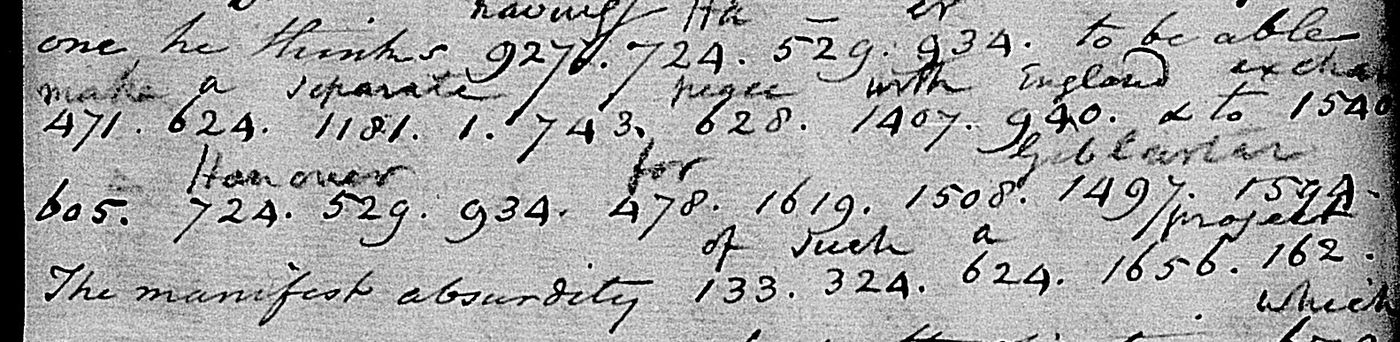
George W. Erving, chargé at Madrid, wrote privately to Madison on 24 March 1807 (No. 21) “In the Cypher of the Legation”, the code Charles Pinckney had used in Spain. He reports a secret conversation between the Prince of the Peace (Godoy) and the Prussian chargé Henry: Bonaparte has offered the Prince the Electorate of Hanover for himself, and the Prince hopes by holding Hanover to make a separate peace with England and exchange it for Gibraltar. The Madison editors (PJM-SS 13:529–31) print the letter from Madison’s interlinear decode on the first received copy and state that the key has not been found (Weber, pp. 152–53). The decode has holes: “Haweder”, “Ha——er”, “Giblartar [sic]”, “see the he was more so”, “sp[eak]”, and at note 8 “to the […]” where Madison wrote “se al e”.
Three sources were used: the first received copy with Madison’s decode (NARA RG 59, Despatches from Spain vol. 10, microfilm M31 reel 12, frames 0283–0286); the “Duplicate” in the Madison Papers at the Library of Congress (mjm014714), coded throughout and not decoded; and Pinckney’s own despatches in the same code (M31 reel 7 frames 0346–0352, 22 February 1803, one copy decoded by Jacob Wagner on frame 0348; reel 8 frames 0083–0084, January 1804). Pinckney’s pages confirm the common values: 1651 the, 133 of, 1343 and, 244 to, 1578 that, 69 in (Wagner: “the In-tend-ant” = 1651.69.1586.103), 1515 late.
| Founders prints | Groups (both copies agree) | Reading | Evidence |
|---|---|---|---|
| “to the […]” (n. 8; Madison “se al e”) | 69.1651.1183.1497.1298 | in the scale | 69 is in: Madison himself so decodes it (“his retreat in Ha—er”, “went in-cog”), as does Wagner in 1803; his “to the” is a slip. 1497 is al (Madison, and in Gibraltar). Madison reads 1183 as se (se-em-ed), and se-al-e can only be scale: “might be of importance in the scale; again, to raise up an insuperable obstacle … & lastly to get the Prince within his grasp”, the second of Erving’s three objects. Either the key’s 1183 is sc or Erving took the neighbouring group. |
| “Haweder”, “Ha——er” (n. 5) | 724.529.934 (five times) | Hanover | 724 Ha and 934 er in all five; Madison left 529 blank or guessed “wed”, but decoded the same three groups “Hanover” himself at “exchange Hanover for Gibraltar”. 529 = nov. |
| “see the he was more so” (n. 6) | 1578.926.390.720.1219 | see that he was more so | 1578 is that everywhere else, as the editors note; the code is right and Madison’s “the” is a slip. |
| “Giblartar [sic]” | 1619.1508.1497.1594 (twice) | Gibraltar | At the second occurrence Madison wrote “Gibraltar”; with 1497 = al the groups spell the name correctly. The [sic] belongs to Madison’s decode, not to Erving. |
| “sp[eak]” (n. 4) | 244.1212.133 | to sp[eak] of | 1212 is sp (gra-sp, 408.1013.1212). The rest of the word is missing in both copies, so the omission is Erving’s. It stays as the editors print it. |
| “been lately doing” (n. 7, coded only in the Duplicate) | …1164.1515.38.769.66… | been late-ly do-ing | 1515 late (Pinckney 1803), 38 ly, 66 ing: the Duplicate’s coding agrees with the clear text of the first copy. |
So every hole in the printed text closes, and the only real loss is Erving’s own dropped -eak. Madison had the key: the holes are his slips, not missing entries. The contribution is small. The letter was already in print and legible; two of the corrections (that, speak) the editors had themselves suggested in their notes, and Hanover they had nearly established. What is new is in the scale, the proof that the “Haweder” and “Giblartar” forms are Madison’s and not Erving’s, and the demonstration that the Pinckney code is recoverable from the microfilm by the same method as Armstrong’s.
06 What remains open
Grades as in section 02: H clerk’s decode, C Ford-fixed, M uncertain, I inferred. No. 88 is decrypted; the fourteen groups below keep it from 100%.
- Seven gutter-cut groups (needs the original). 142x, 21x, 15xx, 11xx, 10xx, 55x, 13xx: the last group of seven lines of the remainder lost digits in the binding gutter on the microfilm of frame 0207. Context restores most of them (in-, pre-, sa-id, at-tem-p-t), but they are counted as open. The original and the duplicate of No. 88 are not on reel 3, and Adams’s letterbook copy at the Massachusetts Historical Society is not online; with either the letter would be at about 98%.
- 1508, remainder l. 5. le/bable (M) where “as a pre[liminary]” wants a; no other occurrence in the decoded pairs.
- 1185, remainder l. 9. “He [took?] it as a demonstration”: in no decoded frame or Ford block examined so far.
- 570, remainder l. 11. Valued tol (C) but it gives no sense in “it tol he said”; the image shows 570, not 500 was.
- Inferred values (I) that the reading rests on. Nine lines: 1434 journ, 168 ey, 1479 riv, 1398 thither, 1382 th. Remainder: 1864 tain, 143 mod, 350 fl, 1403 ib, 815 def, 239 sive, 108 comply, 821 dem, 549 min, 426 negotiate, 1309 bat, 432 net, 726 rate, 927 pire, 1540 along. Without them 362 of the 390 groups of No. 88 give sense (0.928).
- The route to the open groups. 1185 and 1508 each need one more occurrence: the 1812 blocks of Nos. 77, 78 and 81 and the remaining lines of No. 85 (frame 0196, left, lines 12–23) are not yet aligned with Ford. Frames 0056–57 are a clear decyphered copy, and 0228–0233 No. 95 in code only.
- Ford’s other gaps. No. 51 (26 May 1811, “[One line and a half of cypher not decyphered]”, frame 0085, transcribed and partly rendered) and No. 55 (22 June 1811, “[one-half line of cipher not deciphered]”), both on reel 3; and reel 2 frame 0155 (1810), a long coded passage with no decode on the NARA copy.
- The Forbes-collection letter. Adams to Madison, 7 January 1811, for which the editors name the Armstrong code, has not been checked against its manuscript.
- Erving to Madison, 10 August 1807 (M31 reel 12, frames 0362–0366): several pages in the same code with no decode on the NARA copy. Erving wrote on 22 June 1807 that the Department could not decipher some of his letters. This is the next target for a rebuilt Pinckney key; whether Founders prints a decode (Early Access, 99-01-02 series) has still to be checked.
- A full Pinckney key. The pairs used here come from this letter and two Pinckney pages. Pinckney’s decoded despatches of 1802–04 (Founders 02-03-02-0170, 02-03-02-0313, 02-04-02-0419, 02-04-02-0611, 02-06-02-0346 with Brent’s three-page decipherment, 02-06-02-0560, 02-07-02-0022) are on M31 reels 7 and 8 and should give a few hundred more pairs.
07 Sources
- National Archives, RG 59, Despatches from U.S. Ministers to Russia, microfilm M35, reel 3, NAID 188725601, frames 0047–0048, 0182–0185, 0189–0190, 0194, 0198, 0210–0211 and 0247 (clerk’s decodes), 0005–0132 (1811 coded blocks aligned with Ford), the coded blocks of eight despatches of October 1811 to September 1812 aligned with Ford, 0165 (No. 73), 0228–0233 (No. 95, with the Department’s clear copy on 0230–0232), 0206–0207 (No. 88); reel 2, frame 0155.
- National Archives, RG 59, Despatches from U.S. Ministers to Spain, microfilm M31, reel 12, NAID 188605361, frames 0283–0286 and 0362–0366; reel 7, frames 0346–0352; reel 8, frames 0083–0084.
- Library of Congress, James Madison Papers: George W. Erving to James Madison, 24 March 1807, “Duplicate”, mjm014714.
- Founders Online: Erving to Madison, 24 March 1807, Madison/02-13-02-0559 (Papers of James Madison, Secretary of State Series 13:529–31); editorial notes on the Armstrong code, 02-10-02-0369 and 02-12-02-0197; Adams to Madison, 7 January 1811, 03-03-02-0121.
- Worthington Chauncey Ford, ed., Writings of John Quincy Adams, vol. 3 (New York, 1914), pp. 327–28, and vol. 4 (New York, 1914), pp. 256 (No. 73) and 355–58, and the 1811–1812 despatches whose Department decipherments it prints.
- John Quincy Adams, diary, September 1812 (Primary Source Cooperative, Massachusetts Historical Society): Romanzoff’s two strokes at Wilna.
- Ralph E. Weber, United States Diplomatic Codes and Ciphers, 1775–1938 (Chicago, 1979), pp. 152–53.
- The companion page: Armstrong’s coded postscript to Madison, 1808, and the the = 972 table.
The Adams code table with grades and support (code_table.tsv), the clerk’s pairs by frame (pairs_jqa.txt,
clerk_*.tsv, clerk_notes_pages2.md), the Ford alignments (codes_ford*.txt, ford_pairs*.tsv, codes_ford1812*.txt,
ford1812_pairs*.tsv, ford1812_notes.md, align.py), the group transcriptions of No. 88 (gap88.txt, rem88.txt),
the sense audit (sense88.tsv, measure.py), the renderer (render.py) and the notes are in the repository (targets/jqa/);
the Erving group list with Madison’s decodes (erving_groups.txt), the notes and the frame-scoring script are in targets/erving1807/. Microfilm
images are not committed.