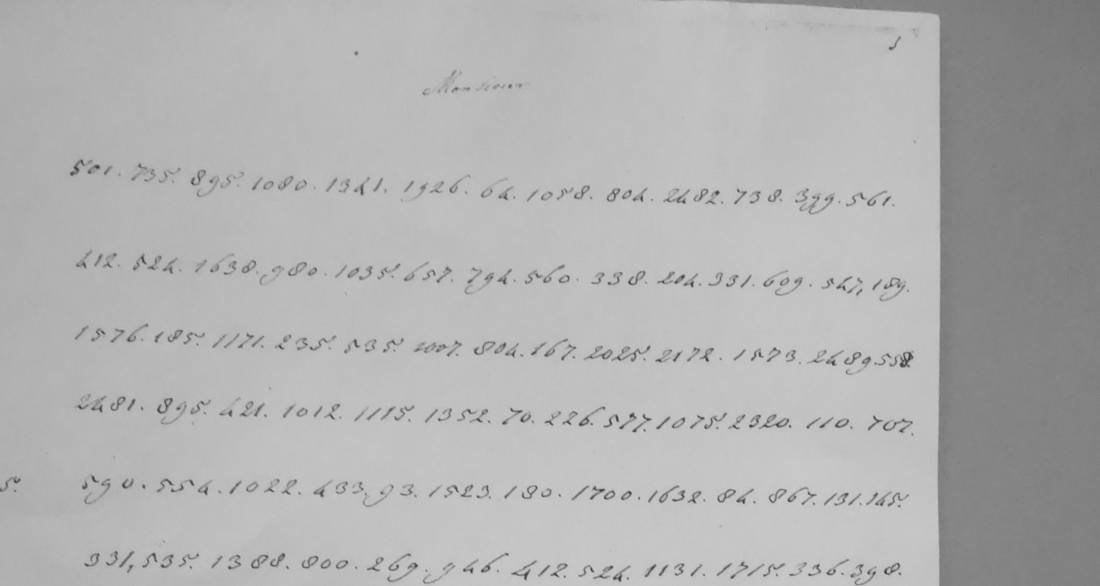
Summary. The two DECODE records hold 13 pages: R1469 (7 pages, dated 9 February 1809) and R1470 (6 pages, undated). Apart from “Monsieur” and a docket, every line is numerical code. There is no interlinear text, margin gloss or decipherment, and the letters are neither addressed nor signed, so the attribution to W. F. Röell is DECODE’s. The legation archive argues against it: Röell’s despatches there are in clear Dutch, and none is dated 9 February. Parsed from DECODE’s transcription, they hold 2,585 groups, 931 of them distinct, running to about 3,300. No group reaches even one per cent of the text, so the code gives the commonest words many equivalents, and its frequent groups are spread over the whole range, so it is not alphabetical. It is not the 1788–93 code of the same legation, whose French and Dutch decipherments would have given cribs, and it is not the ministry’s other open codes of 1804 and 1808. DECODE has no key for it, and Röell’s papers list letters from Van Dedem and from the code-maker Croiset for 1808–09 but no codebook. Without the key or a clear copy, the letters cannot be decoded.
01 The records
- R1469 (images 6681–6687): opens “Monsieur” and ends on p. 7 with a paraph. 1,297 groups, 622 distinct.
- R1470 (images 6688–6693): a docket on p. 1 read by DECODE as “? 69 Fermer? no? 9?”, then code. 1,288 groups, 707 distinct, the highest 3264.
DECODE already doubts the address: Van Dedem was on his way home when the letter was sent.
02 What was tried
- Frequencies. The commonest groups are 1390 and 460 (12 each in R1469) and 804, 75, 357, 296 and 394 (10 each in R1470). In a French text de alone is 4–5%, so a group rate of about 1% means heavy homophony. The frequent groups run from 35 to 2920 with no clustering, which excludes a one-part code whose alphabetical ranges could be predicted.
- The legation’s 1788–93 code (Van Dedem 1788–99), for which French (R1947, R2053) and Dutch (R2121) decipherments exist. It is a different code. Only 30–33% of each crib’s distinct groups occur here, against 28% by chance, and just 0–5 of each crib’s 30 commonest groups are among the 200 commonest here.
- The ministry’s other codes of the period, Van Spaen 1808 (plain groups to 1339) and Fagel 1804 (syllabic groups with clear endings). These are different systems.
- Keys and print. The DECODE metadata dump has no key record for this legation or ministry. Colenbrander’s Gedenkstukken V (1806–1810) gave nothing by web search. The inventory of Röell’s papers (NA 2.21.008.78) lists letters from F. G. van Dedem and from S. F. Croiset, both 1808–09, but no cipher.
03 What remains open
- Both letters in full; no group has been decoded.
- The trailing marks on some groups are not in DECODE’s transcription and were not re-transcribed. They may be part of the code.
- What could supply the key: the codebook in the legation papers (NA 1.02.04, near inv. 804), Croiset’s 1808–09 letters to Röell (NA 2.21.008.78), or a clear copy of any despatch in this code. Henk Boon, Onze man in Constantinopel (2012), was not checked.
04 Sources
- Nationaal Archief, 1.02.04 legatie Turkije, inv. 804; DECODE R1469 and R1470 (login), with the manual transcriptions by SofPe (2020).
- Nationaal Archief, 1.02.20 legatie Turkije, inv. 804, 980, 988, 990 (online scans).
- Nationaal Archief, 2.21.008.78, papers of W. F. Röell, inventory.
- H. T. Colenbrander, Gedenkstukken der algemeene geschiedenis van Nederland van 1795 tot 1840, V (1909).
Parsed groups, parser and notes: targets/roell1809/.