
ton que, zar de, rab vuestra magestad, taf papa) and an alphabet of cursive signs with several signs per letter. Two of them are not new: Bergenroth calendared R9667 (5 May 1523) as CSP Spain ii no. 548 and R9846 (3 and 5 February 1524) as no. 617, from contemporary decipherings. The clerk’s clear version of the first third of the February letter is bound with it on f. 133r. Aligned clause by clause against 38 cipher lines, it gives 105 values, 65 of them confirmed, and shows that the key changed between 1522 and 1524. With that key the six uncalendared letters are partly deciphered, from about a quarter of a letter to about two thirds. They concern Beaurain’s mission to Clement VII, the Pope’s wish to see France ruined or a truce made, the Emperor’s want of money, the departure of the archbishop of Capua, the Datary Giberti, and Hurtado’s unpaid salary. About thirty code groups and a set of look-alike signs stay open.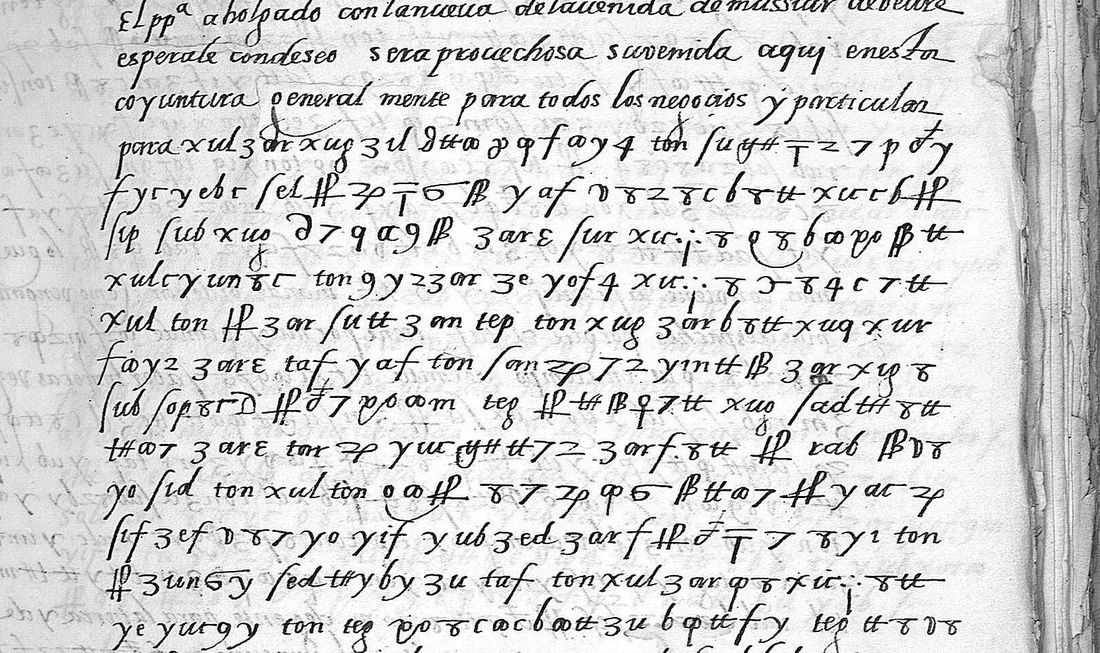
zil con- and the spelled letters t-r-i-b-u-c-i-o-n. Image: Real Academia de la Historia, Colección Salazar y Castro A-30 (9/30) f. 130r, via DECODE R9846.01 The eight records
The dates come from the date lines, the dockets and, for R9867, from the date spelled out in cipher at the foot. DECODE’s dates, addressees and volume are wrong for several records; the corrections are in the last column.
| DECODE | ff. | date | to | state | DECODE says |
|---|---|---|---|---|---|
| R9667 | 9/28 ff. 6–9 | Rome, 5 May 1523 | Emperor | clear with cipher runs; CSP ii 548 | June 1523, unknown recipient |
| R9683 | 9/28 f. 171 | Rome, June 1523 (docket 10 June) | Emperor | clear with 8 cipher lines | unknown recipient |
| R9695 | 9/28 ff. 339–340 | Rome, 8 July 1523 | Emperor | autograph draft, much struck through | June 1523 |
| R9846 | 9/30 ff. 130–133 | Rome, 3 and 5 Feb 1524 | Emperor | almost all cipher; clear of the first third on f. 133r; CSP ii 617 | 1523, 9/28 |
| R9866 | 9/30 ff. 285–286 | Rome, 28 Feb 1524 | Grand Chancellor Gattinara | half cipher | 1523, 9/28, unknown recipient |
| R9867 | 9/30 f. 351 | Rome, 4 Jan 1524 | Emperor | wholly cipher, 30 lines | 1523, 9/28 |
| R9868 | 9/30 ff. 430–431 | Rome, 20 Mar 1524 | Grand Chancellor Gattinara | half cipher | 1523, 9/28, unknown recipient |
| R9869 | 9/30 ff. 444–445 | Rome, 28 Mar 1524 | Emperor | half cipher | 1523, 9/28 |
The Calendar check went through Bergenroth’s CSP Spain vol. 2, pp. 547–709, by the Salazar folio numbers he prints. Only ff. 6–9 of A-28 (no. 548) and ff. 130–133 of A-30 (no. 617) are calendared. The other six letters are not.
R9667 has a leaf headed “Claro” bound beside it, which looks like a crib. It is not one. The leaf is imaged mirrored, and its docket reads “Del abbad de Najera a dos de mayo”: it is the clear of the Abbot of Nájera’s letter of 2 May 1523, not of Hurtado’s of 5 May. For R9667 the content comes from Bergenroth’s abstract, which he made from a contemporary deciphering that is not among the images.
02 The key, from the clear of 5 February 1524
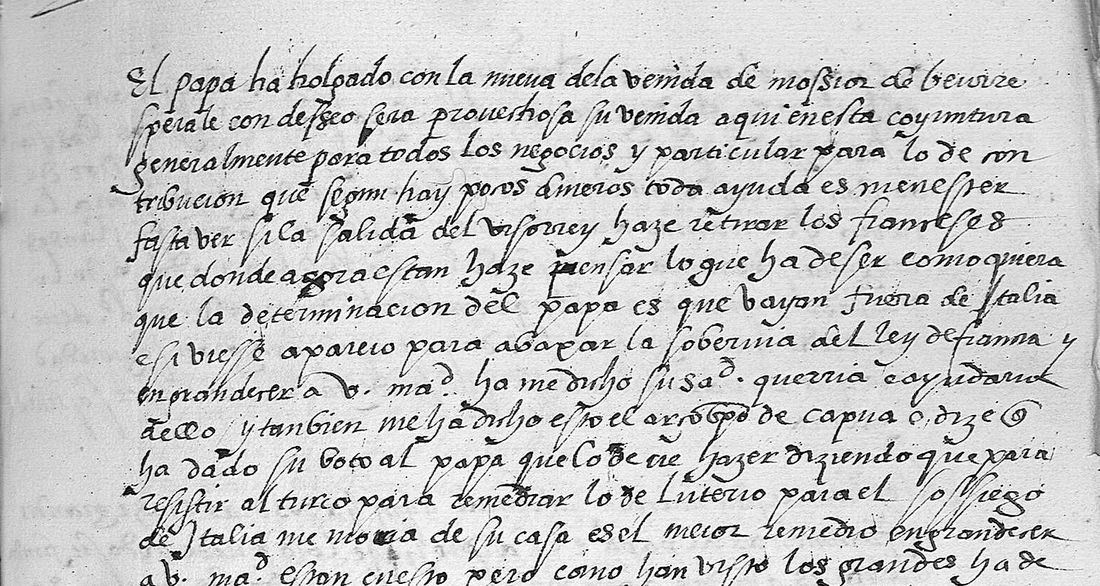
The clear on f. 133r covers the cipher of ff. 130r–130v from “para lo de contribucion” to “el buen animo”, and every clause has its cipher counterpart. Most of the letter alphabet came out of spelled runs whose length matches the plaintext word exactly, with known code groups on both sides: contribucion, ayuda, menester, salida, pensar, determinacion. The alignment gave 105 values, 65 of them confirmed (grade C). It also corrected six words of the first transcription of the clear: señorear, poco daño, concierte, deudas, seguir, conservar.
The 1522 key is the starting point, and 25 of its code groups and the signs for n, e, a and o hold in 1524. Some values changed. tef is paz in 1522 and nec- (necesidad, necesario) three times in 1524. The sign L is i in 1522 and r here. So the 1522 key cannot be applied unchanged.
03 What the letters say
Notation: […] marks a passage not yet deciphered. Coverage is the share of cipher tokens that have a value, which is an upper bound: many of them are single letters in runs that do not yet make words. The “reads as Spanish” column is the better measure. Gists are graded M unless stated.
| DECODE | tokens with a value | reads as Spanish | gist |
|---|---|---|---|
| R9667 | fragments | little | benefices for the Pope’s servants (list on f. 7); CSP 548 has the content |
| R9683 | 67/91 | fragments | the Pope well disposed since Volterra’s arrest; restore the benefices of the chamberlain and Francisco (clear) |
| R9695 | 184/249 | almost none | rumoured poisoning; the Duke of Camerino’s men still in prison; naturalisations for the Pope’s intimates (clear) |
| R9846 | first third from the clear | first third (C) | Beaurain’s coming; the Pope wants France ruined, or else a truce |
| R9867 | 418/467 | about 60% | Beaurain has left the Pope content; the Emperor must not show need of money |
| R9866 | 561/649 | a quarter to a third | to Gattinara: the French mean to stay this side of the Alps; the writer’s unpaid salary |
| R9868 | 328/353 | f. 430r mostly | to Gattinara: Capua gone, all business hangs on the Datary, who must be satisfied |
| R9869 | 310/339 | about two thirds | the Pope’s money offer through Beaurain; Florence undecided; Capua to be well received |
5 February 1524, to the Emperor (R9846, CSP 617)
The clerk’s clear, which the cipher of ff. 130r–130v matches clause for clause (grade C):
El papa ha holgado con la nueva de la venida de mossior de Beuvre; spera le con desseo, sera provechosa su venida aqui en esta coyuntura generalmente para todos los negocios y particular para lo de contribucion, que segun hay pocos dineros toda ayuda es menester, fasta ver si la salida del visorey haze retirar los franceses, que donde agora estan haze pensar lo que ha de ser, como quiera que la determinacion del papa es que bayan fuera de Italia. […] Dize me su Sd. que querria una de dos cosas: teniendo v. mad. aparejo, lo que mas dessea es que el Rey de Francia se destruya […]; no pudiendo ser esto, dessea que se tomasse assiento de tregua o paz antes que las cosas de v. mad. veniessen a necessidad.
The Pope is glad of Beaurain’s coming, since money is short and every help is needed until the Viceroy’s march makes the French withdraw; he is resolved that they leave Italy. If the Emperor has the means, what he most wants is for the King of France to be destroyed; if not, a truce or peace before the Emperor’s affairs come to necessity. The rest of the cipher (ff. 131r–132v) is not deciphered here; Bergenroth’s abstract no. 617 gives its content.
4 January 1524, to the Emperor (R9867)
Wholly in cipher, with no clear. The date and signature are spelled at the foot, “de Roma a quatro de enero — Lope Hurtado”, eleven signs for l-o-p-e-h-u-r-t-a-d-o, all but one already in the key.
Mussiur de Beure […] al papa contento de lo que le ha dicho de parte de V. Md. […] el arçobispo con el […]. V. Md. no deve mostrar necesidad, porque […] poco para sacar dineros […] para que los buscasen los que […] no los tienen. […] suplico mande proveer […] de lo que se me deve […]. De Roma a quatro de enero. Lope Hurtado.
28 February 1524, to Gattinara (R9866)
Beaurain’s coming was timely, and Hurtado has briefed him. The French want, by craft or force, to stay on this side of the Alps; the cipher runs give “en no los aver ofendido por esas partes”, “los exercitos de su Mt.”, “en no poder hazer nada”. The Emperor must not lose the world’s respect now that the French are leaving, since he spends so much on the war. Hurtado asks Gattinara to read a chapter he wrote to Soria and to help him get paid what he is owed.
20 March 1524, to Gattinara (R9868)
A copy of Hurtado’s letter of 11 March to the Emperor. The archbishop of Capua has left, and in his absence all business hangs on the Datary, Giberti, who stands as close to the Pope as anyone can. The cipher gives “porque de lo passado era mal contento, segun el lugar que tiene”, “tengolo por inconveniente” and “cada dia me parece mas necesario cunplir con el”: the Datary must be satisfied. Benefices have been shared among the cardinals, as the King of France did with his. The long cipher passage on f. 430v about a valiant man with many sons and nephews not in the Emperor’s pay is not deciphered.
28 March 1524, to the Emperor (R9869)
The Pope has sent Beaurain money proposals, told Hurtado he would fulfil the rest, and pleaded his need; Florence has not yet decided. If the archbishop of Capua finds the army ready to sustain the war, his report will match the Pope’s offer, and the Emperor should see that he is well received. “The Pope’s goodwill and words could not be better; God grant that the deeds be the same.” Easter news, Hungary and the Turk, the Legate in Moravia and the Infante are in the clear.
June and July 1523 (R9683, R9695)
Both letters are mostly in the clear, and little of their cipher lines is deciphered. R9683 says the Pope has been well disposed since the arrest of Cardinal Soderini of Volterra, and asks the Emperor to restore the benefices of the Pope’s chamberlain and of Francisco and to pay what is owed to the Pope. R9695, an autograph draft of 8 July, reports that the rumoured poisoning could not be verified, that the Duke of Camerino’s men are still in prison and that the Pope eats apart, served by old servants; it asks naturalisations for the Pope’s intimates.
04 What remains open
- About thirty code groups, among them
xun,xor,zad(a person absent from Rome in R9868),ʃal,ʃub, andrubagainstyub. - Look-alike signs: ∂ and barred ∂, two- and three-bar crosses, and a barred m that is f in some places and perhaps c in others. DECODE’s images are not sharp enough to separate them everywhere.
- R9846 ff. 131r–132v: not deciphered here. The rest of the clerk’s clear is probably on f. 133v, which is not imaged; the RAH Biblioteca Digital copy of Salazar A-30 would give more of the key.
- R9667: no crib. Its content is known only through CSP 548.
- R9683: the docket’s sender reading and the date line (“[x]vi de junio” against the docket’s “diez de junio”) are not settled.
05 Sources
- DECODE records R9667, R9683, R9695, R9846, R9866, R9867, R9868, R9869 (images behind login; Real Academia de la Historia).
- G. A. Bergenroth (ed.), Calendar of State Papers, Spain, vol. 2 (1866), nos. 548 and 617: May 1523, February 1524.
- The 1522 key: Lope Hurtado de Mendoza at Rome, 1522, on this site.
Transcriptions, alignments, the rebuilt key (key_1524.tsv and additions) and the per-letter decipherments are in targets/lopehurtado1523/.