01 Four leaves, two ciphers
BnF Français 16093, formerly Saint-Germain-Harlay ms. 1024, is the file of despatches from the Court to Maisse at Venice. It is digitised as btv1b90074656, 558 canvases. Every canvas is an opening, and the canvas labels are all NP, so the folio map has to be read off the leaves. The offset is not constant: unfoliated leaves intervene, and it moves from +48 around f. 362 to +51 by f. 404. For the four targets it is
| folio | canvas | date on the leaf | cipher |
|---|---|---|---|
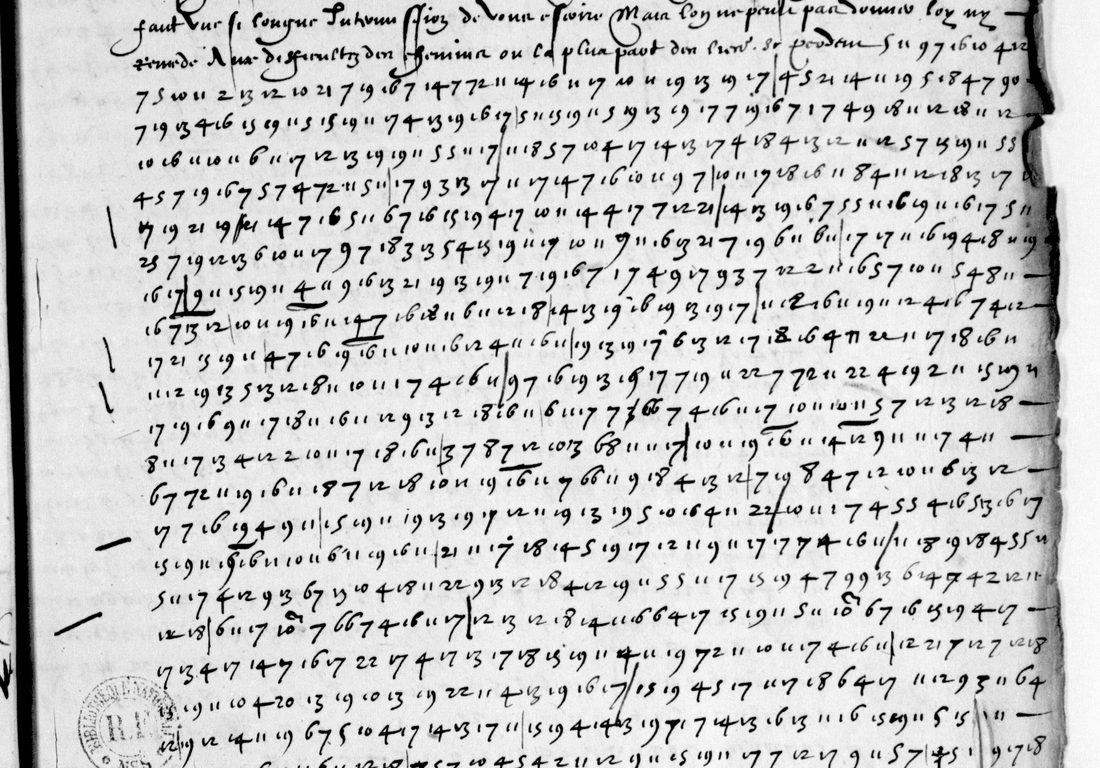
| f. 370 | 419 | S. Denys, 3 November 1592 | figures only |
| f. 373 | 422 | 7 November 1592 | figures only |
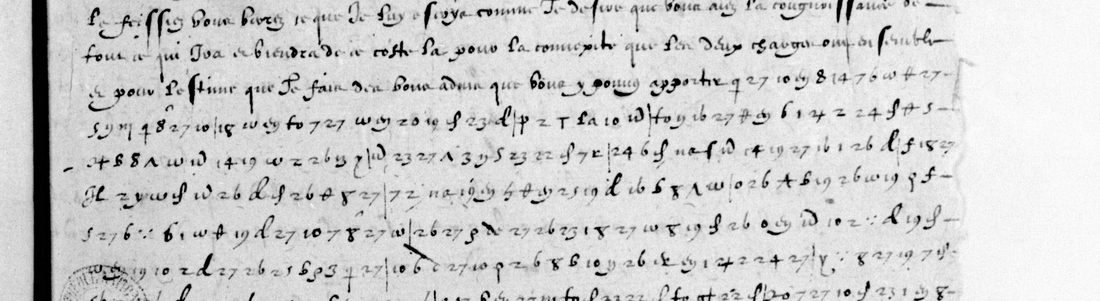
| f. 406 | 457 | Chartres, 8 February 1593 | figures and symbols |
| f. 410 | 461 | Mantes, 27 April 1593 | figures and symbols |
The division is Tomokiyo’s, and the catalogue entry missed it. His list gives ff. 370 and 373 as the last two letters of Maisse’s Cipher (1592), the cipher of ff. 304, 307, 317, 323, 327 and 328 from January to April of that year. He notes that letters countersigned by Revol had moved to the new cipher in September, but that these two November letters went back to the old one. ff. 406 and 410 belong to Maisse’s Cipher (1592–93), the long series ff. 344 to 444, which includes four leaves (ff. 398, 401, 402 and 404) that carry a partial decipherment written between the lines. So each target group has siblings in its own volume, and the second has siblings with the plaintext written on them.
02 The pièce numbers, and where they lead
Every leaf in the volume carries two numbers at the top right: the modern foliation, and above it, after the word Orig., a smaller number from the old Harlay arrangement. On f. 370 that number is 224.
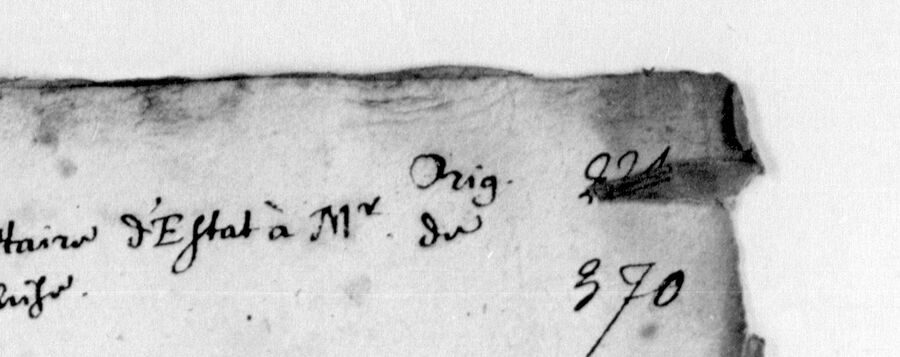
Berger de Xivrey cites Henri IV’s letters by that number (“Orig. — B. R. Fonds Saint-Germain-Harlay, Ms. 1024, pièce 224”), and for most of them he gives a second reference: “Cop. — Fonds Brienne, Ms. 13, fol. 102 verso”. The letters he did not print are listed all the same, with date, place, addressee and both references, in the volume’s closing table, Table de plusieurs lettres non imprimées dans ce volume. That table is where ff. 370, 373 and 410 appear.
Fonds Brienne ms. 13 is BnF NAF 6984, btv1b100904592, cataloged as Collection de Brienne 11–13, “Lettres et depesches de M³re … Hurault, sieur de Maisse, … ambassadeur à Venise, avecq les responses” — 13 III, années 1592, juin–1594, avril. It is a clean seventeenth-century clerk’s copy, entirely legible, and it copies the despatches in clear throughout. Xivrey says as much where he prints a ciphered letter in full: of f. 398, at t. III p. 719, he notes “La partie en italique est chiffrée dans l’original et déchiffrée dans la copie du fonds Brienne.”
In that volume canvas N shows fol. (N−5) recto on the right and the preceding verso on the left. The four targets sit at
| target | pièce | Brienne 13 | canvas | confirmed by |
|---|---|---|---|---|
| f. 370 | 224 | fol. 102v | 108, left | heading Autre coppie de lettre du Roy audict sieur du troisiesme 9bre par ledict Lambert; preamble identical |
| f. 373 | 226 | fol. 104v | 110, left | heading on fol. 104r, Autre lettre du Roy du sept.e novembre mil cinq cens quatre vingtz douze |
| f. 406 | 247 | fol. 171r | 176, right | heading Coppie de lettre du Roy audict sieur de Maisse de Chartres le huictiesme febvrier 1593; preamble identical |
| f. 410 | 251 | fol. 193v | 199, left | heading Mante le vingt huictiesme Avril 1593, receue le vingt douxiesme May |
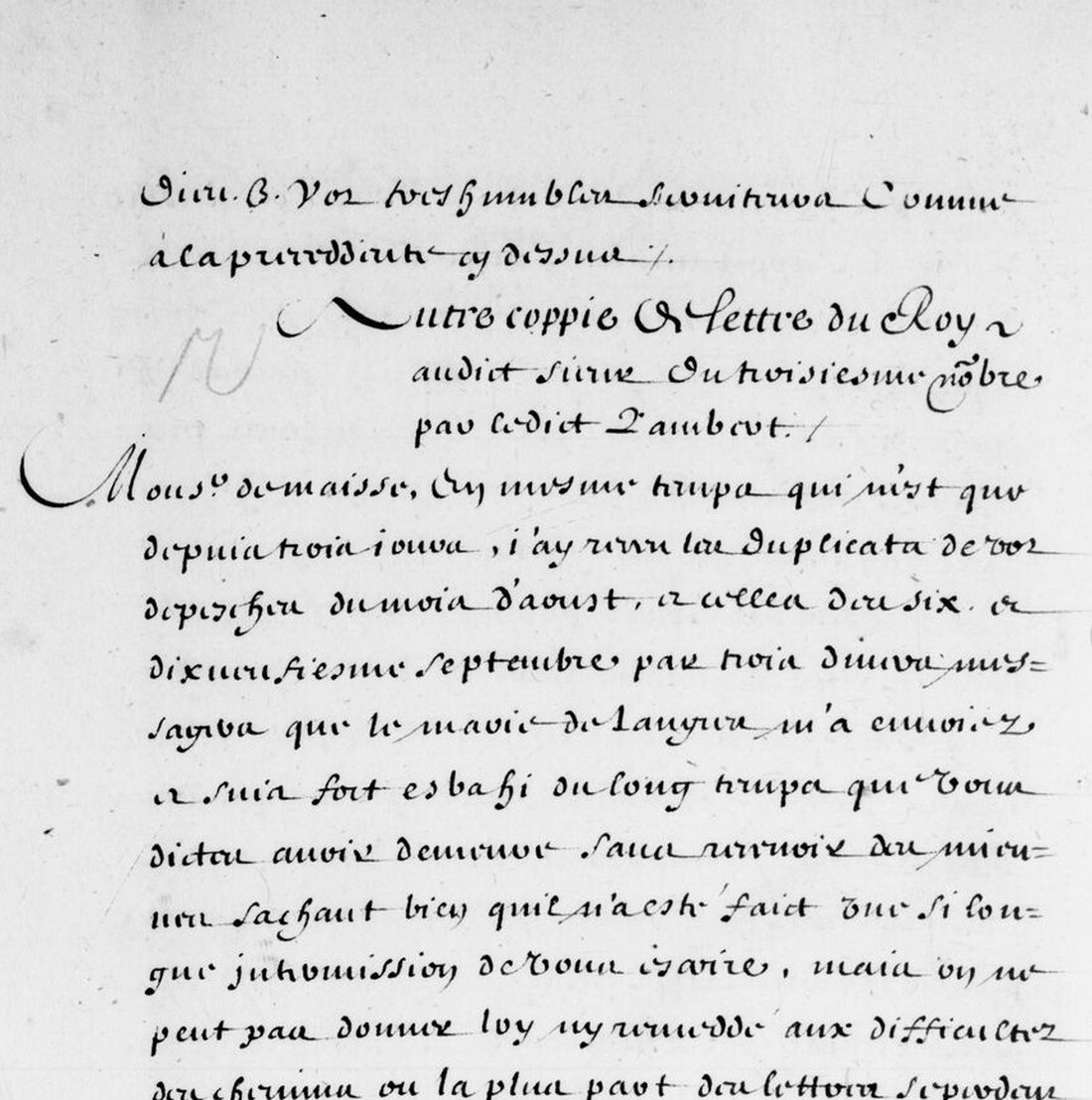
The join is exact. f. 370 keeps its first six lines in clear and breaks off mid-sentence at “mais on ne peut pas donner loy ny remede aux difficultez des chemins ou la plus part des lettres se perdent”. Brienne 13 fol. 102v has the same words and continues without a break into the matter the King wanted hidden.
03 What the letters say
Quotations below are transcribed from the Brienne copy; spelling is the copyist’s, and contractions are left as they stand.
f. 370: Saint-Denis, 3 November 1592 (pièce 224)
The King has had, all at once and only three days ago, the duplicates of Maisse’s August despatches and those of 6 and 19 September, brought by three separate messengers sent on by the mayor of Langres; he is astonished how long they took, but “on ne peut pas donner loy ny remede aux difficultez des chemins”. Then the cipher begins. Cardinal de Gondi will have passed near Venice some days since and will have reported how matters stood when he left; he is to be followed shortly by the marquis de Pisany, going to the Pope in the name of the Catholics of the kingdom who are the King’s servants. This was the embassy that prepared the ground for the absolution. Henri expects this to change Maisse’s mind about coming home, as his last letter had proposed, “car vous avez assez jugé que sur cette rencontre mes affaires de dela n’ont besoin d’estre abandonnées de vostre presence”. He turns to the House of Austria and to the King of Spain, whose ambition “se desborde” and who is as much embarrassed by it as the King is; and he ends with Mayenne, who, having broken up his army, has slipped into Paris with only a few horse and found the people “si las et ennuyé de la guerre et de la vanité des promesses passées” that they are in great confusion, the greater part inclining to a peace and against “l’introduction de l’Espagnol”.
f. 373: 7 November 1592 (pièce 226)
Written the same day the previous despatch left, and sent with its duplicate. The King has Maisse’s letter of 4 October and has weighed every point; he is glad to have the ambassador’s own opinion on each, “d’autant que cela me peut beaucoup ayder à me resouldre en mes affaires”. He will suspend final judgement until he sees what comes of the journeys of Cardinal de Gondi and the marquis de Pisany, by which he reckons he has gone as far to satisfy his Catholic friends and servants as reason and the present safety of his affairs allow. If those friends have the will to help him that they have so often declared, or if they will merely consider their own interest soundly, the way is open on his side and the state of his affairs invites them to it; they can hardly doubt the ruin and necessity to which the length of the war and the efforts of the King of Spain have reduced him.
f. 406, with f. 404: Chartres, 8 February 1593 (pièce 247)
The King has answered every despatch as it came and has docketed the dates of each in his replies, so that Maisse can tell what has gone astray. The ciphered matter turns on Rome: the insolence of the Spaniards and what His Holiness will resolve; it would be very much to the purpose that the marquis de Pisany should not leave where he is, and that Cardinal Gondi should be told the same, “ce que j’ay faict à l’instant mesmes”, for if that fails neither of them has much hope of going to Rome, and their entering among those of the League “pourroit faire naistre parmy eux quelque plus grande division”. This is also the letter that says in clear, of the cipher itself, that Maisse has kept “le double du chiffre que j’ay envoyé aud. de Brèves”, which explains why the same key turns up in the Savary de Brèves correspondence.
f. 410: Mantes, 27 April 1593 (pièce 251)
The copy heads it 28 April, received 22 May. The King acknowledges Maisse’s letters of 20 February and 7 and 23 March, the last of which arrived first because the duc de Nevers had kept the other courier some days with him in Champagne. Maisse shows him so clearly the disposition and state of everything there, and in what touches his service, that he takes great contentment in it and recognises more and more the usefulness of his good offices; he asks him to be assured “que j’en estime vostre merite tel envers moy que vostre absence a cette occasion ne vous y fera rien perdre”. And experience has shown that Maisse was not deceived in the judgement he had long since formed of “les affaires de Rome”.
04 Two corrections to the lists
f. 406 is not a separate letter. Tomokiyo lists f. 404 as carrying a partial interlinear decipherment and f. 406 as having none, as though they were two despatches of February 1593. They are the same despatch: both are docketed Chartres 8 Féb. 1593, both open with the same words, and Brienne 13 copies the letter once, at fol. 171r, under pièce 247. f. 406 is the duplicate sent by the other route; the King says in these letters that he writes “par double voye”. Tomokiyo already records that f. 412 is the duplicate of f. 410 and f. 389 of f. 387; f. 406 is the same case, unrecognised. So the four catalogued leaves are three despatches, and the plaintext of f. 406 is attested twice, by the Brienne copy and by the interlinear decipherment on its twin.
The group is class A, not B. The catalogue scored this item “Maisse’s other ciphers of 1593–94 are reconstructed; these four use a different key with no sibling found yet.” Both halves are wrong, and the error came from treating the four leaves as one group. They are two groups, and each has siblings in the same volume: six for the 1592 cipher, some thirty for the 1592–93 cipher, four of the latter with the plaintext written between the lines.
05 The keys, and the decipherment of f. 370
The catalogue entry said what to do first: “Verify first. Savasse 1997; Tomokiyo’s Maisse keys as a first test.” That step is easy to miss, because the local copy of Tomokiyo’s page is a text dump and his key tables are images, which it does not contain. The page itself carries 62 of them, two of which are the keys:
henryiv_Maisse1.png: “Cipher used in BnF fr.16093 f.317”, the cipher of ff. 370 and 373henryiv_Maisse2.png: “Maisse’ Cipher 2 (BnF fr.16093, f.344 etc.)”, the cipher of ff. 406 and 410
Tomokiyo built both from the sibling letters. He lists the four leaves as undeciphered, which on cryptiana means that no contemporary decipherment stands beside them; he may have deciphered them with his own keys. No decipherment of them had been published.
Maisse’s Cipher (1592)
A simple substitution on a 22-letter alphabet, i = j and u = v as usual:
| a | b | c | d | e | f | g | h | i | l | m | n | o | p | q | r | s | t | u | x | y | z |
|---|---|---|---|---|---|---|---|---|---|---|---|---|---|---|---|---|---|---|---|---|---|
| 7 | 8 | 9 | 10 | 11 | 1 | 2 | 3 | 4 | 5 | 6 | 12 | 13 | 14 | 15 | 16 | 17 | 18 | 19 | 20 | 21 | 22 |
with doubles ff = 66, mm = 67, nn = 68, ss = 72, uu = 73.
Before the key was found, a blind frequency count of 83 transcribed groups had already established the same shape: 94 % of groups in a near-contiguous band of small numbers, the commonest value taking 14.5 % of the text (French e, which the key gives as 11), and a sparse nomenclator above the band, where Savasse’s reported 23, 24 and 74 sit. That count stands as an independent check on the key’s shape.
f. 370 decrypted, and checked against a source independent of the key
The opening of the cipher block transcribes and decodes as
5 11 9 7 16 10 4 12 7 5 · ω 11 2 13 12 10 21 · 7 19 16 7 · 14 7 72 11 · 14 16 11 17 · 10 11 · 19 13 19 17 · 4 5 21 14 11 19 5 18 · 4 7 …
le cardinal · de gondy · aura · pa[ss]e · pres · de · vous · il y peult · ja …
Carried to the end of what was transcribed, the cipher gives 81 characters:
lecardinaldegondyaurapassepresdeuousilypeultiaauoirquelqueiourslequeluousaurafait
and Brienne 13 fol. 102v, normalised the same way, gives
lecardinaldegondyaurapassepresdeuousilypeultiaauoirquelqueiourslequeluousaurafait
Identical, 81 of 81 characters. The clear copy was found independently of the key, through the Harlay pièce numbers, so the check is not circular: “Le Cardinal de Gondy aura passé prés de vous, il y peult ja avoir quelque jours, lequel vous aura fait [entendre de mes nouvelles]”. Those groups are graded H.
A symbol missing from the published table
Between cardinal and egondy the leaf carries an omega-shaped sign, not a figure, and not the pair 1–0, which occurs separately and repeatedly in the same lines. In context it can only be d (cardinal‑d‑e‑gondy), and d also appears as the figure 10 a few words later, inside gondy itself. So d has two signs in this cipher, and the omega is absent from Tomokiyo’s table. Graded C, established from the known-plaintext copy rather than from a key source.
What is not transcribed
- f. 370 carries about 21 lines of cipher on the recto, some 630 groups by the segmentation used here; 81 characters are transcribed. The rest decrypts with the same key (a spot check of the next line gives auoir quelque iours lequel uous aura fait against Brienne’s “avoir quelque jours lequel vous aura fait”), but it is not transcribed group by group, and neither is f. 373.
- For ff. 406 and 410 the key is in hand but not yet applied here. Cipher 2 is harder: it is homophonic, mixing letter-shaped symbols with figures, and carrying word codes for vous, ceulx, est, faict, de, des, fort, par, pour, que, qui, advis, ces, comme, bon, avec, et, jay, les, luy, moy. Transcribing it is a much larger job than Cipher 1. The content of both letters is settled by the Brienne copies regardless.
- A blind attack on f. 370, made before the keys were found, is kept in the repository with its matched control: aligning the transcription against the Brienne text placed 12 groups where a shuffled-cipher control placed a mean of 8.2 (p95 11), which is chance level. It failed for two reasons: the transcription mis-split 9 7 (c, a) as a single group 97, and homophony was assumed for what is a simple substitution.
06 Sources
- BnF, Département des Manuscrits, Français 16093 (formerly Saint-Germain-Harlay ms. 1024), Dépêches originales de la Cour à André Hurault de Maisse, btv1b90074656. Targets at canvases 419 (f. 370), 422 (f. 373), 457 (f. 406), 461 (f. 410); crib leaves at 455 (f. 404) and 456 (f. 405).
- BnF, Département des Manuscrits, NAF 6984 = Collection de Brienne 13, btv1b100904592. Clear copies at canvases 108 (fol. 102v), 110 (fol. 104v), 176 (fol. 171r), 199 (fol. 193v). Brienne 11 is NAF 6982, Brienne 12 is NAF 6983.
- Berger de Xivrey, Recueil des lettres missives de Henri IV, t. III (1846), p. 719 for f. 398, and the closing Table de plusieurs lettres non imprimées dans ce volume for the pièce and Brienne references; Internet Archive
recueildeslettre03henr. - Satoshi Tomokiyo, Ciphers of Henry IV, cryptiana.web.fc2.com, for the division of fr. 16093 into cipher periods, the leaf-by-leaf list, and the note of Savasse 1997.
- H. de Savasse, edition of Maisse’s despatches (1997), cited from Tomokiyo, not consulted.
- Image rights: Bibliothèque nationale de France.
Working notes, the folio and canvas maps, and the fetch scripts are in targets/maisse1592/.