01 レコード
DECODE R597(“TNA_SP106/7_Anne_(0091-0092)”)には画像が2枚ある。その年代1702–1837は巻の範囲である。メタデータは、平文部分が英語、平文がフランス語、暗号の種類はノーメンクレーター、記号は数字、状態は“Partially decrypted”としている。記録の注記にはこうある。“Part of letter with instructions for operating the Cipher with Baron Stosch and Mr. Walton … there are also lines unsolved. The nomenclature in question could not yet be identified.” 画像2はf. 33で、本文の冒頭を収める。画像1は二つ折りの紙を開いたもので、左の葉に本文の残り(スキャンでは上下逆さま)、右に冗字(ヌル)についての段落がある。
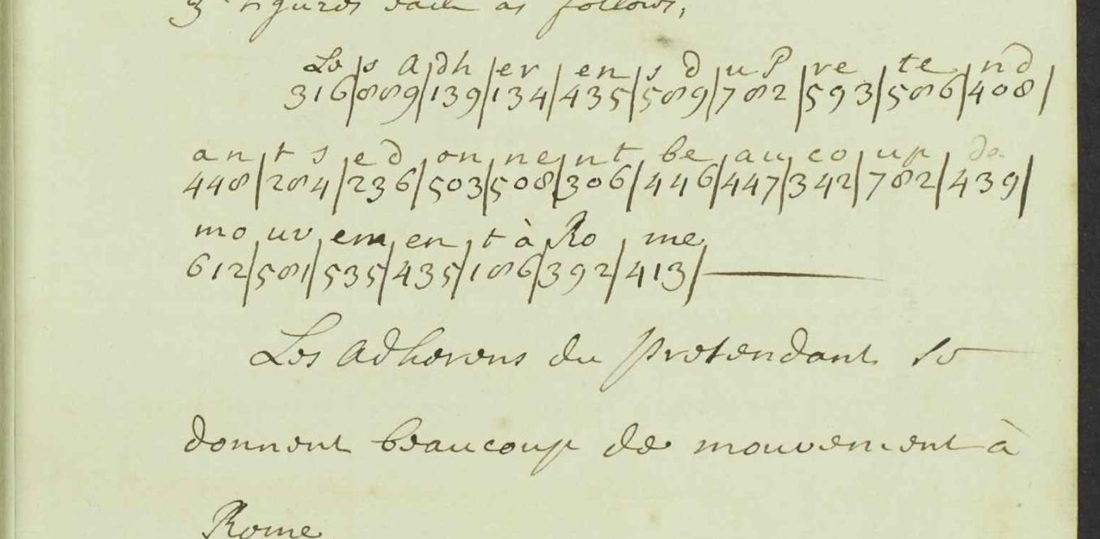
02 本文
画像から転写。行間の音節は書き手自身のもの。[?]は疑わしい数字を示す。
In the inclosed Cypher (which serves only to correspond with Baron Stosch and Mr Walton who reside at
RomeFlorence) is to be perceived one in Numbers consisting of 3 Figures each as follows,Le s ad her en s du Pre te nd 316|509|139|134|435|509|702|593|506|408| an t se don ne nt be au co up de 440|204|236|503|508|306|446|447|342|702?|439| mo uv em en tà Ro me 612|501|535|435|106|392|413|——Les Adherens du Pretendant se donnent beaucoup de mouvement à Rome.
Or to puzzle it more after having made use of the Key A. in black Ink, as far as [Donnent] inclusive, which answers 371. which denotes [Changement de Clef] that the Key alters, and then put the Remainder of this Sentence into the Cypher B. the Numbers in red Ink and it will stand thus.
—   be  au  co  up  de  mo  uv  em
371|436|433|342|218|446|678|417|553|
en  tà  Ro  me
453|023?|620|477|
The chief art of this Cypher consists in the Numbers running on without distinction till a distribution of them is made as above, by three in a parcel, by the person who deciphers, and that you make use of two Keys alternately at pleasure. [When you write you put no Stops, as in our Ordinary Cypher, but write thus, 371436433342218446670 4175534530236208477.]
You have several Nulls to intermix as 110. 220. &c and all above 900 are so. You make use of no Numbers under 100 or above 999.
例文の意味は「僭称者の支持者たちはローマできわめて活発に動いている」である。これはStoschがジェームズ・フランシス・エドワード・ステュアートの宮廷について本国へ送った種類の知らせである。
03 方式
- コード。3桁の符号群が音節と文字対(le、s、ad、her、en、du、pre、te、nd …)を表す。DECODEの「語ではなく文字対」という記述は正しい。繰り返される音節は、1つの鍵の中では同じ符号群を保つ(鍵Aではs = 509が2回、en = 435が2回)。
- 2つの鍵。鍵Aと鍵Bは同じ音節に異なる符号群を与える(be 446 / 436、au 447 / 433、mo 612 / 678)。書き手は随意に切り替え、371がその切り替えを知らせる。
- 区切りなし。符号群は続けて書かれ、解読者がそれを3桁ずつに切る。この点で、紙はこの方法を、区切り記号を使っていた“our Ordinary Cypher”と対比している。
- 冗字(ヌル)。110、220など、百の位と十の位が同じ切りのよい符号群と、901から999までのすべての符号群。
04 不確かなまま残る点
- 鍵Aでは、702が“du”と“up”の両方に現れる。どちらか一方はおそらく書き手の書き誤りか読み誤りである(確度C)。
- 鍵Bでは、“tà”の符号群が023と書かれており、明記された100–999の範囲を下回る(C)。
- 続け書きの実演は、区切られた符号群と数字単位で一致しない(…446670…と446|678、…6208477と620|477)。書き手は大まかに写している(C)。
- わかっているのは例文の30個の符号群だけである。鍵AとBはこの記録には含まれていない。DECODEにある16件のSP 106の鍵記録のどれかがそのいずれかに当たるかどうかは、確認していない。
- 書き手と受け手の名はない。1731年頃という年代はフィレンツェへの訂正から推定したものである。
05 出典
- The National Archives, Kew, SP 106/7、画像0091–0092、DECODE R597経由(画像はログインが必要)。
- “John Walton”としてのStoschについて:Lesley Lewis, Connoisseurs and Secret Agents in Eighteenth-Century Rome(ロンドン、1961年)。
注記と転写:リポジトリのtargets/sp106r597/。